Showing posts with label SRM. Show all posts

Saturday, November 07, 2020

Equipment - The Black Tsunami (pictures)

A bit bright, it seems, but on the camera it seemed fine. I didn't bother trying to edit the pictures. I'm putting them here as much for reference as anything else.

Some updates to the bike - the ISM saddle, it has a wireless SRM now, a not-visible-in-the-picture PC7 (wireless SRM head).

There's a rear camera on it, Shimano CM-1000. I'm not 100% on it yet but it seems to reliably turn on and record, so there's that.

I've had the Exustar pedals for a while now, although I don't remember if I have pictures of them on the bike from before.

Only notable thing is the front derailleur mount broke, probably today. The derailleur wouldn't shift into the big ring so I just manually placed the chain there and left it for the ride (I rode outside!).

With the training clinchers on them.
Jet 9 rear, Bastogne front. 700x23c tires.

With the race wheels.
Stinger 9 rear, Stinger 7 front. 23mm tires.


Monday, April 04, 2016

Equipment - Off Season Experimenting

(Not a great post but I need to put down some thoughts before I post other things.)

I recently realized I may be going for my record between outside rides, with both rides being races. In 2015 my first outdoor ride was the first race in the Aetna Nutmeg Spring Series. My last three rides outside were the second Limerock (July 19th) and two Tuesday Nights (July 28th and August 4th). I haven't ridden outside since. I'm pretty sure my first outdoor ride this year will be whatever race I do in 2016, possibly in May or June. I really don't want to go a year without racing so I want to race by August 4th.

To race, though, I need to make sure my bike is okay.

Winter for me is a time to refresh the equipment, try things out that I've been thinking of trying out. I have a list sorts of things I want to get done. Although I started this post a while back I figure that with today's weather it's appropriate to get this thing up. Now or never, right?

April 4, 2016
The view from our front door.

I have four major bike refreshing/reconditioning thoughts, as follows:

1. Goal: Get black bike up and running. Need: Another stem for that bike, install stem and FSA Compact bars. Install Adamo saddle. Solder in battery in SRM spider, measure slope, make sure wire harness is okay (I think it's not). Install Ant+ speed/cadence sensor for Zwift.

2. Goal: Get red bike up to snuff. Need: rewrap bars (it's been early 2014 since I've wrapped the bars). Replace SRM wire. Get Exustar pedals back on bike. BB30 bearings. Check race wheels.

3. Goal: Experiment with 170mm cranks. Need: fiddle with red bike. I already put the cranks on it.

4. Goal: Experiment with saddle position (related to 170mm cranks). With 5 mm shorter cranks I need 5 mm more set back because my foot doesn't go forward as much. I also need more height, because my foot doesn't drop down as far.

First Goal - Black Bike

I haven't had the black bike rideable since I put the custom stem on the red bike. Those that go to the same races as me might have noticed that I haven't been bringing a spare bike to the races for a couple years now - it's because the black bike isn't rideable.

The main reason is that I haven't ordered another custom stem. I guess it's money I don't want to spend right now. I have the old bar/stem and they fit the same for the drops so that should work for now. If I want to spend a few hundred dollars on a stem I already have the bars for the bike.

I do have a second Adamo saddle that I need to install. The saddle came free courtesy of a pay-it-forward from a member of bikeforums.

The one tricky bit is the 170 mm cranks. I don't have a second set of 170 mm arms for the Cannondale SI cranks, so I may leave 175s on the black bike.

I'm pretty sure the SRM wire is shot on the black bike. Someone asked how such a wire goes bad. Unlike a cyclocomputer (historically the super thin wired cyclocomputers aren't that reliable) the wire plugs directly into the SRM. A cyclocomputer normally sits on a mount, and the wires run into the mount. To repeat, the SRM doesn't plug into a bar mount. Therefore there's some regular movement with the wire  each time you plug and unplug said wire, and I think it makes it go bad. The wired SRMs rely on the wire for cadence, speed, and power. The only wireless aspect of the wired SRM is heart rate.

Since wiring harnesses are about $80-85 each, and I have two bikes, it starts adding up really quick when you consider that for me I need a harness every year or so.

Second Goal - Red Bike

For sure I need to rewrap the bars. It's been about 2 years since I last wrapped them. Enough said.

The SRM wire on the red bike just died a couple rides ago. As mentioned above the wire eventually breaks somewhere so cadence/speed/power data doesn't show up. I have to replace that before I have any kind of power readings and therefore any true experiments with Goal Three.

I put the 170 mm arms on the red bike - the Cannondale SI is a modular crank system so the cranks are separate from the (SRM in this case) spider. I have two sets of 175 mm arms, one set of 170 mm arms. I had some Look Carbon Keo Max pedals on the 170 arms. I slip out of the Keos like nobody's business so I need to switch them out for the Exustars. They're much more reluctant to let my feet out and that's better for me.

One possible solution is to get a wireless SRM. It's possible to upgrade an SRM from wired to wireless (just ask SRM if you have one). Apparently my SRM units are not consistently upgradeable, although I'll find out more what that means. I could sell my SRMs and buy a wireless, and use no power on one bike (leave it on the trainer for Zwift?). This is sort of jumbly totally not solid anything kind of stuff right now though.

My BB30 bearings are worn. I need to replace them.

I need to double check my race wheels to make sure they're okay. I'm sure they are but I don't want to find out at a precious race day that they're not okay.

Third and Fourth Goal - 170 mm cranks and resulting position and pedaling changes

I've been riding 170s for about a month now. It's not a super long time to acclimate to a different crank length but it's enough time to notice a few things. For historical reference I rode 170s from about 1983-1988, 1995 to 2003, in 2009, and in 2011. The last two times (2009, 2011) I was looking to regain lost speed and instead lost a good 30-50 feet in the sprints. I'm furiously chugging the Kool Aid though and I'm hoping that the 170s will help me this time. Otherwise I'll go back to the 175s. With the 170s there are a few things I know about.

First, for some reason, with 170s I need to be toe in a bit. With 175s I need to be toe out. I adjusted my cleats a couple times in about 20 minutes and it's been good since. I had historical precedence so I knew I needed about yay much toe in. Took me two tries, and about 10 minutes of pedaling gingerly to confirm, and I was good to go.

Next, since 170s have 5 mm less reach and drop than the 175s, I had to push the saddle back 5 mm and raise it 5 mm. I raised it a bit more, I think 4 mm extra, because it felt like my back was a bit flatter, but my knees screamed in protest. I quickly lowered it to the baseline and my knees recovered - it took about 3 weeks but they're okay now.

I do know that too much more set back and I'm pretty far back in terms of knee-pedal relationship. I'm slightly forward right now, but not much. The Adamo saddle lets me move back without much problem, so I've been pedaling lower rpm from further back, higher rpm sitting up front. My older saddles really didn't let me do that so this is a nice change.

So that's it for now. It's been pretty busy in a time consuming way here at home so it's tough for me to write posts. I do have a few thoughts jotted down in draft form (a couple hundred to be honest, but maybe 10 or 12 in the last few months). I hope to find time to get those out there shortly. For now this is it.

Saturday, December 13, 2014

Training - Relative Power On My Trainer

Today I had a decent food day. I guess that's the "dieting bike racer" in me. It's strangely empowering to do this, although I have to admit that I haven't had motivation since 2009 to diet. And that time was the first time I ever really, truly dieted.

Anywho…

I got to 8 PM with something like 250 cal left of my 1510 cal budget, so that was good. Yesterday I ended the day at something like 100 cal over (so about 1610) then proceeded to eat 580 cal at night. That put me at a whopping 2300 cal for the day, literally the most I've eaten in a single day in, what, 26 or something days? November 17th, for what it's worth.

Today I knew I wanted to eat just a bit more and I had the chance to hop on the bike. Therefore I got to ride and eat a bit more.

On the ride I remembered a bike forums question where someone asked how much power it would take to go 88 rpm in a 53x17. He added that he rode that fast for 30 minutes and it made him work up "a good sweat". I'd guessed in the mid-300 watt range, definitely a really high wattage for anyone that doesn't race. Talk about sweating, right?

He later corrected it to a 53x19, which is still impressive. I took some pictures of the SRM in the 53x17 (just for kicks) and then a slew while in the 53x19. The trainer is pleasantly consistent, although I could feel if I was in the lower end of the rpm range (meaning I could be going 88 rpm and nudge the power a bit without making the computer say 89 rpm). Still, though, the pictures are worth something.

53x17@88rpm, 378w. Yikes.

53x19@88rpm, 288w. Still yikes for me.

53x19,@89rpm, 295w.

53x19@88rpm, 294w.

53x19@88rpm, 297w.

What's funny (or not depending on your point of view) is that these efforts to take the pictures really killed me. I spent a few minutes trying to take these pictures. Many of the deleted pictures were illegible for one reason or another, like the flash obscured the whole screen, no flash meant it was a blurry mess, or I was at the wrong rpm, whatever. My efforts in producing even the 280w power stuff was probably the reason why I climbed off short of my planned 2 hour ride. My legs just went empty after about 1:30 and I really couldn't justify twiddling along past 1:45.

The heart rates in the pictures are pretty low but it's because the efforts were anaerobic and my heart rate wasn't climbing relative to my effort - the heart rate lagged pretty hard. I looked down once, after uploading one or two of the pictures, and my heart rate was 112 bpm. During the pictures I felt asphyxiated, like I was suffocating.

Now I've rewarded myself with some food, 420 cal worth.

A side thought. I can handle less or no sugar in food. But to skip salt? No way. I've gotten my oatmeal down to no brown sugar, 1/4 cup raisins, and it's otherwise plain oatmeal. Coffee? Black now. But my snack right now was 150g of chicken (skinless, roasted), weighed on a scale, with 140 cal of green beans. If you check around you'll notice that's two cans of green beans. I sprinkle a nice bit of salt, some spices, and that's good enough for me.

And my blood pressure is fine at the moment. I just had a physical and they tagged me at 112/60 or something like that (and I was looking after a very active Junior during the physical so I wasn't just relaxing in peace and quiet). I still need to get my bloodwork done. It'll be interesting to see the numbers (hematocrit, hemoglobin, and cholesterol) as I haven't had a physical in something like three? years. On the positive side I think I was 14 pounds heavier when I went there last.

Of course I was 10 pounds heavier less than four weeks ago, so it's the last four weeks that have made a difference in my weight.

But whatever, it's all good.

Monday, September 16, 2013

Equipment - End of Season Maintenance

Not to be confused with "Beginning of Season Maintenance", naturally.

The end of each season sees the normal wear and tear on the bike, the stuff that you think, "Well, it should be okay next week". My thought process usually goes a bit more like, "Well, I'll replace that part next week".

In Maine I don't think I mentioned it in the post but right before I left for the last Kingman Loop I switched out the cleats. It's one thing to break a cleat at home, no more than about 20 minutes away from home base, with so little elevation changes that it takes me 40 hours of riding to climb the same amount as 8 hours of "flat" riding in Maine.

It's another thing to break a cleat in a place where I may not have a cell signal, there aren't any bike shops around, and where I may be a couple hours ride away from home base. Even if I had a signal it may be that the calvary, i.e. any potential help, may not have a signal.

Finally there's the off chance that I run into some wolf or something, even get bitten by a couple of dogs.

With these factors in mind I felt it prudent to swap out the cleats. I didn't know when I'd last replaced the cleats but I thought it was in the spring. However, checking back on Strava, it seems that I replaced the cleats last June. Based on my Strava log I have about 200 hours on the cleats. This includes a bit more walking around than normal at some points, especially at Bethel, and a bit less than normal, like my trainer rides. Whatever, 200 hours is pretty good. I'm at 140+ hours for 2013 and I did 75 hours in 2012 on them after June 2012.

I also took the opportunity to twist the left cleat a touch. Usually I like my heel to miss the crank by about 10 mm. For whatever reason I had my heel a bit closer and I found myself twisting my foot outward all the time. This didn't do much for my clipped in confidence as I unclipped somewhat regularly. With short rides and races I kept forgetting about it, but in Maine, with lots of time, I thought about it a lot.

Therefore when I replaced the cleats I adjusted the left one. Of course I then had a really fast ride (for me) immediately after. No knee pain either, and I have really, really fragile knees.

I kick myself when I realize stuff like this.

I mean, I knew it before, but it didn't seem important enough to deal with it. When I finally deal with it I'd think, "Why didn't I do that earlier?"

Along those lines I switched out my cranks. My SRM battery died in July or something and I've been too lazy to fix it. First I needed to find my Cannondale SI crank tools, which I lent the shop when they faced the BB shell. Ends up I buried it in my gear bag so I'd never forget it. Next I needed to stage a new battery (I have it and I know where it is) and solder it in. Finally I wanted to make a decision on crank length.

This year I committed to the 170 cranks. In 2010, my best recent year, I was on 175s, and I was on them since 2004 (minus a break in 2008) after I dropped a friend and returning to racing road rider while on my 175mm crank mountain bike. I then went to do sprints with a 175 mm road crank and went 10 mph faster than my previous 170mm sprint. I wasn't in shape but I figured that some of that 10 mph had to have come from the longer cranks.

I wanted to try 170s again because in my heyday, back in the 80s and 90s, I rode 167.5s and I was literally 6-8 mph faster in my fastest sprints. I thought I could regain that speed by getting shorter cranks.

Unfortunately aging 20 years had something to do with my loss of speed, and 170s actually made me slower than the 175s. In similar circumstances (tailwind sprint on the same course) I was about 3 mph slower on the 170s. Also I haven't even gotten a whiff of those heyday type speeds while on the 170s.

Therefore I gave up on the 170s.

Instead of doing a new battery and stuff I just put the other SRM Cannondale SI cranks on, the ones from the black bike. The battery is good, I have a second head unit so no calibrating, and it has both the 175s and my best-so-far Keos, the Carbons.

BB axle looks fine

The two right side crank arms.

That's another thing. The Keo Max2 pedals feel really loose, like really loose. The Carbons, allegedly possessing the same retaining force, are much more decisive in their grasp of the cleat. I made the assumption that the Keo Max2s would have the same retaining power due to the same newton-meter rating, but alas the pedals easily give up the cleat.

So my overall changes are as follows:
1. New cleats on my shoes (and they didn't change the retention feel on the Keo Max2s).
2. 175mm crank arms, instead of 170mm. This involves dropping the saddle 5mm to keep the saddle-pedal distance consistent.
3. Second SRM spider with newer/working battery.

I approached my first ride on the 175s with some caution. Longer cranks means a bit more stress on the knees, not because of the higher leverage but because your leg closes more with a longer crank. It opens the same amount, based on the same saddle height, but your knee closes up more. This means more pressure on the knee cap at the top of the pedal stroke.

Well I got on the bike, did some spinning while deliberately not looking at the SRM headunit, and then peeked when things felt okay.

110 rpm.

Whoa.

I expected 90 rpm or lower, after coming from the 170s. Apparently I'm more used to the 175s, even after a season on the 170s.

For 15 minutes I averaged over 100 rpm on the 175s.

No knee twinges, no weird aches, nothing.

I geared up and slowed down my pedaling speed.

One concern with the 175s was that my legs would come up a bit more, a total of 1 cm, based on the fact that my saddle dropped 5mm but the cranks come up 5mm more as well. In my 2012 fitness levels, or even my early 2013 fitness level, I was basically too fat to ride the 175s without gut punching myself with my quads on each pedal stroke.

Now, at the end of 2013, having dropped 12-13 pounds since March, I can pedal the 175s fine.

If I can continue the trend and get down another 10 pounds or so, I'll be back at or close to my 2010 weight. That was a good year, and I hope to at least start 2014 in a similar fashion.

Saturday, May 04, 2013

Equipment - Tsunami 1.1 (Red)

I haven't put up a recent picture of the now-red Tsunami in race form. I did only race it twice in its full race regalia and twice with a training front wheel due to the gusty wind conditions.

The second "race", if you could call it that, lasted just three laps.

The bike is therefore still a bit foreign to me. I hadn't really sprinted on it, not "ferociously", and I still haven't checked the SRM for accuracy. I mention the former because I wanted to make sure things were up to snuff - derailleurs adjusted, position reasonable, stuff like that - and I mention the latter because the power numbers I'm seeing were immediately 10-20% higher than those I see on the black Tsunami.

I went for a ride on a very close by loop recently on the bike shod with its Bastognes. After some intraweb discussions on wheel weight and aerodynamics I decided to throw on the race wheels to check them out. I'll post about the rides later but the second ride gave me a chance to photograph the bike loaded out in race day gear.

The Tsunami 1.1

First off you'll note some half finished yard work in the background. That's our handiwork. The part you don't see is that there's poison ivy mixed in there. I didn't know either but it's all over me - my arms, legs, stomach, back, neck, even just below my eyes. I must be much less stressed in life because it's not really annoying me, not like it usually does.

Anyway, back to the bike. I have some messy electrical tape holding the SRM cable to the frame. I plan on replacing it with clear tape of some kind.

One thing that you can't see are the parallel honed and faced bearing surfaces (the BB30 bottom bracket and the headset). It's made a huge difference in how the bike works. First off I started riding a bit squirrelly because the bike steered too easily (to me, coming off of some pretty stiff headsets). Second I am saving some decent amount of power because the cranks turn so easily. I would regularly see 5 or 8 watts when soft pedaling on the black bike, and I saw 15 watts once when pedaling with no load. Now it's negligible.

The quick steering and the efficient crank bearings make the bike feel like I'm riding rollers when I'm actually on the road. The bike feels super smooth, super quick.

Very nice.

The frame is much shorter in the rear now, I think 39.2 cm chainstays, so it reacts really quickly if I want it to change direction. They're just a touch longer than the black Tsunami's stays but basically the same.

For pedals I wanted to get the Keo Carbon again but with the metal plate for the cleat surface. Unfortunately the new pedals are absolutely wimpy on retention strength - I can clip out pretty much at will, even with the tension totally cranked. I need to figure something out because right now all my out of saddle efforts are somewhat checked, even sprints, because I'm afraid of unclipping.

For "race gear" I have the HED Stinger 7 front and Stinger 9 rear on the bike. I'll do a post on them soon, I promise. Suffice it to say that they're really wide, they have a rounded rim edge (the spoke side of the rim), and they feel really fast.

Oh and they make that cool "Swoosh swoosh" sound.

The SLR saddle.

I'm trying this saddle because I'm running out of the Titanio that I favor. It seems minimalistic but I rode it to Bethel, a 4.5 hour ride for me (at 14 mph), and it worked out well. I admit I was a bit tender because the different shape resulted in different pressure points but I was also going from virtually not riding to doing a 4.5 hour ride. In addition I started cramping almost immediately on that ride, due to a severe lack of fitness, so I had to stay seated for most of the ride. This literally kept me in the saddle even when I wanted to stand and stretch - the saddle definitely got tested on that ride.

Not only that but even when I was pedaling okay I couldn't pedal hard. This meant I wasn't supporting a significant portion of my weight with my legs, resulting in increased pressure on the saddle.

Even with both those things working against me the saddle seemed to work fine for me. The one thing is that it's more slippery than the Titanio. I don't have a solution at this point.

As far as fit I had to raise the post a bit because the saddle sits closer to the post. I raised it a touch more because the "center" of the saddle, where I end up sitting, is much further forward than the Titanio. This had the effect of shortening the distance from the saddle to the pedals by about 3-4 mm.

Err no you can't see the smudge marks on the seat post.

I took this picture because I could see the smudge marks on the post from where I raised it first for the saddle height difference and then again for the slightly different "center". No worries, it shows the seat collar area well.

The business end of the bike.

The Deda stem is misnamed, in my opinion, as a track ("pista") stem. In fact it only points 3 degrees (70 degrees or -20 deg) down from my regular stem which is horizontal (73 degrees or -17 deg from the head tube angle). I want a 14 cm stem that drops me at least a centimeter more but I can't find one.

The Deda is a 14 cm to try and make up for the lack of reach of the FSA Compact bars. I'm still short 1 cm in reach and the bars are 1 cm higher than my other bars. Due to this I'm almost positive I'm going to be moving back to the lower crit bend bars. Either that or I need to find some compact reach bars that drop 140 mm instead of 120 mm.

Centaur 10 speed shifters

I'm going to post more on this decision later too but I had two reasons for getting these shifters. One, I wanted to see if the new shape works for me. Two, I wanted a shifter that only gave me one shift at a time. The Record 10s shifters I have allow me to dump the chain down a lot. Limiting that to just one cog will hopefully save me from shifting too many cogs at once in a sprint.

GOOP and my PCV (off the Cannondale so the first one I got)

On a side note my SRM has a slight crack in the front "cover", the clear plastic that covers the whole face of the computer head. The plastic alternately bulges and gets sucked in, depending on the atmospheric pressure I suppose, maybe temperature too. It tends to bulge in the summer, get sucked in in the winter. Whatever, the important part is that whatever I used to patch it would need to be flexible.

I used GOOP to patch it up. It's clear after it dries and it's flexible. I've used it to fix the driver's side mirror on the van, gluing new mirror glass to the plastic backing. Someone had hit the van while it was parked on the street and left me with a broken mirror glass. So far it's worked well - about 5 years or so.

Reviewing this post you can see that the bike isn't quite complete. I still need to hone the bar position relative to the saddle or change the bar completely. I need to address the pedals. But overall the bike is great - responsive, agile, and fun.

Thursday, April 11, 2013

Equipment - Tsunami 1.1 or "The Now-Red Orange Frame"

For over a year I've been wanting to get this frame back online. It started out as my original Tsunami frame, with the now-standard-for-me geometry - 40 cm seat tube, 56.5 cm effective top tube, 75.5 degree seat tube angle, 73 degree head tube angle, and designed to be used with a 43 mm rake fork.

The original bike, shortly after I built it up in SoCal.

This makes for a long bike to fit my long torso. It's not very tall though, to fit my not-very-tall legs.

The original Tsunami (version 1.0) had industry standard 40.5 cm chainstays and that's where it faltered. Even coasting in fast corners the rear tire would chatter or slide across the pavement. The unusually long front end meant I had too much weight up front, leaving the rear wheel to fend for itself.

This, along with my short-lived upgrade to Cat 2, instigated the second Tsunami, the black one. Geometry-wise I wanted the same bike but with "as short as possible" chainstays. Those ended up measuring 39 cm in length.

The black Tsunami (version 2.0 if you will) also had some aero features. I wanted the narrower tubes with the thought of racing with a CamelBak. This would eliminate the very bulky bottles from the bike, allowing me to take advantage of the aero tubing.

My CamelBak idea faltered because I didn't like the way it worked (can't toss an empty CamelBak, can't empty it all the way, pain to refill, warm in warm weather, harder to breathe, etc). I resorted to using the bottle bosses, literally an afterthought in the build process.

"Might as well put them on although I don't plan on using them."

The black frame worked well although the nut that held the seat down (aka "the rider" aka me) wasn't as good.

I started thinking of combing my favorite elements from both bikes into what would be a Tsunami 3.0 - internal cabling (easier to clean), short chain stay, regular tubing.

On the off chance that Joseph (aka Tsunami Bikes) could alter my orange frame I contacted him. He told me no problem, he could put new chainstays, seatstays, and a brake bridge on for me. I didn't realize it's just trimming one tube; he'd have to rebuild the whole "stays" area.

I decided it was worth sacrificing the internal cabling to save 6/7 of the money a new frame would cost me.

Joseph sent the frame back unpainted (per our agreement) and I had a local car nut paint my frame the same color he was painting his Mini. It happened to come out red so fine, red it was.

I also invested in some frame prep tools, specifically 1 1/8" head tube facer/reamers and a BB30 reamer, ordering them through Expo Wheelmen sponsor Manchester Cycle. These cutting tools, combined with Manchester Cycle's cutting tool handles, would give me a perfectly finished frame. The frames arrived unprepped and the headsets were always a bit tight and the bottom bracket was also. Bob, the owner of the shop, did the work himself, and the red frame (Tsunami 1.1) came back to me ready for assembly. This would save me a few watts turning the cranks - it's bad enough that I can see wattage numbers pop up on the SRM when I'm soft pedaling (i.e. not keeping up with the wheels)

That process dragged on for months while I realized I was missing this piece or that piece. Minor things roadblocked the build, like a front derailleur hanger, or cable housing (I ran out of Nokons), or trying to figure out what stem would work with the FSA Compact bars I wanted to use.

Finally, before the April 7 2013 Criterium de Bethel, my bike was ready to ride. I wrapped the bars at the prior March 24 Bethel CDR Gold Race, rode it on the trainer before April 7, and did my shake down ride during the April 7 Cat 5 clinic.

It seemed to work okay so I put the race wheels on it.

Tsunami 2.0 to the left, 1.1 to the right.

Note the different shaped bars. The Compact FSA bars on the red bike are 3 cm shorter in reach and 2 cm shorter in drop. To accommodate this discrepancy I have a 2 cm longer stem (so 1 cm shorter overall) with about a 0.5 cm drop (so the drops sit about 1.5 cm higher).

For the Cannondale SI cranks I have two sets of arms, 175mm and 170mm. The 170s came with my Cannondale (Team Replica blah blah blah bike). I bought a used SRM setup that had 175s. In the past 10 years I've had much better results with 175mm crank arms, I think due to my lower general power.

170mm and 175mm crankarms on the Cannondale.
Picture taken in SoCal just before I moved the parts to the orange Tsunami.
What's nice is that you can change the crank arm without changing the spider (that holds the chainrings).

However I chose to install the 170 mm crankarms on the red bike. The shorter arms give me an extra 0.5 cm in saddle height. The resulting net height difference is about 1 cm less drop to the drops. More significantly the drops are about 1.5 cm higher relative to the bottom bracket. When I'm sprinting out of the saddle that's the height that matters. We'll see how it goes. If it doesn't work out I'll revert to the old style crit bend bars and I may have to go buy a second set of 175mm crankarms.

A final change, but I'll expand on that more later. I'm using a lower end brake lever, one that doesn't allow multiple shifts into higher gears. It's one click at a time, no more dumping 2-3 gears when I jump. I'll explain this move in a different post.

I accidentally used my last name rather than the Sprinter Della Casa sticker.
I want my name to go on my hubs and helmets. SDC goes on the bike.

Note the smoothed out finish around the seat cluster. It's a combination of gentle filing and an expanding primer. The primer puffs up when applied and then hardens. The guy who painted his Mini showed me the roof - when he started it looked like someone dropped a bucket of golf balls on it from a couple floors up. When he was done with the expanding primer the roof was perfect. I bought into the expanding primer idea.

Deda 14 cm Pista stem.

"Pista" is misleading here. I wanted a 65 degree (-25 degree) 14 cm stem but I couldn't find one. I felt the reach (14 cm) was more important than the height (65 degree) because I was already compromising my reach by going 1 cm shorter. Going 2 cm shorter with a 13 cm stem would be really significant because I tried it already. I figured by using shorter cranks I'd have an extra 0.5 cm in saddle height. Therefore I sacrificed the drop to get the 14 cm stem. The Deda "Pista" stem is only 70 deg so about -20 deg. It barely drops 0.5 cm.

In order to have 100% clamp surface for the stem I left the steerer tube too long and used spacers on top of the stem. This way the whole height of the stem clamps the steerer tube, not all-but-the-top-5-mm.

Close up of tire clearance.

The chainstays are about 39.2 cm. I have to measure them again because I keep forgetting what they measure but they're just a touch longer than the black bike's 39 cm stays. There's plenty of fore/aft clearance. To the sides it's bit tighter.

The head tube area. Note how smooth it is compared to the first picture in this post.

It's a bit smoother than before, primarily due to the expanding primer. I put clear frame protector stickers on by the cable housing. I had to stretch the black Nokon housing by adding extra blue and silver segments. I'd have run out otherwise.

The headset is a super low stack Cook Bros headset. It's a bit of a pain to install but Manchester Cycle did it fine. I installed the orange bike's headset in my basement using unofficial tools. The black frame got its headset installed by a SoCal shop during that year's SoCal training camp. I use the same type of headset on both bikes, just the black one got a steel headset and the red one has a stainless one.

Not exact but you can see the drop/reach.
Wire sticking up is for the SRM, two wires carefully taped up into one.

The bars drop more with the old crit bars and they reach more.
SRM wire is hanging forward and down. I need to rewrap that, it's unraveling.

If you look at the two bars you'll see that even though the FSA Compacts on the red bike are longer on the drops (I wasn't as aggressive when I cut off the excess bar) they obscure more of the front brake. They don't drop down to the tire also.

The black bike, with my standard position, shows how the old crit bend bars drop down more and reach out further. Keep in mind that the black bike as a 12 cm stem, 73 degree (-17 degree). The red bike has a 14 cm stem, 70 degree (-20 degree). Due to the FSA Compact bar geometry I lose both reach and drop even after using a longer and lower stem.

You may have noticed a lot of barrel adjuster showing on the red bike. This is so I don't have to unclamp the brake cable when I switch between the "wide" clinchers and the wide tubulars. The clincher rims are only 23 mm wide but that's the "wide" size. Normal is 19-20 mm.

The tubulars, on the other hand, are close to 28 mm wide. I bottom out the barrel adjuster to clear the tubular rims. It's about 5 turns difference between the two.

I have normal 19 mm wide clincher wheels but they're far too narrow if I want to use the wide tubulars. They've been relegated to the basement.

I have new-to-me wheels but I'll cover those later. Right now they've become my default race wheelset.

I've only ridden the bike a few times now, once in a race, once for a few laps in a Cat 5 clinic, and three times on the road. The biggest thing I noticed is that the bike seems to move more freely. It's due to the reamed/faced bearing surfaces - the bike steers eagerly and the cranks turn easier, even if I'm soft pedaling down a hill. It feels a bit like riding rollers - the bike wants to skate around a bit. It's not a bad thing to have the bike feel more eager to go, that's for sure.

The other thing is that the top tube is a bit lower on this bike. It means I can't put a frame pump under the top tube - the space is too tight for the Park pump I have. It does fit on top of the top tube though and it's where I had it the last time I rode. I may rig up a front-skewer-to-bar thing or a rear-skewer-to-seatpost, depending on how easily I can set one up.

I have a few good scratches on the frame already. The bars turns hard into the downtube when I was building the bike - no tape, no bar plug, a coarse hacksawed bar end. The downtube has a good gouge/nick in it now. And yesterday, when I finished my ride, I sat on the frame pump and it scratched the front of the seat tube above the top tube.

Ah well.

It's now a race bike because I raced on it. And it's a training bike because I trained on it. Such things will happen.

Thursday, June 21, 2012

Racing - June 19, 2012 @TuesdayTheRent

The last time I was here I got shelled in two quick laps. Quick in the sense that, yes, the field was going fast, and quick in the sense that I got shelled quickly.

I knew I hadn't been training but this was pretty bad. The Missus even said that I should train a bit more. She knows me well enough that although I don't berate myself too much when I get shelled I still feel disappointed that I wasn't in the mix. For me racing is about being in the mix, whether it means helping a teammate or going for a place myself.

Since that last race I trained a bit more. I took the approach that this was the beginning of my season. I have no base so I figured I should work on that - when I start cramping 20 miles into a ride I know that I'm lacking something serious.

I also had some mechanical issues that I never fixed. In the past, through 2011, I worked on my bikes a lot while I was in SoCal at my annual 2004-2011 training camps. Although the long days wiped me out  the short days gave me a lot of time to fiddle with the bike - spend an hour or two on the bike and I'm left with 5 or 6 hours before the host family returns home.

This year not only did I not go to SoCal. I didn't train that much. I didn't work on my bike. I had this weird problem where my bike would shift out of the big ring spontaneously - I discovered my big ring had a bunch of bent teeth, teeth that would try to dump the chain into the small ring on every pedal stroke.

With that fixed, the brakes tightened up a bit, and some other miscellaneous maintenance stuff done, my bike felt a lot better.

I also trained a bit more. Instead of riding once a week I could ride twice, even three times a week. I managed to do two races at the Nutmeg State Games, going on the attack in the M45s and hanging tough in the Cat 3s.

I've also gotten a bit better with my schedule at home with Junior. I can get more things done, I'm better at focusing at a task, and a lot of stuff comes to be automatically that didn't before. Amazing how a little tyke can do all that to an adult.

All this meant that Tuesday June 19th would be better. Before we left for the race I had the bike packed, my number pinned, and even an entry form filled printed and filled out. Ironic on the last bit - I had a bunch of forms left from the 2012 Bethel Spring Series but gave them away because "I didn't need them anymore". Now I have to print them to get more.

At any rate after the Missus got home we packed up Junior and headed out. We practically flew along until we got to the entrance to I291, when traffic ground to a standstill. Apparently an accident closed the left lane of I291, backing up traffic for miles.

Instead of arriving with 45 minutes in hand we got there with just a few laps left in the B race. All my prep came in handy as all I had to do was present my release, pay, slip on the jersey (and helmet and gloves and Sportsiiiis and start Strava), pee (in the portapottie) and line up.

With this type of warm up my SOP in Bethel I figured it would be okay. The race went fine for about 30 minutes, although I was hurting the whole time. About halfway in the field splintered chasing a prime.

I was already dangling dangerously near the back of the reasonably sized field (30 or 35 racers I think). I saw friend Laura S struggling, trying to close a gap that really someone else should have closed. I gave her a good push to get her to the next wheel, but then that guy left a gap. She went around again and I knew that that was the move that would blow her up.

I couldn't even stay on her wheel so that was that for me. The last few guys rolled around me and then I was clear to sit up completely.

My heartrate, every time I had looked down, read 158 or 159. I know that I can hold the mid 160s when I'm working really hard, so not breaking 160 seemed a bit low. I figured I was having an off day, where I couldn't rev the engine very hard.

After downloading the SRM I learned that I was looking down when my heartrate dropped a bit (which makes sense). I didn't see the 160-164 stuff, but I was there. So it wasn't as off an off day as I thought, and that's actually worse. It means I can't go much faster than what we did there.

Curiously enough, at the end of my lap off the back, my heartrate had dropped to about 130. I recovered quickly, it seemed.

I don't look too cooked, do I?
Photo by David Wells

I know that at my best I'd make huge efforts, really suffer for a bit, recover, then go again. I was never good at long continuous efforts, like climbing rock steady for 5 minutes. I did better when I had to surge a couple times to stay on wheels then sprinted over the top of said climb.

My heartrate curve seems to show that my recovery is starting to come around. I need this to happen since I use big efforts sporadically and rely on some off periods to try and recover quickly. The choppier the pace the more I can recover.

Tuesday, though, the pace felt relentless. I never had more than a few seconds of soft pedaling per lap and that wasn't enough to allow me to recover. After running an aerobic deficit for most of the race I finally popped.

For now I'll be working on just getting on the bike. Pedaling certainly beats not pedaling, that's for sure. I'll also try and get some exercise in while in the house looking after Junior, stuff I can do without getting on the bike.

Sunday is the Keith Berger Crit. I'll see what happens there.

Wednesday, June 06, 2012

Tsunami - 1.0, Take Two (1.1?)

A while back I got that first wonderful custom-fit frame from Tsunami Bikes.

It changed my world.

That year I found I could train longer, race harder, and, for the first time ever, managed to get a Cat 2 upgrade.

Even so I found a few details that I could change. The biggest was the chainstay length - with a front end so much longer than before, the geometry unweighted the rear wheel significantly. I found that going through corners under power I could almost always break the tire loose. On particularly fast laps I could break the tire loose even without pedaling.

Okay, fine, I could move my weight back a bit and anchor the rear wheel more, but after seeing a few pictures of me cornering I realized that it would be better to bring the wheel closer in to the bottom bracket. If Mohammad can't go to the mountain, move the mountain to Mohammad.

This led to the second Tsunami frame, the black one. Although its aero styling made it look different, it fit exactly like the orange frame. Out back, though, the stays were shorter. 39 cm for the chainstays to be exact, the shortest the builder could do without massive tire rub.

It's tight. I'm going to file/sand it down a bit.

(I get some pretty horrendous sounding scraping going when I ride over sand and such - the sand sticking to the tires scrapes the frame, jamming into it. I can feel the grit jamming my tire and frame, slowing me down. It's that tight.)

The second frame gave the nod to aerodynamics over weight. I asked for it with the thought of running just a CamelBak, i.e. no bottles, and trying to get more aero by eliminating the big clunky things in the frame. Real world experience led to me installing two cages - my aero bike experiment failed, mainly because I found it so cumbersome to take a sip of water with the CamelBak on.

The experience made me look at my lighter (by over 200g) orange frame with a different eye. I wanted the slightly lighter frame back but with the shorter stays.

This is where Tsunami Bikes made the difference.

Joseph Wells, the welder behind the name, agreed to modify my frame with shorter stays. He'd have to cut off and replace the seatstays to accomplish this, in order to relocate the brake bridge. He would be sending the frame back unpainted (I asked him to strip off the rest of the paint).

Just unpacked after it arrived.

After several weeks I got the frame back. Shorter stays, no paint, and looking admittedly a bit sad. No glowing Candy Orange paint, no decals, no battle scars.

 I weighed it out of curiosity. Without a rear dropout, without the cable adjusters, no bottom bracket cable guide, the frame weighed in at 1210g, a full 230g lighter than in its original form. I'll weigh the small pieces but I don't think they'll break 50g, leaving the frame at about 200g lighter. I'm guessing the shorter tubes will count for about 40-60g (based on the 30g I saved by cutting down my heat treated aluminum bars), so the luscious paint probably weighed about 150g.

After talking with a few people I decided to make some unauthorized changes to the frame. I started by drilling holes in the bottom bracket shell, swiss-cheesing the dropouts, and even the back of the head tube. I also honed the inside of the head tube and bottom bracket, thinning the tube diameters. Finally I acid etched the tubes with muriatic acid to thin them out.

(pause)

Okay, I didn't do any of that.

I did start filing down some welds, shaping some of the cable stops, and and basically trying to get rid of any superfluous material. I gained a new appreciation for the artisan frame builders; I also realized that I could do this shaping stuff for a long, long time and not be satisfied until it was perfect.

(I realized I was paralleling another rider's experience, albeit in a slightly different way. When Chris Boardman was laid up for a while after breaking a bunch of bones, he whittled away at a Mavic crankset. It looked beautiful when he was done but, based on seeing and feeling others done the same way, it was probably super-flexy. Nonetheless the idea of "honing" a finished product appeals to me in some way, I guess the same way I want to mod a brand new car.)

I've been filing a little at a time, after my trainer rides, maybe once a week. I weighed the frame after a few filing sessions - 1190g, or 20g lighter than before. I wanted to get rid of any excess weight but not reduce strength. I even looked at pictures of the frame bits before they got welded (I looked them up) so that I'd have an idea of what I was working with.

A friend happened to be painting his Mini a bright red color. He is doing part of another project for me, and when I realized he was painting yet another Mini (this is his fifth one), I asked if he could maybe shoot some paint on my frame. Since I had to work around his schedule I had to accelerate mine - I dropped off the frame at about 80% complete.

My friend promised me some miracles, using a really heavy (gulp) primer that puffs up and fills stuff out. He'd then sand it down. I must have looked a bit alarmed because he looked at my face and mentioned that he'd try and keep the weight down.

(On an aside I realize now that I could have spent months filing and sanding the frame, and if I were selling the thing under my own name I'd feel somewhat obligated to do that if the finish was an issue.)

With Junior occupying my time a bit, I kinda sorta forgot about the frame. Then I realized, oh, he's probably done with it. I went to call him and saw that I had a missed call on my phone.

From him.

"Dude, your frame's all set."

I headed over.

With Junior in the car too, of course.

 Frame hanging up.
Mini is in the background, with "Actual Size" already in the window. Right now he's doing the jambs and stuff, the stuff that isn't visible until you open doors.
Painter is off to the right.

My painter friend said he brushed on the primer around the joints so as not to spray too much of the heavy stuff on the frame, then went over it with a bunch of different sandpaper, then shot the whole frame. I haven't weighed the frame yet so no report on the total paint weight.

I had to take this shot. Expo Wheelmen's sponsor Manchester Cycle sells Bell helmets, and because of Expo I now race in a Bell. That Bell sticker is on the Mini.

The frame is now red. It happens to be a Hyundai color (I think).

Originally my friend was going to paint the mini a Viper red. Even though that would have dovetailed nicely into my "what car should I buy" post because I briefly contemplated a Viper, ultimately it was his choice. If he picked yellow my frame would be yellow.

 Note the smoothed out welds.

 I also filed away at the base of the cable stops. I wanted them to be more "formed" than just triangular blocks.

 Another view of the front end, with the formed cable stops on the downtube.

 The bottom bracket got cleaned up a lot.

So did the welds around the rear drop outs.

The Missus said "Wow" when I opened the door holding the frame. I'm psyched to build it up now. I have all the frame's small parts downstairs (dropout, seatpost collar, stuff like that), a lighter fork, and the actual parts kit. I also have a second SRM crankset, including the special 104mm spindle, for this frame.

I hope to incorporate a couple pieces off other frames - I have a Ti seat collar, for example, that I'd like to use.

We'll see how it goes. It's not that I don't have the stuff to put the bike together - it's just finding the time that'll be the trick.

Monday, May 28, 2012

Training - Cadence

I've had the chance to watch some of the Giro in the last week or so. One thing that impresses me is how the pros can pedal so fluidly and make it seem so effortlessly.

I know it's not effortless and that's the point. Pedaling efficiently while putting down massive watts takes a lot of practice, a lot of good pedal strokes. When I learned to play various pieces on the violin, I have to focus on good habits/technique, practice things slowly at first, then faster and faster. Likewise on the bike I have to have a good, smooth pedal stroke, and then I need to bump it up in speed.

I'm nowhere near as fluid as a pro, even when I'm going relatively easy. I know there are two ways to work on pedal stroke.

1. Ride the rollers. A lot. And keep a high cadence while you're on them.
2. Spin a lot while riding outside.

Rollers really helped me with my pedal stroke. I used to try and average (average!) 120 rpm for an hour on rollers. It's quite hard because as soon as I dropped down to 110 rpm or something my average would drop and I'd have to go really fast for a while to bring the average back up. If any of you have average speed on your car computer you know what I mean - to average 50-55 mph means you're constantly driving 65+ mph on the highway because as soon as you hit the secondary roads your average speed plummets.

Likewise, if you allow your cadence to drop just a bit it will take a lot of work to bring the average back up.

Rollers are difficult for me. I can't stand well, even with the motion rollers I made (maybe my well ingrained habits are working against me there), so my crotch area goes numb in about 30 minutes. Standing is okay, it resets the numb clock, but then my average cadence drops. Doing 120 rpm for an hour is hard, hard work, but after a couple rides like that I'm pretty smooth again.

The other way of working on smooth pedal stroke is to ride outside in lower gears. In the old days everyone said that you had to do 1000 miles in the 42x18 on flat roads. If you were serious about the season then you were supposed to do 2000 miles, or maybe even 3000 miles.

Although a current coach may laugh at this concept there was some validity to the idea. If you were gear limited to a 42x18 (a 39x17 nowadays), on a flat road, it meant that you were limited by your max cadence, not your strength. You automatically worked on pedal form, on spinning, on being smooth.

Once you "graduated" from the 42x18 then you could start using bigger gears.

This concept still applies on the track. Racers will start off on an easier gear, like an 84" gear, and slowly work their way up to an 86", 88", and maybe even a 90" gear. It teaches pedal fluidity, speed, and gives you great snap.

The only problem with the "1000 miles in a 42x18" was that you spent a lot of time riding 1000 miles in a low gear. Although you worked on your pedal stroke, you didn't gain a lot of strength.

Greg Lemond was one of the first riders to go against this idea, at least in public. He advocated working on power, with the understanding that the rider had already honed their pedal stroke. This meant that after 5 or 10 years of doing the "1000 miles in a 42x18" and after the following 5 to 10 seasons of racing, a racer really didn't need to work on pedal form that much. A little bit of work would do just fine.

He advocated rolling bigger gears in the winter and doing a sprint day every week (adjusting training levels by increasing or decreasing the number of sprints). This seemed sacrilegious to the Euro pros, but then again they also avoided Coke, didn't believe in non-cycling activities (including staying away from sex for weeks before big races), and "fit" meant dropping the saddle and slamming your cleats all the way back on the shoes.

So why am I writing about cadence?

Because normally I work on my pedal form after a break on the bike by riding rollers. This usually happens in the dead of winter, after I get sick or something. By late January I start working on power, doing longer rides, and, from 2004 to 2011, going to SoCal to do multi week training camps (typically heading into the mountains for power work).

This year it didn't happen. With Junior on the way I curtailed my training. Instead we were prepping the house for his arrival, and I decided not to go chasing form for the racing season since I had no idea what to expect from this 2012 season.

I took a huge short cut and basically started racing on virtually untrained legs. It went reasonably well I guess, but even 29 years of base didn't really help my pedaling form.

Combine this with the absolutely incredible fluidity of the pros and I decided that, okay, I had to get my pedaling form back in gear before I did anything else.

My post on motorpacing kind of alluded to this. I wanted to get that pro power fluid pedal stroke right away, and motorpacing is a great way of doing that. It assumes that you have the resources to motorpace (i.e. a moto and a driver). Since I don't I figured I'd do my rollers thing.

One minor problem - I don't want to ride rollers right now. I don't know why but I just don't feel like it.

Therefore I had to take my training outside, on the road. I tried to raise my cadence on my own, keeping an eye on the SRM. I found that I kept dropping down into more a comfortable cadence (a sure sign that my pedal form is bad).

I started focusing on the Sportsiiiis that I have. I set my target cadence to 92-100 rpm. Although my training averages don't reflect it well (due to the coasting down hills and pauses at stop signs and such), I've been really good about keeping my cadence in the low-mid 90s. I regularly find myself in the 105-110 rpm range, one that on shorter 170mm cranks I would consider "normal", but on the 175mm cranks I've been using for a while I'd consider that cadence high.

For the last few training rides I've been diligently charging all my gadgets, the SRM, the Sportsiiiis, the helmet cam. I've gone out and focused on spinning, spending the majority of my ride in the small ring (okay, it's a 44T, but I'm using the lower gears in the back).

I've been working on a fluid pedal stroke. I try and spin up rises (no real hills), even if it means I'm in my bottom gear. I've been avoiding pushing big gears to gain speed, instead relying on spinning up.

I think about my 39T Rent race, where I ended up unable to use my big ring. Despite this handicap I won the sprint from our little group at the end.

I think about the pros, spinning their gears up monster climbs and in 30 mph time trials.

I think of a saying that the boys told each other back in the day: "Spin to win."

I spin my time away on my bike, trying to weave the tapestry of form that will let me race respectably this year.

If the weather holds, I'll be racing at the Rent tomorrow. When I line up all this stuff becomes secondary. If I race well, great. If not, well, then I have to figure out the best way to improve the fastest.

We'll see what happens.

Tuesday, July 26, 2011

Equipment - Midsummer SRM Maintenance

With the hopes of racing today at the Rent, I wanted to straighten out some of the issues I've been having with my bike. Due to some pretty intense storms (tornado watch was in effect) the races were called. This left me with some time to do a good hard ride on the trainer. I hoped that fresh legs, a fueled body, and a fixed up bike would make me fly.

So what did I do to the bike?

First off, on Friday, I finally reinstalled my front derailleur cable. The new stop had plenty of time to set, and it seemed pretty solid, so I figured, what the heck, I could use the small ring, might as well install the cable.

Cable stop oozing epoxy. I'll sand it down.
In the winter.
No cable in it in this picture.

It took me about 2 minutes to realize that the 0.4 mm cable used in Nokon housing is a bit thinner than the 0.5 mm cable I had as spares. SOC ran into this problem recently and I just pshawed him, and then I ran into it. Ugh. SOC was right, the slightly larger cables barely or don't fit.

I ended up reusing the front derailleur cable, already quite short, with an unsoldered end (thinking about this with a clear mind I should have soldered it to begin with), and a bit crushed where the clamp bolt clamps it.

If you have to know, it took for freakin' ever to install that stupid front cable, like 3 hours. It should have been a few minute job so the Missus looked rightly surprised many hours later when I admitted to her that, no, I hadn't ridden, and, in fact, I just got the cable hooked up.

I have to admit that I did fiddle with the bars too. My levers have been a bit too low on the bars (I know, me complaining about low levers, go figure) but, seriously, I figured I needed to raise the levers a bit. The tape looked really ragged too (even the Missus suggested that it be time to rewrap the bars), so I figured I could take care of everything at once.

I relearned this trick for fitting Ergo levers on crit bend bars - I just slide them as high as they go before the crit bend prevents them from moving further. When I "discovered" this I realized that, oh, that's how I did it almost 20 years ago, when I first installed Ergo levers in 1992. I just forgot when I built the Giant TCR and I forgot it for the bikes I built after that.

Levers slammed up all of, oh, about 5mm on the bar, I e-taped the Nokon housing down, planning on doing a few rides on the trainer to make sure the levers felt even. There's this cardinal rule about wrapping tape - if you wrap your bars right after moving your levers, one lever will be higher than the other. If you don't wrap the bars right away, you'll find that the levers were even and you could have done it right away.

I left them unwrapped.

I managed to do a trainer ride on Saturday, like I did on Wednesday and Thursday, and it made a huge difference to be able to shift into the small ring. I could spin more, felt my legs load up quicker, and basically felt like I was riding a bike again. Since it was (and I checked) the first time I rode in the small ring since MAY 31 (!?!) it's been way too long.

The levers felt even so that was a good sign too. Of course they were, they weren't wrapped. So I left them alone.

Because if you wrap them after one ride, you'll figure out the levers sit crooked. You have to ride them at least twice before wrapping with tape.

With steady riding throughout the week, I felt pleasantly fatigued by the time Sunday rolled around. So pleasantly fatigued that the Missus and I barely got anything done.

Then, Monday, I redid the SRM battery in my spare spider, one I got off someone on eBay a while back with a "new" battery. Well, that battery lasted maybe a month, but at about $19 a pop, they aren't too expensive, and they last at least a year under normal use. They're supposed to last like 10,000 to 15,000 km, or 6200 to 9000 miles, but that's like a few years for me. A year is fine.

Soldering iron. Butane powered, no plugs needed.

Voltage checking stuff.

Tip on SRM battery replacement - check voltage of battery before installing in spider. Then check voltage at the end of the wires (i.e. beyond the solder point) after soldering. It would suck if you put it all together and it didn't work. This set up garnered 3.2 volts, what it should have garnered.

Done right, with the soldering iron at good temps, it should take about 15 seconds of heat to melt the solder and "stick" the wire to the whatever (terminal, post, etc). The first time I did this I probably heated the battery for 15 minutes, not 15 seconds. I even had to redo it after a solder failed, so I added even more heat. It's got to be why the battery didn't last very long, about 8? months.

To be fair the PCV head I got from the same seller has been going strong and I've been using that while I figure out a radical plan to revive the original PCV head - non-PCV owners probably don't know this but there is no stock battery produced now as replacements for the PCV, at least not the same spec as the original battery. You can get a lower capacity battery or try and go for a radical solution. I'm leaning towards the latter.

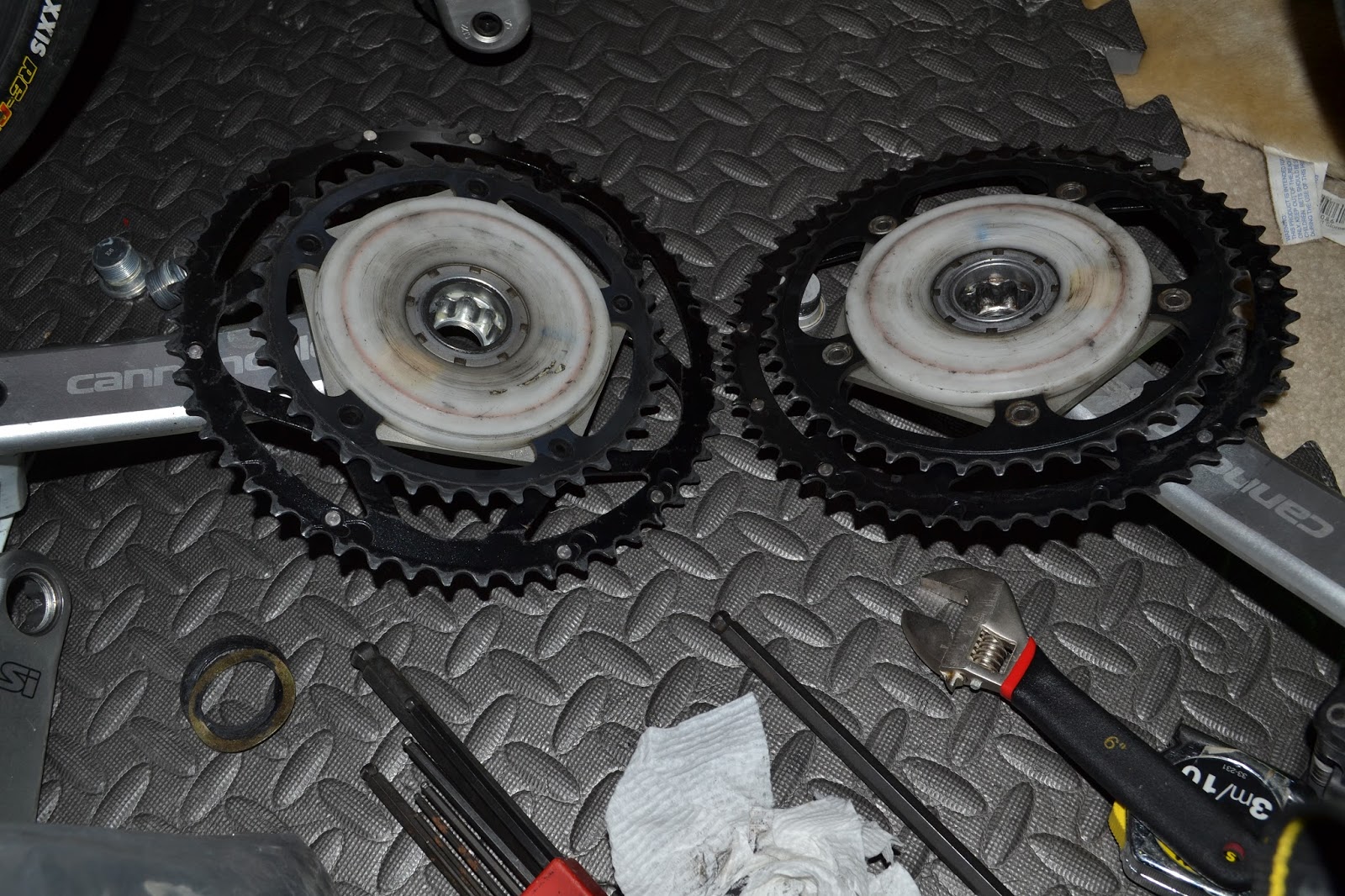
While I had the crank spider out, I really wanted to replace the rings on the crank. I have two sets of the Cannondale SI chainrings and both show considerable wear after a combined total of three years of use. These certainly aren't the beautiful cold forged Campy rings; they're just machined soft aluminum ones. I don't have any other 130mm BCD (bolt circle diameter) rings, just a whole slew of almost-useless-to-me cold forged 135mm BCD rings...

Except for one pair of rings. I couldn't resist fondling some chainrings I bought for the tandem, a matched 55T/44T, in 130mm BCD (in soft aluminum, alas).

Yep, a 55T. Oh yeah!

Holy big chainring Batman!
It don't even fit in the picture!

So, yes, I stole some chainring bolts off of the donated Athena crankset I used from about 1995 to 2001 (the others are Record or Chorus cranks which have an odd bolt in there) and stuck the big, thick, heavy rings on the newly-battery-ed spider.

(The donor was the designer of the 1997 kit, the first kit I wore that had argyle on it. I'm sure Vaughters took note of this for his future Slipstream kits.)

I took my original SRM crank off the bike and discovered two things. First, the arm wasn't really tight on there. It was snug, okay, but not tight. Second, the lockring holding the spider to the arm was only finger tight. It wasn't rocking but it was close to it.

Note to self: check these things a bit more often.

I mounted the 175mm arm to the fresh battery SRM spider (replete with the beautiful huge chainrings), snugged the lockring firmly, and installed it on the bike, firmly.

Just before it went on the bike.
The lockring (out of view) is tight.

Then, because the enormous 55T ring is a tad taller than the 53T it replaced, I had to adjust the front derailleur.

A two minute job, right?

Uhhhh....

You guessed it.

Problem was the derailleur mount, welded on the frame, was set up for regular and compact cranks, i.e. 53 tooth max and about a 48 tooth minimum. The 55T macho ring had no place on this bike.

A little digging around got me my nice round file, and, after covering the chain, chainrings, and front derailleur with a cotton rag, I modded my front derailleur mount so my derailleur would clear the 55. I carefully removed the rag and I think got zero metal shavings into the drivetrain.

Yay!

Not in the big ring.
You can see the silver chainring bolts. Dirty bike. Cable still has to be capped.
Pay no attention to file marks.
But it works.

By now my fingers were black with various oily grease, mainly from the bottom bracket and crank fiddling. Since I planned on putting on lighter than black tape, I knew I'd have to wait a bit, else I'd ruin the tape just installing it.

Because, as you know, the best way to finish washing your hands is to install new bar tape. The new tape will suck up whatever tiny bits of oil or grease you missed, ruining the tape in the process. Even if your hands look clean they're not (as any doctor will tell you).

Therefore I had to get my hands really clean. I took a dinner break, washed dishes by hand in the sink, washed my hands a dozen times, and, finally, with hands scrubbed about as clean as a surgeon going in for open heart surgery, I wrapped my bars.

In white Cinelli cork.

Oh what a joy. I forgot what it's like to use Cinelli cork. It wraps so nicely, so smooth, looks so pro.

Poor picture but you get the idea.
This is after 90 minutes of riding.
With clean hands.
Note big floor fan. Critical for trainer training.

And white tape, yes, because, well, because that's all I had left. But it's so pro looking. I won't be rewrapping my bars every week or two like I did for a season in the mid 90s, but I figure I'll be replacing the tape a bit more frequently than, oh, once or twice a year, like I have with the black tape.

With the spider swap and bar tape, another bit of maintenance that should have taken only a few minutes stretched out into hours, and I skipped yet another ride.

But my bike, she is beautiful.

Well in a functional way.

Now I just have to ride it.