It never ceases to amaze me what I have missed while living in the same area for decades. One such instance is the city of Mount Vernon in New York, a short drive from the Connecticut line. Although I've trained thousands and thousands of miles all over western Connecticut and southern New York, in the almost 20 years I'd been living in Connecticut I had never, ever seen Mount Vernon. That changed when I took the exit off of I95 one June day on the way to a new criterium there.
Once we exited the highway and started driving around I got that uncomfortable feeling you get when you drive through a sketchy part of town. I'd gotten the same kind of feeling, but worse, when I drove through Bridgeport, Connecticut. The white car with the bullet hole waiting at the light didn't help much, and it certainly wasn't high on my list of priorities to return there. For a long time a section of Bridgeport had been off limits to EMTs - since they'd get shot at when responding to emergency calls, they had to stop responding to calls from that part of town. Mount Vernon, in a less extreme way, reminded me of Bridgeport.
The city itself was in much better shape than Bridgeport but the big, faded "SALE" banners in the dusty windows, the closed shops, the waxed over windows, and the general dreariness made the area somewhat depressing. A strong wind only added to this feeling, pushing papers and litter around the roads.
Here was a city that had been passed over for bigger and better things. There were some "distressed" people walking about, probably homeless or living in shelters, their slow, shuffling walk depressingly familiar to any big city resident. Another character I noticed was a tiny old woman in mourning - she was all dressed in black. Someone later described her as "the little Italian widow". I think that described her perfectly. She may have been old, little, and wearing black, but she seemed full of life and vigor, her walk resembling an military march. She stomped past me with single minded purpose when I first noticed her.
The race brought a lot of the local residents out, curious about the oddly dressed interlopers in their city. The fancy machinery never fails to intrigue the young, bright eyed kids and they all watched, carefully, from a distance, as the racers took over a parking lot (with a crater big enough for a small house on one end) and prepared for the races.
The course itself was a typical criterium thing in the middle of a small city's downtown. The front and back stretches were wide, perhaps four lanes, and the two shorter stretches were much narrower two lane roads. Totally flat and very windy, the course promised for a strung out, hard, fast race.
It went counterclockwise so it was all left turns. Eddy B said in his book that a racer's heart disrupts the balance of the body and therefore racers fall on their left side more often. I figured racers fall on their left side because they don't make hard lefts on training rides but they will make a lot of hard rights. Except where they drive on the left side of the road. I found the same with right and left turns in cars - I could get my GTech to register much higher G-force numbers (with correspondingly more stress on my part) on right turns than left turns. I think this is because left turns tend to be pretty wide - you turn left from the right lane and you finish 100 or more feet later it in the right lane. In contrast, when you turn right, you start in the right lane and pow! you finish about 10 feet later in the right lane. Whatever the reason, left turns meant a higher chance of a crash according to the guru.
The course had only one potential problem: the third stretch, on a two lane road, was hemmed in by large brick buildings which extended virtually to the street. This created a cool looking artificial valley for the racers (it even echoed a bit) but made it impossible to see around the third and fourth turns. The third turn wasn't a problem - only race spectators ended up walking down the narrow third stretch. The fourth turn dumped the racers out onto the big main straight - and even on this quiet Sunday, a number of city folk scurried back and forth on the sidewalk next to the main street, running errands and such. None of them could see the racers on the third stretch until the racers came barreling onto the main street.
My race ended prematurely - without too much of a warm-up and with virtually no fitness left after a period of non-training, I nevertheless scampered off after a guy who attacked at the gun. The guy is a friend of mine and I actually thought in some delusional state that I could bridge up and we could have a little breakaway for a while.
Me, in a break. Ha!
I went around him pretty hard, pulled like a maniac, and realized half a lap into the race that, well, that was it. No break. No legs. No nothing. I tried to recover a bit as the time the field caught me but I'd inadvertently set the tone of the race with my 35 mph blast off the front. With the field strung out and flying along like a flight of F-111s, I had no chance of integrating into the group.
Off topic - the F-111 bit makes me wonder, why did Phil Liggett use the F-111 to describe Ekimov in the 2003 Paris Roubaix (he uses it when Eki bridges to that big Italian Saeco racer, I forget his name) ? Why not a B-1 or an F-14 - both are swing-wings like the F-111, and the F-14 was immortalized by "Top Gun" and the B-1 is the ultimate Cold War bomber. Why not an F-15 or F-16 - the most versatile of the planes in action at the time? Ach, it doesn't matter. No matter what the field resembled, I dropped right through them and off the back.
My partner in crime, the guy who attacked, said that when I went by him I was going so fast he couldn't go with me. And, knowing me, he also wondered exactly how long I'd go before I totally and completely blew.
Not far.
Anyway, I went back to the cratered lot, changed, and after carefully locking up the car, I walked back to the course. I watched some friends/teammates race, taking pics of them - a few did the 4s and my Purple Jersey friend did the Juniors (a combination race with the women I think). My Cat 4 friends did okay, finishing in the top 20 or so. Purple Jersey did better - he won his race, and he did it the hard way. He attacked shortly after the start and time trialed around the course for 20 minutes or so on his own. He looked really smooth but each time he rode by I could see the signs of enormous effort contorting his somewhat pained looking face. I would last maybe a lap at that kind of speed - he lasted virtually the whole race. I guess all that Cat 1-2 work paid off.
We all settled in to watch the big race, the Pro-1-2s. Since we all wanted to watch different parts of the course we split up. I wanted to walk around the course since I didn't remember anything from the two or three laps I did in the race. We walked by some of the guys eating at a deli with a few tables and chairs out on the sidewalk. I passed up an offer to join them - the race seemed pretty exciting and I wanted to focus on that, not on food.
When I got to the fourth turn, the second of the two turns hemmed in by the tall brick buildings, I decided that this would be my spot. I could watch the racers stream into the narrow third straight and, literally only half a dozen seconds later, take the wide, sweeping turn into the final stretch. The echoing magnified the thrumming of the tires and made for an excellent vantage point, visually and aurally.
The little widow came marching down the sidewalk once again and I cautioned her against crossing without checking for the racers. She glared at me and stated emphatically that this was her town and she walks where she wants to. She turned and marched right off the sidewalk and across the narrow road, the end of the walled in third stretch.
I backed off, mindful of the whole bike racing public relations thing, and figured if the field did come streaming into the third turn, I could scoop her up and move her out of the way. Her forceful march and take-no-prisoners attitude got her quickly across the street and the problem, if there even was one, wasn't a problem anymore.
The race went by a few more times. Graeme Miller and Jeff Rutter, both of Scott/BiKyle, were tag teaming the rest of the field, slapping them silly. Miller had spent a long time soloing off the front and Rutter was comfortably sitting second or third wheel in the field, covering all the moves. I'd seen this before at a number of other races - Miller soloing to victory, Rutter beating most or all of the field for second.
A good way to make some money.
Miller, by the way, soloed in for sixth place at the USPro Championships in Philadelphia that year, behind a small break but well ahead of a motivated field. He'd stayed away for something like 15 or 20 minutes on his own. No slouch this guy.
Shortly after the widow marched off, one of the distressed women, carrying two full shopping bags, shuffled by in her pajama like dress shortly after the field passed my spot. I watched as she set off across the wide final stretch with a little concern, but with a full lap, perhaps a minute and change, to cross, she'd be okay. I turned my attention back to the third turn and waited for the race to return to my stretch of the course.
Miller came flying into view, coming off the wide back stretch, his tires barely clearing the outside curb as he straighted out for the two or three pedal strokes it'd take him to cover the short section of road. I watched with admiration as every lap, every guy in the field came within one or two centimeters of the curb at 30 or 35 mph, each one of them confidently sprinting out of the turn and diving into the next one. I'm always impressed when I watch good racers corner, and although I allegedly do similar things, it's much more impressive to watch it done by the pros.
Miller's scruffy face flashed by, his deep section aluminum rims humming (and amplified by the echoes) past me, a contrast to the bright orange kit he wore. I turned back and looked for the field - they had been closing a bit and were about 15 or 20 seconds behind. Sure enough, here came a Bettini like figure in blue, flat out, with Miller's teammate Rutter about a length off his wheel. The blue guy must have attacked on the long back stretch, trying to escape the clutches of the field, trying to bridge up to the superb Miller. Behind Rutter a short gap opened so even as the two flew by me, I turned my head back to the right to see what the field was doing.
That was when I saw a flash of light to my left.
I turned my head and realized the flash was the sun hitting Rutter's rear deep section aluminum rim. Since he was riding directly away from me (I was at the apex of the turn), the flash meant his wheel wasn't parallel to me anymore - in fact, it was sort of perpendicular to me.
In the microsecond it took to register that thought, I realized Rutter was doing an insane power slide at 35 mph, his back wheel hanging out there like a dirt track motorcycle racer, his bike at about a 50 or 60 degree angle to his actual path. As all this registered I realized why he was pulling this insane stunt.
Directly in front of him was the shuffling woman.
Both her arms were at her side, holding onto her bags, and she flinched her shoulders as first the blue guy shot past her on the outside. Immediately after came Rutter who miraculously managed to straighten up in the last ten feet and pass on her inside at something like 30 miles an hour.
The woman stood frozen in the road.
I looked back - the rest of the field was coming! And here they came, strung out, sprinting desperately down the third stretch, responding to the attacks at the end of the back stretch. They couldn't see the woman and had no idea she was there. I screamed a warning but I think they probably thought it was for a spectator, not for the racers. I saw some faces hesitate but others bore down on the turn like the finish was 200 meters down the road.
I cringed as I watched the field burst out of the valley'ed road, the riders registering this sudden and new obstacle in their path. Tires zinged as riders locked them up and the field disintegrated around the poor woman. I thought for an instant that she might make it but then I saw it happen. One guy was practically glued to the next guy's wheel and had no idea what was in front of them both. The lead guy saw the woman and swerved out of the way and the second guy looked up and, well, he saw her.
He hit her at full speed.
Her bags went flying, scattering their contents all over the road. The woman herself got flung perhaps 10 feet, her ragged dress billowing and then settling down onto her and the pavement around her. The rider went flipping over her and landed hard on the pavement, his bike breaking into pieces on impact with the woman. She lay motionless on the road.
Yet the field was still streaming around the turn.
Rider after rider swerved, skidded, and somehow avoided her. But a guy deep in the field came sprinting around the turn. He might have been just off the back and bridging while he could, I don't know. Whatever he was thinking, he was sprinting into a turn with people already running into the street. He came flying around the turn and bam there was a woman laying across the road right in front of him. He slammed his brakes on but there was no way he'd stop, and as he skidded he lost any chance of maneuvering around the woman. Then tensed his body, his pedals level, his butt coming off the saddle. I knew what that meant.
Oh boy.
Bd-dump-bd-dump.
He bunny hopped over her legs, but without enough air, he made pretty solid contact on her legs with his tires. The woman's legs bounced up and down about an inch as each tire bounced off of her her, a nice rhythmic bounce, kind of like two piano keys each played twice in a row.
The racer slowed and looked back with a shocked look on his face. I don't think he thought he was going to make the bunnyhop but after he did his next thought must have been something like "Did I just run over a dead woman??"
The scene resembled something out of a wild west movie. A wide, deserted road, albeit with racers rolling away or turning around and coming back. A couple bodies laying in the middle of it. Wind blowing stuff around (clothing, not tumbleweeds, but still). A shocked silence blanketing the scene.
In the tense second or two of this surreal pause in life, I noticed something on the road, about ten feet away from the downed woman.
Her shoes.
The woman's shoes lay on the road, side by side. They looked like someone had carefully placed them there, pointing the way across the street. She'd literally been knocked out of her shoes.
Then, suddenly, everyone sprang into action.
The marshals at the corner - volunteers from a local charity - suddenly came to life. The six or seven of them on the turn started blowing whistles, the EMTs came rushing over, cops ran over, and the race was neutralized.
I stood there in semi-shock - I thought for sure she was dead. But after a few minutes the EMTs, having checked her, pronounced her relatively okay. Bumped and bruised but no serious damage. Her bags had mostly clothing or at least fabric type stuff, and people ran around picking up everything and bringing it back to the woman's general area. As a precaution they loaded her onto a stretcher and ambulanced her to the hospital. Apparently she'd started to cross but couldn't decide where she wanted to go - and ended up wandering around the road for the minute and change it took for the field to come around the course.
The racer was hurt bad. He'd broken something, a collarbone, maybe a shoulder, and possibly some other stuff - an arm or a leg. He'd been peaking for Fitchburg, the biggest stage race in the area. It was next weekend and there was one guaranteed non-starter - him. His bike was broken into two, cables holding the two halves of the bike together. The front rim was broken into a couple pieces - he hit her really hard. His day was over and it wasn't going to get any better any time soon.
The marshals, seeing the consequences of their relaxed attitude towards marshaling the course, adjusted to the other extreme. No one else was hurt that day, save a bruised ego or two for a few pedestrians forcibly held back by excited and fervent marshals.
The race at Mount Vernon didn't last very long, maybe another year or two. But that first race there will always stick in my memory. I spotted the finishing straight many years later while commuting on the train to the City. I was gazing out the window absentmindedly when I saw a parking lot with a crater at one end. I sat up, suddenly alert, and looked carefully as we streamed past the lot - the big, faded SALE posters in the windows, the uneven and broken up parking lot. There was the little bridge that people sat on to watch the race. And finally I could see the finishing stretch flash past, the walkway over it, connecting the two sides of the street. And then it was gone.
I looked for it whenever I sat on the north side of the train and it became one of the many landmarks by which I measured my progress either to work or back home. When I stopped commuting, I stopped seeing the updates to that sad, dreary lot. The race succeeded in putting Mount Vernon on my map of New York State.
All because of the woman who got knocked out of her shoes.
Friday, November 16, 2007
Thursday, November 15, 2007
How To - Handlebar tape
At first thought installing handlebar tape doesn't seem too complicated. Just wrap the bars, right? I've seen a lot of people come into the shop, buy tape, look at the package, then look up and ask, "So, this is pretty straight forward right?"
Well.
It's when you actually do it that you realize it's a little more than "just" wrapping the bars.
Bar tape is unique in that there is an infinite number of ways to install it. Maybe not infinite but something like that - a math major might have a better handle on that one. You can start at the top or the bottom, wrap over or under (think toilet paper - do you install a new roll over or under?), you have to figure out the bit by the brake lever, and finally you have to figure out the bit at the end.
It's not like, say, a rear derailleur. If you install a rear derailleur incorrectly, it simply doesn't work. But a poor wrap job? It's not critical to your bike's performance. However, a poor wrap job reflects on its rider, and since people judge others first by appearance (where do you think stereotypes come from?), it's better to broadcast that you know what you're doing.
Anyway, I've been waiting to wrap bars so I can take a pic or thirty, but with about 1100 miles on two bikes since March of this year, I really haven't had an excuse. See, typically I'd rewrap bars when the tape got dirty (black tape dirty?), it ripped (nope), or I wanted a change of scenery (my five sets of black tape doesn't really allow me that luxury). My old "wrap my bars every week" habit died a decade ago but even so, I thought I'd be wrapping tape much earlier than eight months later. Alas, that was not the case.
Then the Cannondale showed up. With a new bike and swapping bars, at least temporarily, came the chance to wrap some bars.
Here's how I do it:
(With props to SOC who mentioned this, use nitrile (it's non-allergic), latex (you can get allergic to it), or other thin gloves to keep your grubby hands from dirtying up your precious new tape.)
1. Wrap a lot of electrical tape around the cable housing that will sit under your tape. It used to be that with flexy and compliant housing and much stiffer and stronger bar tape, the bar tape would hold the housing in place. Now, with the rigid index shifting housing and even the somewhat stiffer brake cable housing combined with thinner and stretchier bar tape, that is no longer the case. The bar tape has a function - it's for you to hold. It's not designed to hold cable housing in place.
2. Start wrapping the tape at the open part of the bar, towards the end of the drops. Work your way to the stem. This allows the tape to overlap correctly, to "fishscale" correctly. Your hands naturally slide from the center of the bars towards your levers. If the tape overlaps with the edges facing the stem, you'll peel the tape back, slowly but surely. If the tape overlaps with the edges facing the brake lever, nothing happens. Well, eventually the tape slides a bit, but that's unusual with the current generation of adhesive. Tape wrapped too loosely will slide but that's not the tape's fault. I wrap from the inside, over the bar. If you do it the other way it's up to you, but I've found the "over" direction works well.
3. Use an extra piece of tape (Cinelli supplies you with pre-cut one which you'll probably have to trim) under the brake lever. It allows you to avoid wrapping tape over and over around the lever while trying to hide the bit of handlebar peeking out at you. That multiple lap wrap results in unsightly bulges. The extra piece avoids all that.
4. End the tape cleanly using electrical tape, optionally covered by the manufacturer's end tape.
Some goals for a professional bar wrap job:
1. No unsightly lumps in the tape - it should be relatively even in thickness from end to center.
2. No peeking handlebar.
3. Securely wrapped tape - no tape rotating around the bars in a sprint.
4. Cleanly finished edges, bottom and top.
5. Wrap job should last until the tape compresses (Cinelli and the like), gets dirty (any light tape), the tape rips (crash, rough stone wall, drop bike, etc), or you swap bars or teams (the latter perhaps determining a new bar tape color). The tape really shouldn't move, it should never peel, and there aren't a lot of other reasons to change tape. In my heyday I'd rewrap the bars weekly with white Cinelli, the tape that's about the easiest in the world to get dirty.
Pictures work better than words so here is a set, from start to finish, of a bar wrapping procedure. Note that all the comments refer to the picture above the comment.
 Note the electrical tape is holding the housing to the bars securely. I have extra laps of tape at the brake lever to hold the cable housing securely - the gear housing is particularly rebellious. I've already determined the brake levers are even. This is critical since it's hard to move a wrapped-bar lever. It's relatively easy to move an electrical-taped-only lever.
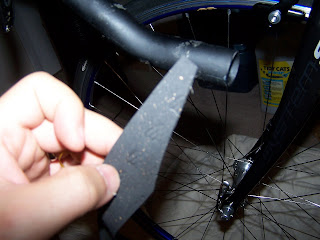 I cut the tape at an angle to start it without lumping. The left side looks like this.
 The right side like this - note the tape starts inside, wraps over, and continues. Mirror image to left side.
 Back to the left side. I always cut the bottom of the tape on the left side. On the right side, I always cut from above. The angle is the same (I'm right handed so it's easier to cut to the right, like the picture above). This way the wrap rotation mirrors each other - a detail but then again, this whole post is about details.
 I start the tape using the cut part - the actual start of the roll is at the bottom of the bar (where my finger turns pink). Then I wrap over the top from the inside. This is the left side of the bar.
 Here is the first bit of wrap - notice no lumps, no unsightly or uneven tape sticking out past the end of the bar. Very smooth, it could be a grip instead of tape. That's your goal - smooth like a grip.
 Next, the piece under the lever. Note how on the outside of the bar the short piece is tilted down a bit - this is because the main tape will wrap around the upper part of the lever naturally. The inside of the lever is covered up higher because the main tape wraps the lower inside. The small piece of tape is therefore placed at an angle - perhaps 30 degrees from parallel to the lever. It is not straight on purpose.
 The main tape approaches - you can see how it will wrap over the top of the lever next. However, if the little piece wasn't tilting forward, you'd have a gap just above the main tape, just under the lever. Not pro.
 Now the main tape has completed its wrap to the top. Everything is nicely covered, inside and out. From here you wrap to the center of the bar.
 When you get to the center, pick out an end line for the tape. This line should work on both sides of the bars - so if you have a bar mounted computer or light or something on one side, take that into account on the other side. A "winter" wrap might end really far from the stem to give room for lights and stuff, but a "summer" wrap may go to the beginning of the taper for the bulge. In the old days the bar had two layers of metal here so you'd always have a nice solid line. Nowadays, with bulges, there's no real "line". Make one up, measure to be sure, and note where your tape will end on each side. Once you do that, hold the tape out like I'm doing in the picture above - you're going to cut along a line that is exactly in line with your target "end line". My target end line is just to the left, perhaps 1-2 mm, of the shiny bit on the bar (the shiny stuff is electrical tape).
 This demonstrates where I chose to "end" my tape. I've cut along the edge, ending the cut where my index finger is touching the tape. You'll find the tape twists and turns when you cut it - it's critical that you hold the bar tape without stretching it or otherwise applying tension to it. This cut will essentially replicate the effort you made at the beginning of the whole process, when you cut an angle at starting end of the tape.
 Wrap the cut end until you get to the end. Notice no lump since tape is tapering along the cut line.
 For reference, I'm showing the right side. Note it's the mirror image to the left. Now comes the finesse part (as if there's been no finesse so far).
 Start by lining up the tape along the cut edge. Electrical tape stretches if you pull on it - and if you stretch it, it gets longer and it gets narrower and changes color (lighter). If you start with a less tensioned wrap, you start with a wide base of tape. If you then stretch the tape, the layer underneath shows up. So this first bit is not tensioned. Therefore it is black and it is wide.
 The second bit is tensioned. It is narrower and it turned a little grey. This is the end of the first full lap of tape. I've tensioned the tape and wrapped it so the edge of the electrical drops off the inside edge. The tape, designed to stretch in order to seal gaps, stretches down to the side of the tape. It ends at the bar, covering the cut edge of the main tape. Note that in the picture you cannot see any Cinelli tape under the electrical tape.
 Then the electrical tape goes around once, no tension, to cover the stretched and discolored electrical tape underneath. Do only one lap without tension - you don't need to do more. When you finish you'll have a lap that quickly goes from no tension (since it's hard to start with tension) to tension. A lap without tension follows. Your total will be about 2.5 laps, maybe 3. This was the finesse part.
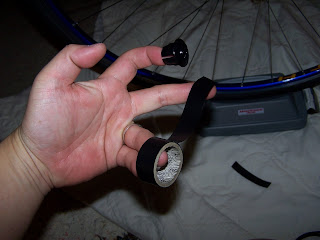 Finally the plug. You have to have your bar ends plugged to race, it's a rule. Prevents "apple core" wounds. Now whether they're mythical or not, I don't know, but I don't want to take a 1 cm wide biopsy of my thigh. So I plug my bars. Since I don't like lumps and cut the beginning edge of the tape, the plug is slightly under the required diameter. I use electrical tape to make up for it, usually only two laps or so. If you put too many laps of tape, you'll break the plug when you force it in. You're going to rely on the squishy tape and it's higher friction (compared to the plastic plug) to hold the plug in place.
 The wrapped plug.
 The wrapped plug going into the bar.
 And finito! Grab a beer and celebrate.
Well.
It's when you actually do it that you realize it's a little more than "just" wrapping the bars.
Bar tape is unique in that there is an infinite number of ways to install it. Maybe not infinite but something like that - a math major might have a better handle on that one. You can start at the top or the bottom, wrap over or under (think toilet paper - do you install a new roll over or under?), you have to figure out the bit by the brake lever, and finally you have to figure out the bit at the end.
It's not like, say, a rear derailleur. If you install a rear derailleur incorrectly, it simply doesn't work. But a poor wrap job? It's not critical to your bike's performance. However, a poor wrap job reflects on its rider, and since people judge others first by appearance (where do you think stereotypes come from?), it's better to broadcast that you know what you're doing.
Anyway, I've been waiting to wrap bars so I can take a pic or thirty, but with about 1100 miles on two bikes since March of this year, I really haven't had an excuse. See, typically I'd rewrap bars when the tape got dirty (black tape dirty?), it ripped (nope), or I wanted a change of scenery (my five sets of black tape doesn't really allow me that luxury). My old "wrap my bars every week" habit died a decade ago but even so, I thought I'd be wrapping tape much earlier than eight months later. Alas, that was not the case.
Then the Cannondale showed up. With a new bike and swapping bars, at least temporarily, came the chance to wrap some bars.
Here's how I do it:
(With props to SOC who mentioned this, use nitrile (it's non-allergic), latex (you can get allergic to it), or other thin gloves to keep your grubby hands from dirtying up your precious new tape.)
1. Wrap a lot of electrical tape around the cable housing that will sit under your tape. It used to be that with flexy and compliant housing and much stiffer and stronger bar tape, the bar tape would hold the housing in place. Now, with the rigid index shifting housing and even the somewhat stiffer brake cable housing combined with thinner and stretchier bar tape, that is no longer the case. The bar tape has a function - it's for you to hold. It's not designed to hold cable housing in place.
2. Start wrapping the tape at the open part of the bar, towards the end of the drops. Work your way to the stem. This allows the tape to overlap correctly, to "fishscale" correctly. Your hands naturally slide from the center of the bars towards your levers. If the tape overlaps with the edges facing the stem, you'll peel the tape back, slowly but surely. If the tape overlaps with the edges facing the brake lever, nothing happens. Well, eventually the tape slides a bit, but that's unusual with the current generation of adhesive. Tape wrapped too loosely will slide but that's not the tape's fault. I wrap from the inside, over the bar. If you do it the other way it's up to you, but I've found the "over" direction works well.
3. Use an extra piece of tape (Cinelli supplies you with pre-cut one which you'll probably have to trim) under the brake lever. It allows you to avoid wrapping tape over and over around the lever while trying to hide the bit of handlebar peeking out at you. That multiple lap wrap results in unsightly bulges. The extra piece avoids all that.
4. End the tape cleanly using electrical tape, optionally covered by the manufacturer's end tape.
Some goals for a professional bar wrap job:
1. No unsightly lumps in the tape - it should be relatively even in thickness from end to center.
2. No peeking handlebar.
3. Securely wrapped tape - no tape rotating around the bars in a sprint.
4. Cleanly finished edges, bottom and top.
5. Wrap job should last until the tape compresses (Cinelli and the like), gets dirty (any light tape), the tape rips (crash, rough stone wall, drop bike, etc), or you swap bars or teams (the latter perhaps determining a new bar tape color). The tape really shouldn't move, it should never peel, and there aren't a lot of other reasons to change tape. In my heyday I'd rewrap the bars weekly with white Cinelli, the tape that's about the easiest in the world to get dirty.
Pictures work better than words so here is a set, from start to finish, of a bar wrapping procedure. Note that all the comments refer to the picture above the comment.
 Note the electrical tape is holding the housing to the bars securely. I have extra laps of tape at the brake lever to hold the cable housing securely - the gear housing is particularly rebellious. I've already determined the brake levers are even. This is critical since it's hard to move a wrapped-bar lever. It's relatively easy to move an electrical-taped-only lever.
 I cut the tape at an angle to start it without lumping. The left side looks like this.
 The right side like this - note the tape starts inside, wraps over, and continues. Mirror image to left side.
 Back to the left side. I always cut the bottom of the tape on the left side. On the right side, I always cut from above. The angle is the same (I'm right handed so it's easier to cut to the right, like the picture above). This way the wrap rotation mirrors each other - a detail but then again, this whole post is about details.
 I start the tape using the cut part - the actual start of the roll is at the bottom of the bar (where my finger turns pink). Then I wrap over the top from the inside. This is the left side of the bar.
 Here is the first bit of wrap - notice no lumps, no unsightly or uneven tape sticking out past the end of the bar. Very smooth, it could be a grip instead of tape. That's your goal - smooth like a grip.
 Next, the piece under the lever. Note how on the outside of the bar the short piece is tilted down a bit - this is because the main tape will wrap around the upper part of the lever naturally. The inside of the lever is covered up higher because the main tape wraps the lower inside. The small piece of tape is therefore placed at an angle - perhaps 30 degrees from parallel to the lever. It is not straight on purpose.
 The main tape approaches - you can see how it will wrap over the top of the lever next. However, if the little piece wasn't tilting forward, you'd have a gap just above the main tape, just under the lever. Not pro.
 Now the main tape has completed its wrap to the top. Everything is nicely covered, inside and out. From here you wrap to the center of the bar.
 When you get to the center, pick out an end line for the tape. This line should work on both sides of the bars - so if you have a bar mounted computer or light or something on one side, take that into account on the other side. A "winter" wrap might end really far from the stem to give room for lights and stuff, but a "summer" wrap may go to the beginning of the taper for the bulge. In the old days the bar had two layers of metal here so you'd always have a nice solid line. Nowadays, with bulges, there's no real "line". Make one up, measure to be sure, and note where your tape will end on each side. Once you do that, hold the tape out like I'm doing in the picture above - you're going to cut along a line that is exactly in line with your target "end line". My target end line is just to the left, perhaps 1-2 mm, of the shiny bit on the bar (the shiny stuff is electrical tape).
 This demonstrates where I chose to "end" my tape. I've cut along the edge, ending the cut where my index finger is touching the tape. You'll find the tape twists and turns when you cut it - it's critical that you hold the bar tape without stretching it or otherwise applying tension to it. This cut will essentially replicate the effort you made at the beginning of the whole process, when you cut an angle at starting end of the tape.
 Wrap the cut end until you get to the end. Notice no lump since tape is tapering along the cut line.
 For reference, I'm showing the right side. Note it's the mirror image to the left. Now comes the finesse part (as if there's been no finesse so far).
 Start by lining up the tape along the cut edge. Electrical tape stretches if you pull on it - and if you stretch it, it gets longer and it gets narrower and changes color (lighter). If you start with a less tensioned wrap, you start with a wide base of tape. If you then stretch the tape, the layer underneath shows up. So this first bit is not tensioned. Therefore it is black and it is wide.
 The second bit is tensioned. It is narrower and it turned a little grey. This is the end of the first full lap of tape. I've tensioned the tape and wrapped it so the edge of the electrical drops off the inside edge. The tape, designed to stretch in order to seal gaps, stretches down to the side of the tape. It ends at the bar, covering the cut edge of the main tape. Note that in the picture you cannot see any Cinelli tape under the electrical tape.
 Then the electrical tape goes around once, no tension, to cover the stretched and discolored electrical tape underneath. Do only one lap without tension - you don't need to do more. When you finish you'll have a lap that quickly goes from no tension (since it's hard to start with tension) to tension. A lap without tension follows. Your total will be about 2.5 laps, maybe 3. This was the finesse part.
 Finally the plug. You have to have your bar ends plugged to race, it's a rule. Prevents "apple core" wounds. Now whether they're mythical or not, I don't know, but I don't want to take a 1 cm wide biopsy of my thigh. So I plug my bars. Since I don't like lumps and cut the beginning edge of the tape, the plug is slightly under the required diameter. I use electrical tape to make up for it, usually only two laps or so. If you put too many laps of tape, you'll break the plug when you force it in. You're going to rely on the squishy tape and it's higher friction (compared to the plastic plug) to hold the plug in place.
 The wrapped plug.
 The wrapped plug going into the bar.
 And finito! Grab a beer and celebrate.
Bonus Tip - Before Cinelli shipped their bars with unfinished plugs like the black plastic plug in the pictures, they used to paint them with a chrome color finish. This finish would wear off slowly over thousands of miles of riding. The plug would slowly reveal its base color, the color of the plastic under the chrome paint. Since Cinelli finished the plug with paint, it appeared they didn't care about the plastic's color - the plastic base color varied randomly. A sign of a "real" rider was:
1. The chrome wearing off the plastic
2. And the plastic would be a non-standard color (white and black were standard, but if you had a different color, maybe blue, yellow, red, or grey, those were really cool).
This led to bar plug collections at the shop, at least for me - a little bin of unusual colored Cinelli plugs saved for the next "cool" build. Once installed you'd rediscover only after a few thousand miles of riding when suddenly you realized that under the chrome paint you had a pink or green or some weird color Cinelli plug.
Super Bonus Tip - For very high end bike builds, we'd match the plugs' mold color to the bike - so for example a red bike got red plastic plugs. Since all the plugs were painted that chrome paint, it would take the customer thousands of miles to learn the painstaking detail that went into building that bike.
The unfinished plugs take all the fun out of it now.
Enjoy your bar wrapping.
Wednesday, November 14, 2007
Story - Frank McCormack
A long time ago, in a land far, far away...
Ahem.
In Eastern Connecticut, which, to a Western Connecticut kid was about as foreign as, say, New York City (but in the opposite way), I went to a town called Old Lyme to do a new criterium. The course went around the high school and featured, in its 0.4 mile length, two sweeping turns. The first turn, right after the start/finish, was a long right turn - almost a U-turn. For me it was a special turn, straight out of the CBS coverage of pro racing in Europe.
It was paved in cobbles.
The (paved, unfortunately) backstretch bent to the left, then a very hard right turn led you onto the long straight curving to the right.
A kid, a strong kid, was doing my race. Obnoxious little twerp too - he wore aviator sunglasses (at 16 years old!) with a geeky bike mirror mounted on them. I should add that when I say "little", it's all relative - he towered over me. Anyway, you only put such a mirror on for one thing - to check behind to see how far ahead you were of the field.
In other words, if you had the balls to put such a mirror on, you better have the legs to back them up.
This Kid, he had the legs.
But I had something else, a technological edge. We both went into the first turn together on one lap. I pedaled, he pedaled, nothing happened to me, he dug his into the cobbles. He ended up riding on the grass, laughing. We all eased up, smirking and smiling, he got back on, and the Kid didn't pedal in the turn again.
I had Gipiemme pedals - half length axles, insane cornering clearance. I figured out that if I attacked at the start/finish line, I could completely pedal through the first turn, get about a 3 or 4 second gap, carry it to the next hard turn, pedal through that, and launch into the sprint with a 50 meter gap on the next rider.
The obnoxious Kid would have to eat his mirror.
At the bell I launched hard - and the Kid did too. As soon as he jumped, I realized what he was doing - if he got there first, I'd use up a lot of my pedaling advantage simply passing him. This would keep me within shooting distance for the rest of the course. I pedaled desperately but it wasn't enough. He got to the turn first, coasted, and although I passed him in the turn, I only had a 5 or 10 meter gap leaving the turn. I frantically sprinted through the last turn, out of the saddle, tires skittering, but I had all of 20 meters on him. To my utter dismay he came roaring by me to win the race. I sat up, my dream of winning totally deflated - and two more racers went by me, including the kid's less obnoxious teammate (that one had sunglasses but no mirror).
I conferred with my teammates, some of them 3s, and they said I should race the 4s.
The Cat 4s?
I was a Junior. Junior gear limits. 53x15 Kid. 4s were big guys. Adults. 53x12. They had jobs and stuff. They had already gone through puberty.
With some prodding though my teammates succeeded in getting me to register for the Cat 4s. Nervously I lined up. I had no idea what to expect - it was my first Senior race ever. I looked around at the guys - grizzled cheeks (they had to shave), glasses, fancy bikes, serious looks on their faces - not scared like most Juniors. But like all adults, they were missing some of the "coolness" things. I distinctly remember uncool tube socks on one racer.
What I didn't realize until that moment is that the Juniors races were Category 1 through 4. In other words, that obnoxious kid was a Cat 1 or 2. But when I raced the 4s, I'd be racing Cat 4s. Racers like, well, like me. Although I was young, I was a Cat 4 too.
I expected a flurry of attacks as soon as the race left the line - that's how Juniors race. So when we rolled away somewhat leisurely, I wondered what was up. Maybe they were like pros - go easy at the beginning, so easy anyone can keep up, then they drop the hammer at the end.
I nervously patrolled the front, responding to pretty much every attack. And when the bell rang for a prime, I shot out of the field and went pedaling into the first turn. My gap there, I sprinted to the second, pedaled through that, and hit the line well clear of everyone else.
I just beat the Seniors!
Elated, I let the group come back and eased back into the field. At the next prime, I launched again. And like before, I sprinted out of the last turn well clear of my pursuers.
This happened four times that day. Four bells for primes, four relatively easy primes for me.
I started getting nervous. Perhaps the guys were letting me go, letting me cook myself. After all, when I started racing I was told to go for primes before going for places, but once I focused on places, I should back off on the primes. So these guys who had to shave (probably every day!), who had weathered skin and no baby fat, maybe they were letting me cook myself.
It wasn't the case. At the bell I launched a furious attack, sprinting through the first turn. I'd sprint to the next (and final) turn and do the same. By now I could sprint out of the saddle through the tight turn, the tires skittering sideways, the bike chattering across the pavement. A big dip shot my bike across the road as I exited - scary but totally predictable.
I crossed the line, ecstatic. I remembered the tape of Davis Phinney winning the US Pro Championships in Baltimore in the longest sprint I could ever imagine - I felt like that's what I'd just done by sprinting around the whole (short) course. I'd won every prime and I'd won the race. My grin went from Boston to Santa Monica and nothing could wipe it off my face.
I settled down enough to watch the Veterans (as the Masters were known back then). They were racing pretty hard and I wondered how I'd do against the really old guys.
I sensed someone near me and I turned to look.
The Kid.
He was hanging out, trying to be cool. He had his team Fuji skinsuit on, sat on his saddle, one long leg stretched out to the ground, his toes keeping him upright. He appeared to notice that I was there.
"So, you won the 4 race?" he asked.
"Yeah," my face still glowing.
"You won all the primes too, didn't you?"
"Yeah." The Kid was asking me!
"You doing the 3s?"
"No, I can't, I'm just a 4."
He contemplated what I just said. Then he said a magical word.
"Good."
And he rolled away.
I didn't see him again until July 4th that year, the big criterium in Middletown. The wide roads made the small Junior field seem even smaller but this had been my first race two years ago and I was looking to do something in the race. I had to - my first race had been a total fiasco and I got dropped two turns into the race. Now as one of the older Juniors I felt like I should be in a position to do something.
Right.
The Kid lined up, his Fuji skinsuit and confident swagger different from the rest of the nervous Juniors. The gun went off and we all shot into the first turn. The Junior gear limit was a 53x15 and it seemed like we might as well have had single speeds because we were just flying around the course, the hill a simple five or six pedal strokes in our 15T.
The pace increased rapidly until one racer snapped the elastic and shot away from the field.
The Kid.
He motored away, checking, I'm sure, his obnoxious mirror.
He disappeared around the corners, out of sight. The remaining Juniors chased, at least those that could, but it was hopeless. He won by half a lap, averaging, apparently something like 30 mph for the last lap or two.
If that wasn't enough, he lined up for the Cat 1-2 race. At the time this was probably one of the biggest crits out there - and he was in there with all the big boys. His older teammates were favorites so he spent 50 laps patrolling the front of the race, chasing down rivals, keeping the pace high when things were together. His work is immortalized in the 1988 Cannondale Catalog - pages 4 and 5, a two page spread, shows a skinny kid in grey, aviator glasses, obnoxious mirror, leading one of the strongest fields New England could field that year.
He was 16 years old.
Fast forward to Central Park, maybe six or seven years later.
I was sitting in the field, a Cat 3 now, lost in the sea of Pros, 1s, and 2s in this Pro throough 3 race. Cruising along at the back I realized I was next to a star IME rider, Frank McCormack.
I knew who he was because I'd followed his career in VeloNews and Winning ever since I watched him demolish the Junior field and control the Cat 1s and 2s at Middletown back in 1985, all while wearing an obnoxious mirror on his sunglasses. He'd lost the mirror, gained a ton of power, and now defined how a top domestic pro rode in the US.
We approached the hill on the course - at this relatively easy pace we'd need to be in the small ring. At the time we were both spinning in the big ring, a big cog, probably a 53x19. We'd need to be in the 39x15.
I happened to look over when he shifted his STI levers. "Click" on his left lever while his right went "Click, click, click, click." It took perhaps a half second, maybe a bit more. How fast can you click a single-click-at-a-time STI lever? I watched him settle into his new gear, the double shift accurate. Of course, right? He'd ridden tens of thousands of miles that year on that bike.
He turned and looked at me watching him. I turned my face from him and looked down at my brand new, just installed, barely available Ergo levers.
"Click" went the left side. The right made a whirr noise "Clikliklick" as I shoved the thumb button down. I was instantly in the right gear - perhaps a tenth of a second, about the same time it takes for a downtube setup to do the same shift.
I looked back up at him. He paused, digesting what he just saw. He looked up at me, no emotion, just a racer looking at pack fodder, and turned to look up the road. He had more important things to do.
He was the demi-god in the field, the "Pro", "IME", mentored by the Irish McCormack brothers Frank and Alan (no relation, at least not immediate). He wasn't a punk 16 year old kid anymore. He had responsibilities.
He had a race to annihilate.
Tuesday, November 13, 2007
Life - Working From Home
We were talking one day and the missus has observed some changes based in part on my working from home. Although there are innumerable advantages, there are some definite disadvantages. The advantages include lower transportation costs (I have to make a conscious effort to drive the cars enough to keep rust off the brakes - and even then I end up with rusty rotors), zero commute time, healthier eating (there aren't $200 worth of free candy, chips, and soda available at all times), and simply being close to home.
The disadvantages are somewhat significant. Because I work from home, I feel that if I'm not at the computer ready to respond to emergencies then I'm not doing (part of) my job. So I sit tethered for 8 hours, taking very short breaks for the washroom or to nuke food for a couple minutes. The missus noticed I started having problems getting tired - I was literally resting all day and therefore couldn't stay asleep for a whole night.
A second "minus" is the fact that I can't really socialize. Phone calls increased a bit, same with the Skype chats, but there's no sitting in the kitchen, eating lunch, and chatting about random things with a co-worker. I work with my brother and at the office we'd spend the occasional hour, standing next to our cars, talking about various things. All this is gone now. The missus half seriously suggested signing up with a guy who rents out desks to those that work from home. He works from home, missed the social aspect, and thought it would be cool to have other people working from home to work from his home. He rents out a desk, supplies free coffee and internet, and a bunch of "working from home" people work together. Interesting concept, that's for sure.
A third negative element is I can't drive my car too much. I suffered through some tough times in the office and I'd just keep telling myself, "As soon as I leave the office, I can drive my beloved car." And my trip home would be my typical adventure - trying to time traffic so I hit all my exit and entrance ramps clearly (and therefore I could also try and hit them cleanly), perhaps practice 0-60 launches from rest stop entrance ramps. I had to stop the latter after I realized I was going through my clutch quicker than expected but you get the idea - I had a little motivation for working through the day. On a bike it might be targeting stepping stones up a long climb - "I'll go to that bend.. ok now to that mailbox... ok now to that sign." If you do that long enough you end up topping out the climb, and your efforts were doled out in some manageable way. At any rate, driving one of my cars (one gets good mileage, one is simply a lot of fun to drive) is a form of motivation, a way of seeing the end of the day for me. At home I'm lacking that particular element of motivation.
Finally, I rarely get to listen to music. Not the way I like to anyway. I didn't listen to music in the office (unless it was late) but I definitely listened on the way to and from the office. There's something cathartic about loud music (it's better if it's blended in with cycling on a trainer but the car works too) and right now my car has the best stereo I own. So with its subwoofer massaging my lower back and the mirrors trembling on every beat, my commute home let me drown my ears and body in music. The apartment and working at my desk eliminates the opportunity to listen to my car too much, and I typically keep the noise level down when I work. The end result is that whenever we need something minor in the evening, I volunteer to go get it and crank the music to and from the store.
So although it's really cool to not have to commute, it's still got its "things".
Monday, November 12, 2007
Training - Thoughts on 2007-2008
Sorry for clogging the blog with "For Sale" posts. I just re-installed an application that allows me to reduce picture size (from 1-1.2MB to "tiny") so I can post them directly in my ads instead of linking to posts in the blog. I might have gained a reader or two but I feel like the For Sale posts dilute whatever I wrote before.
Therefore the For Sale things are done.
This past week has been pretty busy with a new project for us, a project that is only remotely bike related. A lot of calls, discussions, and various thoughts and decisions to make. Lots of time and energy and unfortunately so far not much to show for it yet. I hope we make some progress but for now we just take it as it comes.
So I've been distracting myself by thinking about the new bike.
I just, and I mean just, finished putting almost all of it together. I'll ride it on a trainer "as is" then do the final bit, the piece that finishes the bike - wrap the tape. Required tasks to get the bike to this point included cutting the steerer tube (done courtesy of Cycle Center for a nominal fee - but I forgot to order the star nut setting tool so I'll have to do that), swapping out the wheels (the Fulcrum 1 wheelset just looked so cool I didn't want to take them off but they're finally sitting to the side - they're for sale), switching pedals from my primary Giant, and fixing up (cutting down) the cables.
When I first finish up a bike I leave the tape off - somehow it seems that if I wrap the bars, everything is wrong - and if they're not wrapped, things are fine. Superstition may not be scientific but I prefer to wait for a ride to wrap my bars.
A good friend of mine playfully accused me of choosing this bike because it matches my current kit. And although I denied it wholeheartedly, I did admit that if the colors were very different - say, the Giant T-Mobile pink - I'd have probably skipped spending the extra coin for the replica aspect of it.
Whatever, the bike currently matches my kit - being blue, green, and black.
Because it matches my current kit, the bike also matches various other things - my Zenith blue rimmed wheels and, um, well, that's it.
In Florida Mandy pointed out one day, on a miserable rainy ride, that I "matched". My blue tires, blue wheels, blue and green kit (including arm warmers, a wind vest, LS jersey, bib knickers, and a Kelme cap that echoed the colors nicely), all against a grey/black background (the frame, components, and winter stuff like booties and gloves). I'm proud to say that I'll be continuing this obsessive compulsive matching thing.
Although for now I'll be using the Zeniths, I have my view on aero wheels and why one should train on them all the time. I have my eye on some Williams Cycling wheels and if I can sell off some of my other wheelsets, I'll be getting a set of those for my bike. Ultimately they'd be used for everything from easy recovery days to "racing training" rides - group rides which will substitute for races on appropriate training days.
Having such wheels also makes it so much easier to go scampering after various vehicular traffic going about 35-45 mph.
But I digress.
I wouldn't be thinking along these lines if my 2008 season was going to mirror my 2007 - train a bit until the end of February, then ride about 1300 miles from then through the beginning of November.
Such training can't justify new aero wheels for training.
I think a normal Cat 3 would have blown my March-November mileage out of the water in four or five weeks, not the eight or nine months it took me to register those hard earned klicks. For me, 2007 had a lot of major distractions - prep the house for sale (refinish floors, clean out house, do extensive yard prep, unclutter house into a PODS), sell said house, move, prep for a wedding while searching for a house, get married, and go on a honeymoon. This on top of the normal race promotion exhaustion in March and April which overlapped a new tax workload on the then-future-missus.
Lots of stuff in 10 months.
Admittedly the wedding and honeymoon weren't painful in any way - in fact, I'd recommend it for those in long, steady relationships - but from a cycling point of view the two events simply served to prolong the pause before returning to any sort of serious cycling.
We got back, kept looking for houses, and then the weather turned cold.
I managed to get my fun car into shelter for the upcoming winter months this last Saturday, another use of a day that might have been, in a different life, a good day for a group ride.
The aforementioned project took almost five hours out of our last Sunday - another potential group ride out the window. I did see a three rider "pack" twiddle past me on a big climb - does that count as a bit of cathartic training?
In between those two days last weekend, on the drive back from tucking in the fun car for the winter, the missus made a somewhat startling statement.
"I think you should race all the races next year. Get the schedule and sign up for them. And we'll go to the races on those weekends."
I must have been a bit speechless as such carte blanche is rarely granted. I focused on staying on the road.
"Plus, I like watching you race."
I guess that's one of the many reasons why she's the missus.
So it's time to get my act into gear.
Friday, November 09, 2007


How To - Sponsorship
Winter, at least in the snow belt, brings a whole new world of cycling to the forefront. Cyclocross. Jackets and tights. Face masks. Studded tires.
And the eternal search for sponsorship.
Now is the time for wrapping up sponsorship requests - you know, the calls and emails and meetings with various businesses or their representatives to get some schwag for the team for next year. Or, if you've landed a nice one, some cold, hard cash. Unless you're a pro team (and even then perhaps you may be spiraling into oblivion) you're probably in the same boat a lot of other non-pro, strictly for-fun teams regarding sponsorship.
The biggest question is "How do I get some?"
As someone who's been there, I have some suggestions. I've asked sponsors for money, negotiated with shop reps, essentially restarted and ran a collegiate team, managed a shop that had a team (and ran the team), owned a shop that had a team (and ran the team), and now have a tiny team that has no shop (and virtually no sponsorship at this moment). I've also asked for stuff for a race series I've promoted for 15 years as well as miscellaneous individual races or events. All this experience has taught me a little bit about sponsorship and cycling.
For the non-pro, there are two kinds of sponsors - those that don't know you personally and those that do.
Sponsors you don't know want to make money on the money they give you. Some of their sponsorship benefits are not measurable. For example, how do you measure getting the name out for a local restaurant? Other sponsorship items allow them to measure their return on their investment on you. Such things include coupons for that same restaurant (with an ID code that identifies the team) or unique phone numbers for ads relating to your team. Remember one thing about sponsors that don't know you - they are a business, not a charity! Keep that in mind whenever you deal with them.
Sponsors who know you are giving you stuff because they don't have the heart to say no. It's like asking for $20 from a friend. Not quite as easy as asking your parents for money but still easier than convincing a stranger to open their wallet to you.
Sometimes people you know get caught up in giving you sponsorship. The company I work for has two partners. Over a few lunches they asked me about my races and my racing. I showed them pictures - the races, the leaders' jerseys, my bike. They got to see the jerseys and bike firsthand since I had the jerseys shipped to the office and I regularly brought my bike in (and they'd see me riding in the evening). They queried me on the leader's jersey.
I explained to them that we give away a leader's jersey to the overall winner of the Series. This makes the overall fight very fierce because only a few such jerseys are handed out each year. I told them that they usually end up framed in a shop or in someone's house (or tossed into a drawer but I didn't want to say that). They promptly asked if they could be on the jersey for the Series going on right now - I told them I'd want to do that but it'd have to wait till next year.
Ultimately they gave me thousands of dollars (cash!) over a few years to be on the jersey. And I never asked them for anything. We used the money to redesign the jersey. We hired the guy that did the Saeco team jerseys, Spinergy, Sobe, etc, and we used the rest of the money to pay various permit fees and race costs (portapotties etc). In return we linked to their site from the race site - and we're the biggest source for hits on their website so they think giving us money was great.
Anyway, think of the following:
1. If you ask someone you don't know for money, you need to be able to show them some kind of return. If I had a business and had a choice between, say, buying $100 worth of roast beef for deli sandwiches for tomorrow's lunchtime rush and giving $100 to a bike club, guess which one I'd buy? As a business I'd think about which one makes me more money, balancing out long term gains versus short term ones. If my deli was brand new, it might be worth it to have 20 racers zipping around town with my name on their backs. If I have an established deli, such publicity isn't necessary - but perhaps giving some money plus handing out sandwich coupons might be worth investigating.
2. Make sure you don't get too much negative publicity for your sponsor. I guess the Festina doping thing was okay (as was Phonak), at least for those businesses, but they're international companies getting international coverage. After all, Festina gets free publicity whenever someone talks about the "Festina affair" - and that was almost ten years ago! However, at a local level, such stunts typically backfire. If you get yelled at or honked at regularly locally, no one's going to want to be associated with you. One shop's team (since disbanded) got banned from riding in a town after they flipped off the Chief of Police (he was in an unmarked car). Good for business? No way. Make it clear to the sponsor that this will not be the case with your team.
This makes the sponsorship hunt seem pretty negative, right? I mean how does a team earn money for its sponsors? You're not out there waiting tables or having tag sales or anything.
There's hope yet - hang in there, it's like being the tail gunner in the field, 10 laps into a 50 lap race. Things get a touch better from here on in.
Cash is precious - it's unusual to get cash. But you can get a lot of what you want or need to race from sponsors through equipment and discounts. And if you pay even scant attention to your race budget, you know that virtually all your money goes into equipment. Cycling related companies want to be the first name on these "serious" riders' lips when their non-cycling friends and family ask about bikes so they're willing to give some to get some.
1. Bike shops. Approach your local shop and ask for a discount in return for the name on the jersey (maybe they pay for the artwork on the jersey, perhaps if they really like the jersey they can sell them in the shop). You want to get the riders used to going there, recommending others to go there, etc. Choose a shop you like if you're in a town with a lot of bike shops.
2. Once you have an in at the shop, ask them to ask their vendors for deals. Virtually all big manufacturers have some kind of "club deal". You order 10 or 20 of whatever (frames, helmets, shoes, shorts, pumps, pairs of tires, etc etc), you get them in matching colors, and you get a serious break on price. One helmet manufacturer sold $150 or so retail helmets for $40 to the shop for its team - that's more than half off wholesale. This doesn't mean anything is free but it's still a good deal and helps make you a "team", attracting other sponsors with your "professional appearance". Usually the deal is the team pays up front, the shop pays upfront, you get an early batch, and you're all set. As a team make the process as painless as possible - have your matrix of sizes clear and ready so the shop simply faxes or hands the matrix out to the vendor (or, more probably, to the vendor's rep).
3. Bikes are virtually never on the amateur sponsor list, at least for free. You might get a deal on a mass purchase though (see #2 above). A domestic pro team I know of gets "free" bikes - but the rider has to return his three bikes or pay for them at the end of the year. A pro/1 women's team around here had no bike sponsorship - they all ride their own bikes. Framesets maybe - again, a discount on frames pre-ordered for the team, but you go through the shop.
For the regular racers out there, the ones that don't race full time, the idea is the manufacturer wants to get the shop involved so you go and patronize the shop (and the shop buys more of the manufacturer's bikes and so on). This means you don't say to the shop, "Dude that's a ripoff - I can get it cheaper on eBay!". What the shop doesn't need is to have the beggars they're helping get mad at them. Not worth the trouble to essentially give money to someone to have them yell at you. Maybe it'll fly in one of those dominatrix houses, but it won't fly in a bike shop.
4. Energy bar/drink/gel etc - the local reps usually have some freebie budget - usually for sample sizes and such. They'll really give you a lot of stuff if you hold a race. We got a 2000 pound pallet of drink mixes from an energy food manufacturer for a 6 week series of races - 2000 pounds! That's a freaking lot of stuff. The truck driver used a forklift! That's serious! Even with 300-450 racers a week we couldn't give it all away. We gave away boxes of the stuff at every race, gave them away at registration, gave bunches to the ones we term "good guys" - influential racers in the community, and used it personally for the year the stuff was still unexpired. Think of other opportunities - new sodas or drinks, new bars, etc.
5. Hold a race. This last item is important. If you can hold a race and keep costs under control, you can make money for the team's budget. Basically you get other people to come and pay to race, and don't give all of the money away. You'll make some cash money. However, races rarely make money when they start off - but you can use the race as a vehicle to ask for sponsorship. If you have a nice picture of the start/finish (or a sprint or something) with some sponsor opportunities, you can ask around for some sponsors to fill that gap. For example, if you don't have a start finish banner, you can ask for sponsorship in exchange for the sponsor's name on a new banner (and perhaps renaming the race - like the Tour de Trump becoming the Tour du Pont). Every year set aside anything you can get to start off next year's race, team, and whatnot. Buy a loudspeaker or a registration tent or something you needed to borrow this year to make the race happen. In 5 or 6 years the team will own all the stuff it needs to hold a race and hundreds of eager racers will stream to your course every year to pay the team money and race on the course. It's hard work holding a race, more than you'd ever think. The payoff? The sense of accomplishment is tremendous.
By the way, this leads to a pet peeve of mine (as a long time promoter).
I have a rule about people who complain at races - only those who have promoted or helped promote a race before can complain. Everyone else should hold their own race first, figure out a way to address their own complaint, and then suggest their solution to the promoter that doesn't do it. If you go to a race and start to open your mouth to complain, stop, think about what doesn't seem right, then figure out how to address it when you promote your own race.
After you promote your race? Go back and complain your head off - you totally have the right.
By the way, if you watch race promoters at other races? They virtually never complain. Maybe a suggestion or an idea, but they never complain. There's a reason why that's the case.
Back on topic, whatever you do for sponsorship, don't expect something for nothing. If you sour any relationship (with the shop, a manufacturer, local sponsors, promoters, school, whoever) you're screwing not only yourself but many years of future cycling club members as well.
The first venture in race promoting I witnessed occurred in the town I lived in until I was five years old. I have an emotional connection to the town and when my team decided to hold a road race there, I was ecstatic. I trained for it and hoped my home town advantage would propel me up the biggest climb, a 0.8 mile drag up a wide road, no protection from the wind.
One of the nation's top woman racers showed up (and destroyed the field) and we had a fantastic Cat 2-3 race. Unfortunately someone in the town's organization had left the Chief of Police out of the loop. He watched the race and commented "I ought to pull every one of those guys over for not riding in single file."
You want to guess how many races we held there in the next 24 years?
Zip. Nada. Zero. The big donut (or "the bagel" as my math teacher once told me, and yes, it was my exam he was talking about).
Sponsorship is a delicate thing because most small businesses (the ones you're going to approach) don't budget for such "marketing". The bike companies do budget for this so it's easier to approach them for discounted gear.
Keep in mind that November is about as late in the year as you want to start as far as a sponsorship hunt goes. By January the money is gone. Call your local shops now (or better yet, talk to the owner/s after you buy a winter jacket or a pump or booties or something).
And good luck with your team.
Thursday, November 08, 2007
How To - Fitting a Bike in This Day and Age
It used to be that a serious road rider would have to go to a local shop to be fitted by the master ex-pro/racer. The guy would put you on a bike, put on different stems, wrench your foot here and there, push down on your forearms and back, and lift your chin. He'd grumble and measure and write, squeeze your calf, look at you suspiciously, and then grumble some more. Then he'd declare that he's fit you and you should come back in 8 weeks for your custom bike.
Okay so that's sort of mythical.
25 years ago it was a little less mythical, a little more awkward. One guy holds the bike up. Another guy does some stuff like ask you if you can see the hub or is the handlebar blocking the way. They eyeball your seat height, moving the seat up and down in somewhat random amounts, trying to hit "that spot". They have you pedal backwards (because you certainly can't pedal forwards while the bike is being held). After a few revolutions they drop a line from your knee which should bisect the pedal axle. They fiddle with the stem, putting different stems on the same bars (Cinelli 66 for big guys, 64 for smaller guys, 65 for guys who look like they should be playing football) and figure out which of the stems fit you best. The wrote all the numbers down and then you were done.
That's when Cyril Guimard, Greg LeMond, Bernard Hinault, and some other people (Bill Farrell, I think, who invented the FitKit) came into the picture. All of a sudden a fit included actually measuring someone (!). Inseam, torso, arm, shoulder, quad length, things like that. The FitKit was great because it included excellent tools for measuring, even if you didn't subscribe to their numbers. Fit became getting a good measurement and multiplying it by some ratio to get seat height or perhaps looking at a chart to get top tube and stem length.
A bonus was that by this time stationary trainers were common and the rider being fitted could pedal forward to "settle into his position". This made for more accurate fits as the rider wasn't perched abnormally forward or back on the seat.
The FitKit got upstaged by more sophisticated measuring devices - like the Serotta FitCycle, a totally adjustable stationary bike on which a "fitter" could adjust the different key dimensions (seat tube, top tube, stem, crank length) with virtual impunity. Typically the fitter would use the position derived from the various ratios as a base, adjusting for individual preferences and limitations.
This is all good for brick and mortar stores. Nowadays though many people buy their bikes online. How should they be fit? The question came up and I came up with some recommendations.
Ultimately, you are looking to get position the contact points correctly, with the pedals (really the bottom bracket) as the base. The contact points are the two pedals, the seat, and the bars (two hands usually). The contact points are determined in that order - that is critical. So critical that I'll put them in a list.
1. First figure out where the seat will go in relation to the cranks.
2. Second figure out where the bars will go in relation to the seat.
You should never, ever move the seat in order to adjust the distance to the bars. You always adjust the bars. If you can't, you have the wrong frame and need to start over again.
Since an improper fit might lead you to buying the wrong frame, I would definitely get your first "serious" bike fit at a shop that knows what it's doing. I don't have any recommendations on how to tell if they're good or not but personally I'd use the "gut instinct" method. Are they fit? Nice? Do they ride? Do they have a team? A local shop here is owned by a former pro and his (ex-)World Champion wife. They'll have experienced a lot and will know how to fit you, even if you have a bum knee or some other issue. My gut instinct told me that shop was good.
On the other hand, I've been to shops where my alarm bells started ringing as soon as someone opened their mouth. I rode to (and into) a huge, and I mean huge shop in California. Bikes were dripping down from the rafters, there were two open floors, and the floor was just a sea of road bikes. Impressive, even just at an inventory level. I figured I just walked into bike heaven.
Then one guy asked me if I race track. Track? He pointed at my criterium bend bars.
"Well aren't those track bars?"
I would NOT get fitted in a place like that. Luckily I was there to buy a frame pump.
As someone who's fit hundreds of cyclists, am very particular about my fit, and whose frames tend to be ordered sight unseen, I look for the following when checking frame fit on a sight-unseen frame:
1. Seat tube height - leg length related, simple. This can vary by a lot due to different types of frames. Ultimately you should choose your size on other factors - the only thing I'd worry about with seat tube height is "Can you straddle the frame without getting (as my mom used to say about the cats) neutralized?" I have frames that measure 44 cm center to center and 52 center to top. They all fit me correctly due to the next two measurements.
2. Top tube length, horizontal/virtual - this relates to your torso and arm length. It's affected by your cycling fluency - a more experienced or performance oriented rider will want a longer setup. A newer or less experienced rider will want shorter overall length. This is due to lower back strength, glute strength, and comfort sitting on a saddle. You should strive to keep the stem length away from the extremes (i.e. length) unless you are extremely experienced. In other words, if you're not really sure about your fit, you haven't been riding too long, and the only way a bike will fit you is if you put on a very long 14 cm stem, you probably need to go to the next size up. That size up will have a longer top tube.
3. Head tube length (height) - this is CRITICAL for proper bar height. I cannot say how important this is. It used to be a given with level top tube frames because the head tube always ended at same level as the top of the seat tube. With such a set up, for experienced riders you slam the stem down, for less experienced you raise it a bit. This has changed with the non-level top tube bike designs - the seat tube no longer determines the headtube length. The head tube can vary by 3 or 4 cm for a given seat tube size.
You can get a bike that has the right seat tube and top tube and the bars might be 2 or 3 cm too high or low, and without a radical stem it won't fit you. A shorter headtube is good for those more experienced/performance-oriented riders. A longer headtube is geared for less experienced or more comfort oriented riders. A good example is the difference between Giant's TCR (performance) line and their OCR (recreational) line. The OCR frames have longer headtubes for a given size but they are otherwise virtually identical.
The above three dimensions are critical when selecting a frame. To a lessor extent, I check the following when checking if a frame fits me:
1. Seat tube angle - based solely on quad length, but unless the angle is extreme (less than 72, more than 75), it's probably going to be fine. This is due to various seatposts which have or don't have setback, a measurement of how far behind the centerline of the seat tube the post holds the saddle.
2. Stand over height - make sure you can get off the bike without squealing.
Once you get the bike, you'll install the following parts. Based on your previous fit knowledge, you'll probably have the proper lengths already:
1. Stem - this adjusts the overall length of the bike for you. A newer rider should aim towards frames which use shorter stems - this way they can use longer stems as their body acclimates to cycling. An experienced rider will probably be using a 12-14cm stem, perhaps a 10cm for a shorter torso rider. This is because the experienced rider will not be making position changes as their body adjusts to cycling - all that's been done already.
2. Crank length - this is based on riding style/preferences but a longer/shorter crank will move your seat forward/backward and down/up respectively. 5mm is 5mm. It'll be unusual to need to change frames for this but realize it's a factor. Probably stem or bar changes will suffice.
3. Bar width, drop, and reach - all affect the overall length of the bike. I rarely change bars (I have the same bar on my bikes) but if you're getting a snazzy carbon bar, make sure it doesn't throw off your length too much. More width increases length slightly. Drop can be corrected using a stem (unless the adjustment is out of range). Reach is critical since a 2 cm longer reach will mean you need a 2 cm shorter top-tube/stem combo if you want to maintain the same position in the drops, a significant difference when selecting a frame. On the other hand, if you end up with a frame that's not quite right, a radical bar change can make a big difference towards correcting fit.
The following have absolutely nothing to do with fit but everything to do with how the bike handles, a totally different topic. If a shop claims these factors are involved in fitting the bike, nod your head politely, look at your watch, and say, "Hey, I just realized I have to go to the hospital for emergency surgery! Bye!" These factors simply help determine the bike's riding style.
1. Head tube angle - a 73 or so will give you a responsive bike that is still stable. A shorter bike (under 52 cm or equivalent size) will be very shallow to give the rider's foot more room to clear the front wheel. The bike will handle correspondingly slower. No way around it.
2. Chainstay length - shorter keeps more weight on the rear when standing. Longer is softer/comfy. If you're looking to do very aggressive riding, look for a short stay. 40.5 cm seems to be the "short stay" measurement for now - it gives some tire clearance and allows you to make big efforts out of the saddle without having the rear wheel skip around too much.
3. Wheelbase - reflects the above two factors, but basically a shorter one is more agile. A long one is better for comfort. Pros typically use 1 cm longer wheelbase bikes in Paris Roubaix, the cobbled and very bumpy classic in France. Most if not all of the wheelbase difference is made in the chainstay. This way the front end of the bike (where it's all fit to the racer) doesn't change.
A good fit will recommend:
1. An overall seat height (measured from the sole of the shoe to the top of the saddle). This means the following affect it: pedals, shoes, crank length, frame size, and saddle. This is virtually unaffected by anything out there - only individual preferences and physical disabilities factor in here.
2. An overall length - seat to bar, depends on how detailed they get. The bike is adjusted by using the saddle, top tube of frame, stem, bar, and height/angle of stem. The rider's experience level and riding goals affect the recommended length.
3. Crank arm length - I've decided this really depends on riding style and has virtually nothing to do with leg length. However a fitter may recommend a crank arm length to you. I'd keep an open mind on this topic.
4. Bar width - easy enough - about the width of your shoulders - but affected by riding style.
Based on the numbers and questions about your riding, the fitter will probably make some recommendations on bike and equipment.
Remember you only contact the bike in five spots - bars (twice), pedals (twice), and saddle. As long as those spots are in the right place, you can have anything between them, within reason. Once you know where those five points are, your job (and whoever else - LBS etc) is to figure out a way to connect the points in a logical and efficient way.
There is one more factor when choosing a frame. It has to do with bar to seat height - the vertical drop from the saddle to the bars. With virtual top tubes, it's hard to tell what's right.
Dave Moulton (frame builder) has an interesting chart on his blog relating to this (and associated commentary):
http://davesbikeblog.blogspot.com/20...ebar-drop.html
His numbers seem pretty good. I have a 53.5 + 13 top tube (66.5 cm total) and his chart says about 8.1 cm drop. My primary Giant has about a 5 or 6 cm drop to the top of the bars, and I'm setting up the Cannondale with perhaps another 1-2 cm of drop. His numbers seem to be aggressive but pretty close.
I have shallow drop bars so the delta between the two positions is less than with a deep drop bar. This means riding the tops is still pretty low but the drops don't put me that much lower. I could get deeper drop bars to get a lower low position but my lack of fitness (i.e. my stomach) gets in the way. For now I'll have to lose weight and have a relatively high position.
If you have a lot of doubts, buying an adjustable stem helps a lot. My stem is a Ritchey 12cm adjustable and it's a great tool for experimenting with bar height. I think they're $60 from Excel.
Add seat to bar height in the list of things a good fit provides (it would be #5).
Wednesday, November 07, 2007
For Sale - Bianchi Trofeo
(Update: this has been sold)
I'm going to be interrupting the blog here and there to post pictures of stuff for sale. For now I'm linking back to these posts from other places so sorry about the jarring topic change between this and the SDC blog. I have to admit that I have way too much bike stuff and I'm not keen on moving this all to whatever house we buy - and then try and figure out what to do with it all.
Here's the next thing up. A bunch of dibs so I won't bother with price.

 Note Tiger sitting to the left.


Top tube: 21.75 inches or 55.2 cm
Seat tube: 21 inches c-to-c, 21.5 inches c-to-top or 53.3 cm c-to-c and 54.6 cm c-to-top
Chainstay: 16.75 inches or 42.5 cm
Headtube: 4.5 inches or 11.5 cm
Dedaccai cro-mo tubing, no specifications.
I'm going to be interrupting the blog here and there to post pictures of stuff for sale. For now I'm linking back to these posts from other places so sorry about the jarring topic change between this and the SDC blog. I have to admit that I have way too much bike stuff and I'm not keen on moving this all to whatever house we buy - and then try and figure out what to do with it all.
Here's the next thing up. A bunch of dibs so I won't bother with price.

 Note Tiger sitting to the left.


Top tube: 21.75 inches or 55.2 cm
Seat tube: 21 inches c-to-c, 21.5 inches c-to-top or 53.3 cm c-to-c and 54.6 cm c-to-top
Chainstay: 16.75 inches or 42.5 cm
Headtube: 4.5 inches or 11.5 cm
Dedaccai cro-mo tubing, no specifications.
Subscribe to:
Posts (Atom)

 Posts

