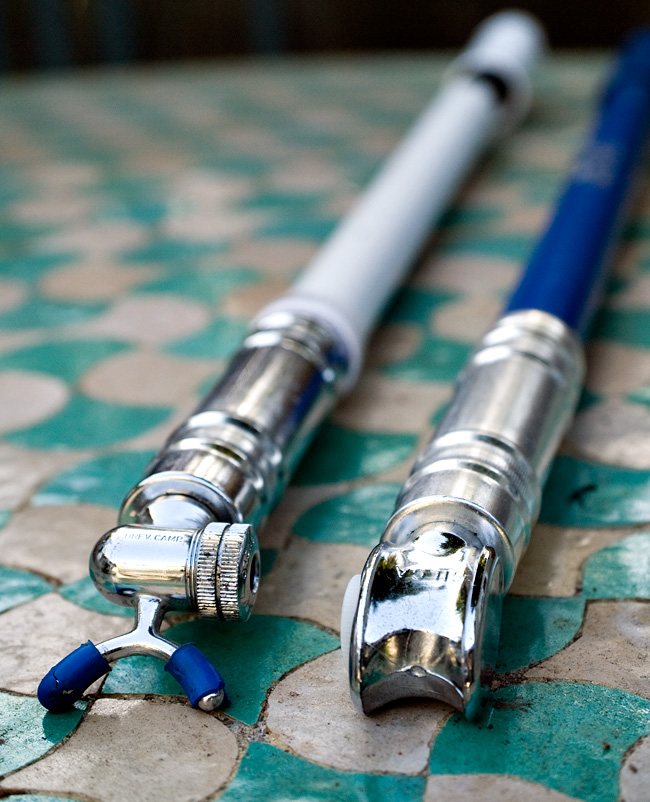
A while back I alluded to the Park PMP-5 that I carry with me when I train. It's a great pump, a full size frame pump that allows you to adjust the size for different size bikes.
The only problem is that I'm not that tall. You cannot shrink this pump below a certain length.
On the black bike the pump fits nicely under the top tube. The red bike... not so much. I tried putting it on top of the top tube but I managed to really gouge the paint when I accidentally jammed the pump sideways and slid it off the frame while applying great pressure down and back on the pump.
I tried creative solutions - rigging it up between the rear skewer and the seat post (heel hits it), stuff like that.
I returned to the "front skewer mount", something that I've tried on and off since I had my first Silca pump. I first saw this pump mount position in use by the uber-cool Cat 2 that rode with us, Morley. As a very impressionable kid in total awe of all that was Cat 2, I eagerly took in this most "out of box" approach to carrying a frame pump.
When I tried it, though, I managed to drop the pump. One of the last significant times I tried it took place something like 9 years later, when I was doing some long rides into northwestern Connecticut. I distinctly remember bombing down a fantastic descent, lots of curves and steep drops, when the pump went skittling across the road.
I had to slow down, laboriously climb back up the steel bit that I'd just blasted down, get my pump, and continue on. With my "pump security" shaken I took it easy on every rough surface until I got home.
Not fun.
Fast forward about 20 years and I'm back it again. I still have the fascination for the "outside of the box" solutions like the skewer pump mount. With my age and experience I am much more risk averse, so instead of relying solely on the pump's internal spring to keep things stable I've added two straps. I haven't had a problem, even with really fast or really bumpy descents (I haven't yet done a really fast AND really bumpy descent, meaning a bump 55+ mph descent).

View from the rear quarter.
Note the notches in the lower black area - that's how you adjust the length.
My pump is at the shortest possible length.
The above view really shows how I carry the pump. With the older skewers the pump had a better surface on the lower side - a rounded bar, basically a very thin frame tube, perhaps an ultra skinny seat stay. The HED skewers offer a poor profile - two flat bars that meet at the tip - so I tilt the skewer a bit to make it perpendicular to the pump and then use the strap to hold the pump to the fork. This way the pump's spring simply has to keep the pump from moving around too much. The strap actually holds it in place.
I bought an old-school Zefal pump peg. It's a plastic hose clamp that has a nub on it for the pump. In the old days of brazed steel frames the Zefal pump peg allowed you to "install" a pump peg under your top tube or on your seat tube, letting those with undersize frame pumps to carry such pumps. The fancy bikes had brazed on nubs but most of us had to use either frame-size specific pumps or, if using a fixed length pump like the Zefal HPX, we used the nub thing.
Well I thought I'd use the nub on the fork instead of using the skewer as the nub. Problem was that when I thought about it, meaning when I got the Zefal gizmo and held it up to the fork, I realized that the fork tapers. This meant that the Zefal nub thing would just slide down until, at some point when I had the front wheel off, it'd just fall off the fork.
Not good.
The Zefal nubs (I think they're called DooHickeys but I'm not sure) stayed in their plastic bags and the pump stayed strapped to the skewer.
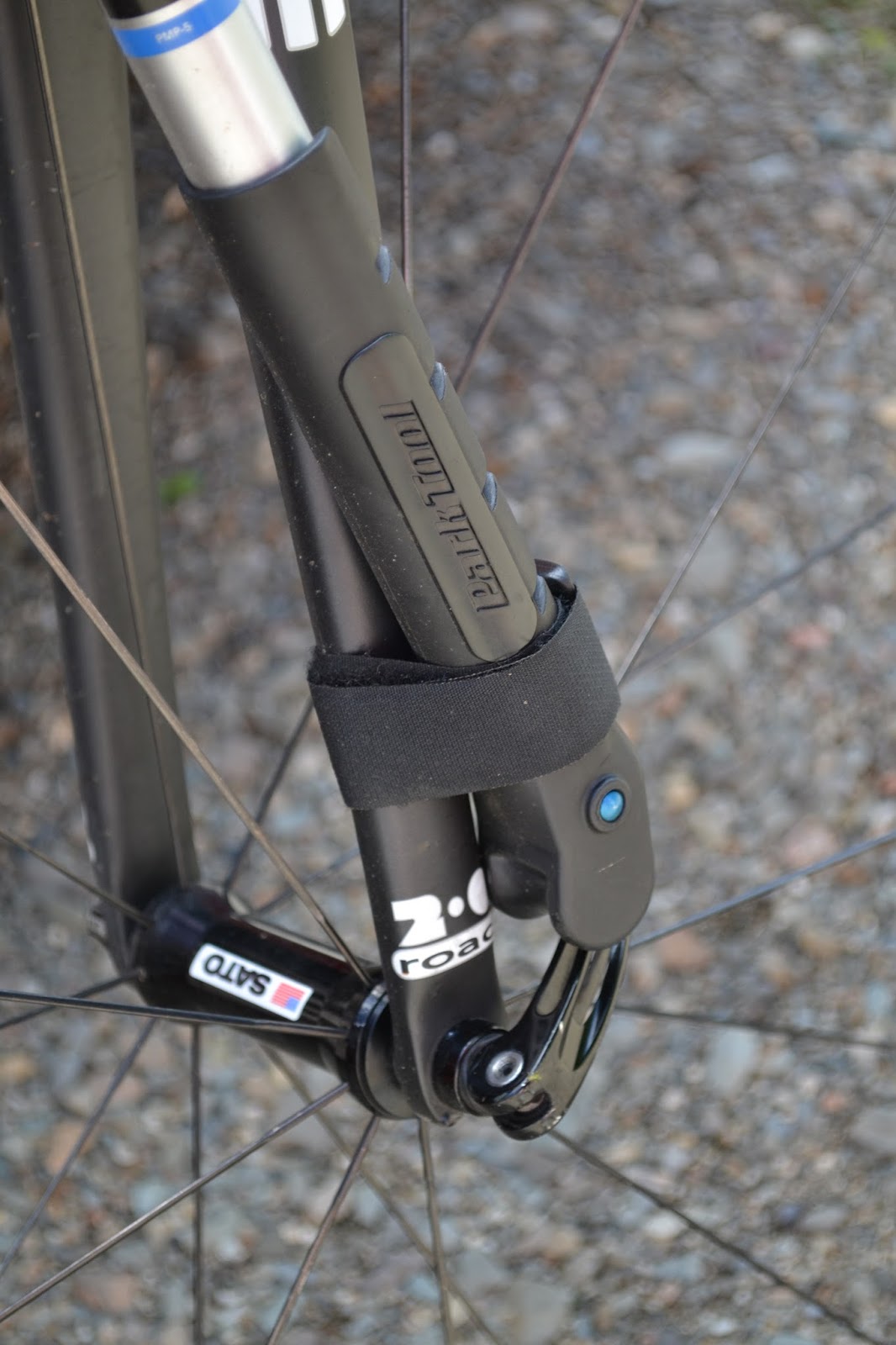
Detail of the skewer end.
Skewer angle is not correct here.
It seems precarious but the pump is on there pretty tight.

Sideways detail of the bar end of things.
Up top I thought of putting something under the tape, a nub of sorts, so that the top of the pump would have a snug spot to sit. I contemplated using part of the Zefal DooDad, the spacer thing, and using the thing in the middle so it sat between the bar and the pump.
Ultimately I decided to just leave it. Maybe on some long training rides I'll think about it again but for now this works fine.


 Posts
Posts