Friday, July 08, 2016

Equipment - Helmets That Saved Me - Specialized Sub 6, Scotch Plains, NJ

When the USCF passed the rule requiring helmets in races must pass Snell or ANSI tests, manufacturers scrambled to get helmets out there that didn't resemble motorcycle helmets. The first year of "the helmet rule" the peloton was wearing a mish mash of various helmets. One was the Monarch, one of the lighter approved helmets (who actually altered their design after testing and therefore production models didn't pass the test). Many of the other helmets out there were pretty heavy, and Giro was, I think, a year away.

I had a Monarch (and very few pictures of me using it). I never crashed it and when I learned it didn't pass the tests I only used it long enough to get another helmet. Then I tossed it. So no Monarch memorabilia here.


My (illegal) Monarch and me, Limerock, same direction as the cars.

We're on the little hill which is currently a downhill for the Limerock races. No chicane yet (that's where the backside wheelpit sits now). At the bell I was in a three man break with about 10 or 15 seconds on the field. I finished the race on the deck on the hill just as we got caught by the Richard Sachs team led field. I shifted hard into the small ring and managed to shift the chain right into the bottom bracket. I fell over but the ground was pretty low compared to the track - I couldn't reach the ground with my shoe and ended up rolling over onto my back.

Although initially mad at myself and covered in sand and dead grass I finally picked myself up and got back on the bike. I rolled down the course, mentally kicking myself for falling over. As I cleared the top of the hill and could see under the bridge I realized there were a lot of riders all over the place. I rolled forward and took in a breath taking sight - about 50, maybe 70 riders were scattered on the track and on the grass.

Apparently on the downhill (currently the "uphill") one of the first riders rode into the grass on the right trying to move up, tried to get back in, and fell over into the field. The field was going about 50 mph (the point man happened to be someone I rode with regularly) as the front riders sprinted down the hill to lead out the sprint. When the grass rider toppled over into the field at about 5th or 7th wheel, he took down a bunch of riders right there with the rest scattering mostly left to avoid the crash. I rolled across the line covered in dirt so everyone thought I crashed there also but I'd actually fallen over at zero miles an hour. I remember a Cat 1 put an ad in Velonews for the next year or so, selling all his bike stuff. Rumor had it he fell in that crash and was disgusted with how no one knew how to ride and he was selling all his stuff.

Anywho...

When Giro helmets came onto the scene it was huge. Suddenly there was this lightweight helmet that was reasonably ventilated, as much as anyone might expect, and it passed the tests. The trick was to use a harder foam (I think) as well as a mesh cover to hold all the bits together when the helmet hit the deck. This "foam with a cover" helmet design spawned a number of competing helmets. I had one of the cheap ones, an Avenir helmet. It was similar in construction, foam with a mesh cover. My helmet I'm pretty sure only passed the easier ANSI standard; I'm almost positive it failed the more stringent Snell test. However, at the time, I had just the Monarch. I negotiated with my mom - if she bought me the Avenir ($34.99?) I'd wear it every time I rode.

She bought it.

That helmet perished protecting me as well. I'm pretty sure it ended up chunks of styrofoam held together with a mesh bag (the cover). That, too, went into the trash can. Therefore no Avenir helmet memorabilia.

Avenir helmet in action, 1988, in Middletown, CT.
Rider in orange has a Giro helmet. I think they cost twice as much as the Avenir.

Another competing helmet was the Sub-6 helmet from Specialized. The goal was to have a sub-six ounce helmet that had good ventilation. This came out a bit after the Giro, Avenir, and such. I bought into it as we were a Specialized dealer and I was looking for an alternative to the ubiquitous Giro (mainly due to cost but also I just didn't want a Giro).

The Sub-6 helmet was pretty straightforward. One big innovation is that it had a plastic "frame", sort of a roll cage inside the foam. It helped hold the foam together in case of a crash. The super duper version had no shell on it; I can't remember if it eventually had to have a shell on it, I think it did, but I think initially it had no shell on it. I skipped that version but bought the one with the shell. Red, of course, to match the kit. Now that I think of it maybe it had no shell later? I don't know, 
Sub 6 in action, A race, Bethel Training Series.
I'm behind one of the Whalen brothers; John B is in the blue. I think the purple is a guy named Tom.

One of the problems with the Sub 6 is that they lightened up the helmet by making it really, really shallow. Less material meant less weight. It sat really high on your head, exposing a lot of the head up and around the ears.

However, if Motorola used it (with Phil Anderson, Steve Bauer, Andy Bishop, and a slew of other inspirational English speaking racers) then it was good enough for me.

My bike with my mechanic, if you will, Victor.
He had just gone over the bike for me and was very proud of his work.
Normally I did all my own work but he'd just resurrected one of my wheels so I let him check everything else over.

Specialized Sub-6, Scotch Plains, NJ

Scotch Plains Crit, P123

This was a P123 race that I didn't mean to enter. I'd intended to race the Cat 3 race but due to some logistical problem, probably traffic, I didn't make it to the race on time. Since I made the long drive going through NYC and committed to paying all the various tolls to and from the race, I decided to get some motorpacing in by doing the P123 race. I decided this with absolutely zero expectations of even finishing the race, forget about trying to do well.

Scotch Plains was an 8 corner, 1 mile course. The pavement melted a bit in the hot sun and the tar the Public Works Department dribbled into all the cracks softened up nicely. Sometimes you'd dive into a turn and your front or rear wheel would slide out a few inches. The melting tar felt like riding over thick oil, which, when I think of it, is exactly what was happening. It really unnerved me and I figured out the lines through the sunny corners where I'd miss the tar stripes. I think everyone did that because after the first few laps, where everyone explored different lines, we were single-double file for much of the race.

I assumed that I'd be shelled partway through the race, but as the race went on I realized that although I was hovering on the edge of explosion I wasn't getting pushed over the cusp. I told myself to do just another lap, another lap, another 5 laps, get to the prime, so on and so forth.

Racers crashed regularly. I counted at least 3 or 4 crashes in one turn alone, a left hander, three turns from the finish. It came up after one of the longer straights, transitioned from a wider road to a narrower one, and somehow guys would hit the deck there. It was such that the ambulance at the course moved to the corner and their crew stood there, waiting for the next batch of riders to come tumbling toward them.

It was about 10 laps to go, about 30 or 40 miles into the race, when I realized that, hey, I may have a chance at doing something here.

I started moving up every chance I could, usually just before or just after turns. With 8 turns a lap I had a lot of time to push a bit deeper into a turn, taking maybe 1 or 2 or 3 or 4 spots in a turn. On two straights in particular I could pedal a bit more and I'd pass another few riders.

At the bell I darted around the comet head of the field and planted myself squarely in about 8th or 10th spot as we dove into the right hand Turn One. I knew I had a couple minutes of racing left, just one mile, and I'd spend a huge portion of it coasting through turns. That meant that I could do a big surge, recover, surge again, recover, and so on. This kind of course favored my abilities, punchy efforts with quick recovery.

With the finish just a half dozen pedal strokes from the last turn, the battle would be to that last turn. This meant that going into the second last turn would be critical as the straight between them was very short. This meant going into the third last turn would be critical. The straight between the third last turn and the second last turn wasn't super short but it'd be hard to make up a lot of places. I guessed that at speed I could make up maybe 3 or 4 spots max; behind a fast guy I'd be doing well if I just stayed on the wheel. I figured the sprint would open up 100% after the third last turn.

To compound things the first five turns of the course came in rapid succession so we were lined out single or double file. It was next to impossible to move up significantly flying along at speed. We flew through that first turn, a right, then the next three turns, all lefts. Then a right at Turn Five, the opposite side of the intersection from Turn One. Then a bit of a straight to Turn Six.

Turn Six was the third last turn. The critical one in my eyes.

I approached the Turn Six sitting about 4th wheel. That in itself was a huge accomplishment. In front of me was J-ME Carney (or maybe it was his brother Jonas?). I don't remember, it was one of the two Carney brothers. More importantly, it was a pro, he was a phenomenal crit racer, and he'd be (or was already) national champion in various disciplines including the criterium.

I was on a pro's wheel, a good pro's wheel, in a P123 race, and we were approaching 3 turns to go.

I figured he'd go after the third last turn, I'd be on him like glue, and I'd get a top three.

In a P123 race!

We dove into that third last turn, hustling, with the two riders in front of the Carney brother going pretty hard. I was leaned over to the max when I realized that someone was approaching me from my left, sort of from above since I was leaned over really hard.

Some nut had sprinted up the inside to get into optimum position going into the sprint. The only problem is he couldn't make the turn. He made it up to me and promptly laid his bike down.

He slid right through my wheels.

I don't remember exactly how I flipped and stuff but I remember seeing pavement very close to my right eye for a brief moment and then a fantastic "CRACK!" as my helmet slammed into the pavement.

After that it was tumbling and such.

I ended up curled up, my hands on my head, rolling around. I looked up and saw this shadow of an enormous guy (he was one of those EMTs from that ambulance at the corner).

"Stay still!", he commanded.

I rolled around a bit more. "I'm okay, I'm okay!" I replied.

"You're not okay, you're holding your head."

I stopped and thought about that. Damn. I think he's right. I wouldn't be holding my head like this if it didn't hurt like a mofo, and it hurt pretty bad. I stopped moving around.

He took my shoes off, my socks, my gloves. He made me wince by doing something to my feet and hands. He asked me questions while he did all this. I remember having to help him with my shoes as I had all sorts of nutty stuff on it - toe straps, velcro straps.

I said that I'm okay because I'm not paralyzed so I went to get up.

"We're putting you in an ambulance."
"But I'm okay!"
"You're not okay. You took a big hit on your head. You need to get checked out."
"But I have to tell my friend who drove me here."
"Don't worry about him, he'll figure it out."

The guy, and I'm sure a helper or something, got me onto a stretcher. This was my first ambulance ride. I remember how I thought, boy, I'm glad I'm not really hurt because I feel like I'm being bounced around on the stretcher as they moved me to the ambulance. I remember that they didn't fold the legs, I think they lifted me into the ambulance because once inside I was well above the floor. My head faced the front of the ambulance, my feet the back. I couldn't move my head much (was it strapped down?) so I had to roll my eyeballs to look around.

Then we started off, siren in the background. I tried to look up to look forward. I couldn't see out the front of the ambulance so I just looked up at the ceiling.

We slowed for an intersection. Remember, my head was pointing forward toward the front of the ambulance. The blood rushed to my head.

The absolutely most excruciating pain pierced my head. I couldn't believe how painful it was, just horrible, nauseating. I felt like someone put a gigantic hardened steel spike into my head and then smashed it with a sledge hammer.

We accelerated. My head was okay.

We slowed. Arrrrhhhhhhhhhh!

Repeat about five or six times.

I got smart.
"Can we raise my head? It's killing me when we slow down."
"We're almost there."
"But... Arrrrrrrhhhhhhhhh!"

And then we were there.

Specializd Sub-6, Scotch Plains, NJ

I don't remember very much at the hospital except I was absolutely exhausted and it was air conditioned.

Specialized Sub-6, Scotch Plains, NJ
My thumb is over a sunken part of the foam.

At some point the curtain drew back and it was Mike D, the guy that I carpooled with to the race. It was one of the few times I got a ride to the race - Mike drove in his uber-cool Sirocco (MK2 for those VW nuts) - so I didn't have to weather the drive back.

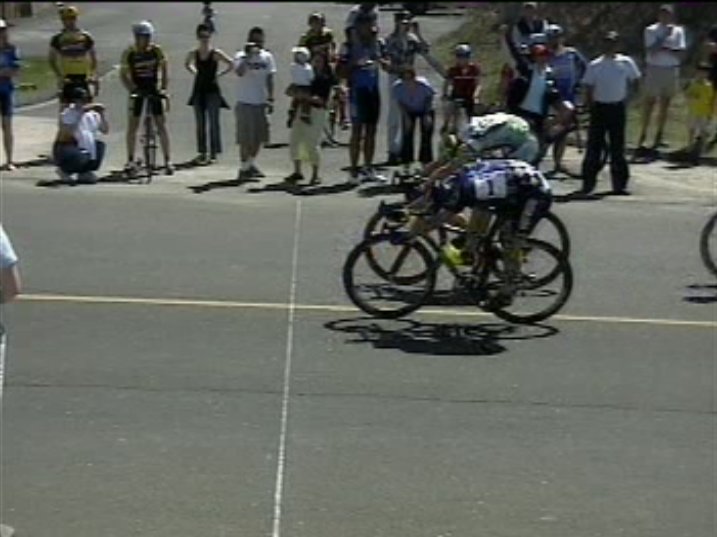
I did subject Mike to a scare though - after the race he went looking for me as I seemed to have disappeared. He went to the start/finish area and saw my bike, shoes, gloves, and helmet on the announcer's platform.

He pointed at my stuff.
"Where. Is. The. Owner. Of. That. Bike?!" he hollered out.
"Hospital."

The next day I ran my hand through my hair, as I do when I'm stressed and stuff, and someone nearby screeched in surprise. Apparently the whole side of my head, under my hair, was purple, one massive bruise. I'd whacked my head pretty hard.

I had a little bit of nausea so I definitely had a minor concussion. I don't remember much about the recovery. Back then there was no Facebook, no blog, and I haven't dug through my training diaries where I probably made notes like "leg hurts" or "didn't feel sick today". Maybe one day I will. For now though the Sub-6 sits in a stack of helmets that saved me.
Thursday, July 07, 2016

Racing - CCAP Tuesday Night Crit - July 5, 2016, Shelled Hard, Tried to Lead Out a 24" Wheel Junior

Ah, the Tuesday Night Worlds. For me it's been a tough couple weeks so I didn't ride much. I did get a half hour in on Monday to loosen the legs, but before that I think I last rode Thursday.

In the meantime my Facebook feed has been full of reports of a number of the local Juniors that do the B Race placing at Nationals.

To top it off the ideal summer weather - 50s at night, 70s during the day - came to a crashing halt today. It was over 90 degrees and sort of humid after a morning shower.

Finally, I got my A1C follow up blood test done and it told me I need to be a bit more diligent about cutting carbs.

Basically I hadn't progressed any on the bike, there were a lot of strong riders out there, I felt a bit under fueled due to low carbs, and therefore tonight would be an exercise in damage control.

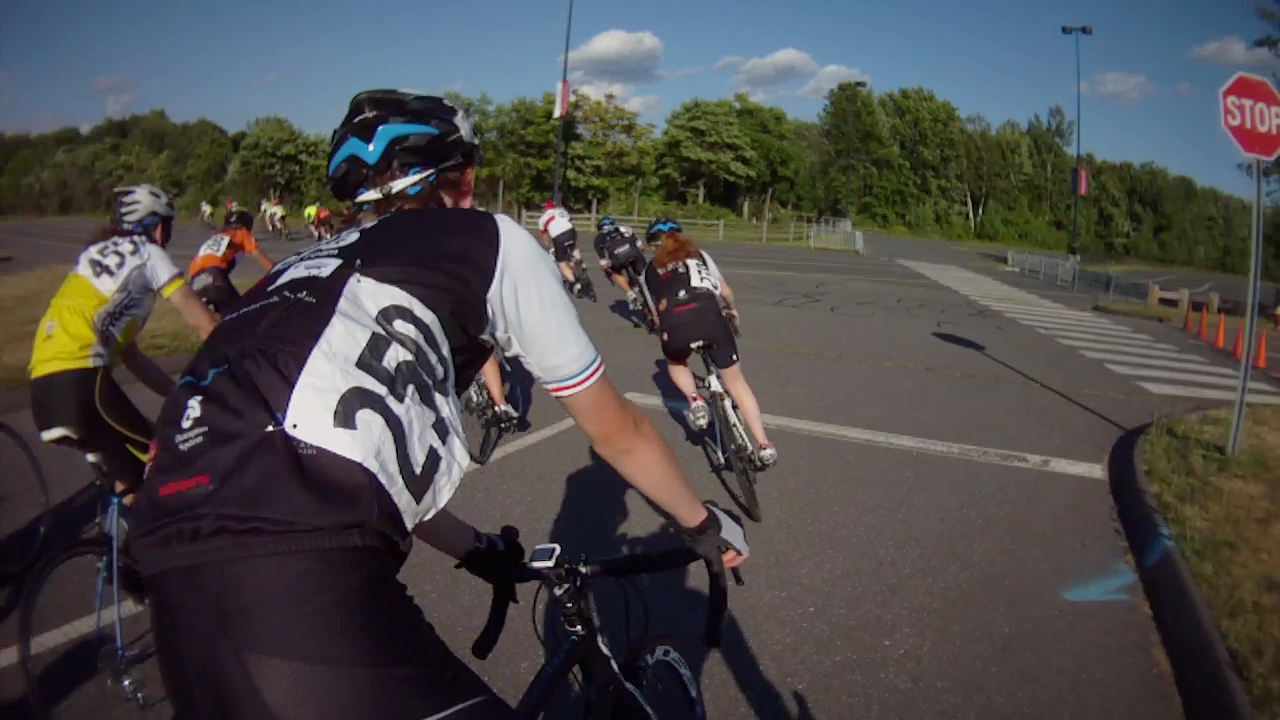
Close up during the neutral laps.

I like to do "best practice" stuff when I ride. So during the two warm up laps I tried to avoid the hoods. I'd ride the tops if I felt it safe enough to not have to brake suddenly. I rode the drops otherwise, because the drops offer the best control, best braking, most secure grip. This is if you can brake from the drops. I know that smaller handed riders may not be able to brake as well from the drops so there are exceptions, but for me the drops are my hand position of choice.

In the third turn, if things looked okay, I tried to ride close to whoever was on my inside. I didn't want to spook them so I'd ride a bit behind, but basically it was practicing cornering in a tight field.

Neutral laps over and we got under way.

A big field.

There was a decent size group taking to the start. However some of the aforementioned strong Juniors started punching away at the pedals and the group started to split apart.

First gap that I closed.

One big gap opened up right away. I debated sitting and sort of keeping an eye out for struggling riders in the field. Then I realized that I was one of the struggling riders. So I made a somewhat impromptu decision to first make the first group, then worry about helping others.

I went to bridge the gap.

Not very hard, just sort of rolled across it.

I couldn't recover well though and when the others started upping the pace a bit, not even really attacking, I couldn't stay hooked on.

Getting shelled hard.

I looked back and realized that the field had really split apart. I didn't have a group to fall back into, there were two or three groups already with a bunch of individual riders scattered around the course. I decided to soft pedal for a while until I felt a bit better, then I'd look around and see what I could do.

A nice benefit to my "solo training ride at about 15 mph" was that I could wave to Junior virtually every lap. It crushes him when he waves or yells and I don't acknowledge him so to be able to see his face light up as he realizes I'm waving to him... it's worth not being in the field.

Junior waving (he's in the little chair)

At some point I jumped in one group but couldn't really do much. I pulled off and pulled myself out of that group.

This 24" Wheel Junior caught my eye.

A slightly more relaxed group rolled by, a Junior on a 24" wheel bike pedaling furiously at the back of the line. I accelerated to see if he needed a hand but he closed the first gap pretty quickly. Entering the next turn a gap opened again.

He closed that gap on his own.
Note the very low position.

And again he closed it.

I don't fault him for cornering poorly. It appeared that even without braking, even with him getting low on the bike, he simply didn't coast as fast. Whether it was the 24" wheels (and their inherently reduced inertia), the different rolling resistance (24" tires have higher rolling resistance), his light weight (less inertia/momentum), I don't know. Whatever, a gap would open at each corner and he'd close it after a brief struggle. This happened in every corner.

Drafting closely and on the correct side (left side at this part of the course).

What impressed me even more is that he seemed to have an instinct for Wind Management. He stayed to the right coming out of Turn Three but then ended up more to the left as we hit the start/finish. During the race I watched a lot of adult riders not get this at all. Here was a kid, if you will, who seemed to get it automatically.

Because of those two factors I left him alone. No helpful pushes, just a little protection from the wind once, but otherwise I let him do his thing. At some point when I rolled by him he seemed to drop off. I figured he'd exhausted himself closing all those gaps.

I initially thought I'd sprint at 2 to go, so I'd "cross the line" at the bell, but then I thought that's a bit selfish. I'd rather contribute to the group. I was at least a lap or two down on some of these riders so I decided to do a somewhat laid back leadout. I could act as the moto, everyone could follow, and there'd be a fun sprint.

I rolled to the front just before the bell. When I checked back I was pleasantly surprised to see the 24" wheeled Junior sitting right behind me.

I put my hands on the hoods and tried to make myself wider. From my own experience I know that drafting a tall person changes the drafting dynamics compared to drafting a shorter person. When I draft a tall person I'm behind their knees - it's not much of a draft. I understood that sitting up really high doesn't help. What I needed to do was to make my torso as un-aero as possible. Hoods were high enough, I spread my elbows, and pedaled a steady  pace.

Looking back to make sure the Junior is on my wheel.
I had to look between my legs as I couldn't see him if I looked over a shoulder.
My HR is 166 bpm - I'm pretty much blown.

Even with this "mellow" leadout I was starting to suffer. I tried not to push too hard and I eased as I came out of Turn One, knowing the Junior would lose a few feet. I looked down just in time to see his wheels veer to the side - he'd pulled out of line.

I looked back because the Junior sat up and moved over.
He's behind the older Junior who is telling me to go, go, go.

I looked back but he seemed to be done. The Junior in front of him told me to go, to jump, to sprint. I think everyone was trying to be helpful to one another no one was actually trying to win.

I looked at the gap to the next rider, the speed that they were going, and decided to do a jump on the backstretch. I'd sit up at Turn Three and see what happened after. The group had disintegrated - I think my pull wasn't really constructive so next time I'll do it a bit slower - and the riders went by one by one.

Junior (our Junior) after I rolled up.

I rolled up to Junior who is an absolute chatterbox right now. He started asking me about this and that, started talking about that and this, and generally jabbered for a minute or two. The crazy thing is that I understand it all, all the subject changes, all the random idea injections.

He's telling me about everything - he's in the Narrative Phase.

Squeezing the brake lever, sort of. It's not just adults that do it instinctively.

He wanted to help me walk the bike back to the car, or, rather, I'd help him walk the bike back to the car. He pointed out all sorts of things as I packed the bike away, didn't run into the street, and basically was a good kid.

On the way to the car I'd spotted the 24" wheeled Junior. He was there with his dad at the very least and I wanted to let the Junior know something important. My Junior and I walked over to the car.

I asked the adult racer (he was in the B race also) if the Junior was his son. He nodded affirmatively. I addressed the Junior, because I wanted to make see if he'd blown up or if he pulled off because he didn't want to get in the way.

"I tried to lead you out on the last lap. I was really surprised that you were on my wheel but you were riding really strongly before. I wanted to ask you - when you pulled off on the last lap were you done? Or did you pull off because you didn't want to get in the way?"

The Junior was nodding before I finished.

"You were done?"

Nod.

"Okay. Because I wanted to make sure you understand that if you're on a wheel you earned your spot. You have every right to be on the wheel. You don't need to give it to anyone. It's your wheel. You understand?"

Nod.

"Okay. Well if I'm at the front at the bell it means I'm not sprinting. It means that if you want a leadout you should get on my wheel. Right?"

Grin. Nod.

The dad and I talked briefly and then (my) Junior and I left to get my Pops.

(As a side note - I said something that wasn't quite accurate to the dad. When I started racing I was a featherweight. Even so I couldn't climb, I couldn't time trial, and I could sprint. My cycling physiology tendencies were already very clear. However I said that "even so" I could hit 42 mph from a standing start in one gear. I realized after the fact that I didn't even know I could sprint until I'd been racing maybe three years. By then I was closer to 100 lbs rather than 90 lbs. At 103 lbs, 17 years old, I could do a standing start, one gear (53x12), and hit 42 mph consistently. It was a Steve Bauer training thing so I did it because Steve Bauer. But when I started at 15, at probably 90 lbs, I didn't have much data in terms of top speeds in sprints and such. I hit 30 mph sprinting up a short hill a few driveways down from the house - I knew that because my mom was just behind me and noting my speed. But other than that I didn't have a lot of data for the first few years I raced. I wanted to clarify that.)

*edit update: the 24" Wheel Junior got the bronze at Nationals just a short time ago. Apparently he is quite strong, I had no idea.

Wednesday, July 06, 2016

Racing - Throwing Your Bike (Pictures)

I wrote a post a while back about throwing your bike, meaning doing a bike throw at the finish of a sprint. I know that I'm somewhat obsessive about bike throws, even doing bike throws when I'm well clear of the field.

However, my livelihood doesn't depend on it. I still do them, just because I want to do the best I can with what I have. I do bike throws because I don't want to leave something to chance.


It's a very minor one, I thought I was clear so I threw the bike out of habit.
I'm not way over the back wheel.

This is a pretty poor bike throw, I've gained maybe 6-12 inches forward travel on the bike. My head would normally be over the bars, or even in front of them in an all out sprint, not behind them. If I had to really reach I could have gotten another 6 inches of reach I think.

The picture below shows just how safe I was playing that finish.

That's me up ahead, the speck below the red and white tent awnings.
Like I said, I threw the bike just to be safe.

And today, July 5th, 2016, in the Tour, I think that Direct Energie's Coquard had the sprint in the bag. He simply could not finish it off with a good bike throw.

Bryan Coquard's finish in Stage 4 of the 2016 Tour de France.
Picture from BH Bikes USA, Facebook.

The significant thing here is that Coquard is sitting on his saddle.

This means he did not do a bike throw at the finish.

Remember that you're classified as finishing when your bike breaks the plane of the finish line. I think if the bike is crashing then it's not necessarily the front tire, but in a normal sprint you're looking to put the front tire to the line before anyone else. That's key because it means that you're not as concerned about your head, your torso, etc. It's the front tire of the bike.

The way a bike throw works is the rider moves momentum/inertia from one part of the bike/rider unit to another. Since the rider, even a skinny Tour racer, is heavier than their bike, a racer can shove themselves backward on the bike to move the bike forward. If you shove the bike forward relative to your body you will momentarily slow your body. In return your bike will accelerate.

Say you weigh 160 lbs. Your bike weighs 16 lbs. If you move your body back one inch, your bike will move forward 10 inches. This means that if you move your bike forward, relative to your body, just an inch or two, you'll gain half a wheel in the sprint.

Okay, that's not totally accurate. There's wind resistance, there's friction, and there's the fact that part of your body is moving with the bike (your hands, feet, some of your arms, most of your legs). Plus there's the whole "how long are your arms" question - if you can't reach further forward then your bike isn't going forward any more.

The reality is that if you move your hips back about 8-10 inches you'll realistically get your bike forward maybe 12-18 inches. It's not ten to one ration between yours and your bike's movement, it's more like three to two. Still, though a foot is significant if you're losing the sprint by a an inch.

The wrong way to do a bike throw is to simply straighten your arms. You don't move your body relative to the bike so the bike doesn't leap forward. This is what Coquard did at the end of Stage 4.

The right way to do a bike throw is to extend your arms as you drop your pelvis behind your saddle. By pushing your pelvis behind your saddle you're moving the most mass possible as far back as possible.

This thrusts the bike forward.

This is the bike throw that basically started the blog.

Once I realized I could sprint on the bike I started looking at how to optimize my sprint. I learned about bike throws, figured out the physics thing (thanks to school), and from then on I was doing bike throws all the time. Easy ride? Throw my bike to whatever shadow was in front of me. Waiting in the parking lot for a group ride? Bike throws to empty parking spot lines. Group ride? Bike throw at town line sprint.

Races?

Bike throws for sure.

Over the course of 30-odd seasons I don't think it'd be unrealistic to say that I've done maybe 10,000 bike throws. If I did 300 a year that would be about 10,000. I probably had single days where I did 50 or 75 or even 100 bike throws. I even had bike throw mishaps, like when I went out on a ride on my Aerolite equipped bike with slippers on instead of cycling shoes.

For a long time I never thought I'd really use a bike throw because I seemed to get shelled all the time. Eventually though I started sprinting, started placing, and started doing bike throws for real.

I did get an interesting place in the Tour of Michigan due to a bike throw. We were sprinting curb to curb, about 10 riders across. I was stuck in the second row. The first row was somehow, magically, sprinting at basically the exact same speed, within a foot or two of one another.

The second row was soft pedaling, waiting for someone to blow, waiting for that gap to open to allow them to surge past that blowing up front row and win the race.

The gap never happened.

At the line I thrust my bike forward as far as I could. My front wheel ended up at or past some of the front row riders' pedals and cranks. I thought I might lose my wheel to those spokes.

There were 10 riders in the first row of sprinters. I got 11th in the race.

Fast forward about 11-13 years. I was one point behind Morgan in the overall in the Bethel Spring Series. I had to beat him in the sprint, and get top 7, to win the Series overall. As a sprinter I was definitely one step behind Morgan. He could beat me straight up; I was close only because he skipped a race, I think because it was raining and he'd used himself up in the Masters race.

Coming into the sprint I followed Bethel Cycle's four man leadout train. They had two sprinters, Stephen G and Bryan H. Both of them would win the Series overall in other years - they are both very good riders. I sat on their wheels, waiting for the right moment to pounce.

I jumped very late, trusting in my jump to give me the best chance against Morgan. We sprinted at similar speeds (he a bit faster) but in the jump I possibly had an edge.

I sprinted towards the finish. I'd jumped hard I thought I had it made. I was debating if I should raise my hands or not. Then, just before the line, to my right, I sensed something.

I looked.

To my horror it was Morgan. He'd gotten boxed in going into the sprint (when one or both of the Bethel sprinters blew up), had to back out of that spot, and was now closing with a fury. He was sprinting noticeably faster than me. I had to get to the line before he passed me for good.

I did a couple more pedal strokes and desperately threw my bike at the line. I threw the bike so hard I lost my grip on one side of the bar, causing me to veer crazily toward the left curb.

But, in all that, I'd done a good bike throw. I'd won the race, and with it, the Series.

You can see here that I'm only slightly ahead of Morgan.

I'm rapidly slowing in the sprint at this point. It's hard to see in the pictures but in the video you can see that I'm not going as fast as Morgan.

However I'm already getting into the bike throw at this point.

As my body extends back my bike moves forward.
I'm trading my body's position to gain bike movement.

At this point I'm going to win the race. I'm deep into my bike throw, I'm still not fully extended, but my front wheel is already ahead of Morgan's wheel.

I'm still extending, trying to get my hips down.

At this point I'm still getting further back on the bike. My head is coming down really hard, hard enough to hit my helmet to my stem. I can feel the saddle in my stomach and I'm hoping that I don't fall back into my own rear wheel.

The finish.

I'm fully extended and on the edge of losing control. The saddle is firmly in my stomach and I have marginal control over the bike.

However, if you look at Morgan, you can see he's really only raised himself up out of the saddle. If he'd thrown the bike forward it would have been a closer race. I always compare head position relative to the line - my head is forward of Morgan's so I think I'd still have won. However it would have been much, much closer.

His hips are basically in the same place as mine, and if he had a similar torso length as me, I think his head would have been about even with mine. It would have been even a closer race.

Bike throws are quick. In pictures they look nice and neat, but in reality it's a little spurt and that's that.

The bike throw for the 2005 Bethel Spring Series (go to just before 6 minutes into the clip for real time, 7 minutes in for slow motion):


Coquard, in the sprint for Stage 4 today in the Tour, didn't move his bike forward relative to his body. If he had done so he realistically would have taken the stage.

The last kilometer, courtesy the Tour (no commentary):


 I did notice that virtually no one threw their bikes at the line, even Kittel. It might have been that the uphill drag was particularly tough. However that's even more the reason to throw the bike, because if only one rider throws his bike...

For all us normal racers the bike throw is an easy skill to practice, you can do it all ride long on easy rides, you can do it warming up for races or group rides, you can even do bike throws when you're testing riding your bike (or someone else's bike). It's a skill that you should master and use. You never know when it'll come in handy.

Tuesday, July 05, 2016

Equipment - Helmets That Saved Me - Bell Biker, Gallows Hill Road

Long story ahead...

Bell Biker, Gallows Hill Road, Redding, CT

Note: Gallows Hill Road in Redding, CT is immortalized (at least in my eyes) in the story about the Revolution "My Brother Sam Is Dead". If you're from the Connecticut area there are mentions of Hartford, Ridgefield, Croton-on-Hudson (NY), a few other places. The bit that gets me is that they walked ("marched") long distances, like Redding to Hartford. Anyway, on to the cycling bit.

When I Got The Helmet

I bought (or rather my parents bought) this helmet for my trip across Pennsylvania when I was 14 going on 15, back in 1982. When I got into cycling I was all about touring - that's the kind of cycling covered by Bicycling magazine. I wanted to ride with panniers, a triple crankset, wide range gearing, long wheelbase bike, yada yada yada.

My mom, ever supportive of my endeavors, found that the local Westport Y offered bike summer camps and requested a catalog. I pored over said catalog like it was a build kit for a bike... okay, maybe not that long, but I pored over it for hours and hours and hours. There were all sorts of choices, from a massive trip from Canada somewhere to somewhere in the US (Montreal to CT? I think it was 600 miles), others that were pretty short.

Because I was a bit tentative I selected a two week long trip that started somewhere way out in western PA and ended in Philadelphia. I think it was supposed to be 200 miles or something. Not very far but enough - the idea was to spend some of the days doing stuff, not just riding from one place to another. It was supposed to be a tour, not a trip.

The drop off was a nervous affair. I wasn't really sure of myself and I had no idea what to expect from the others. I quickly learned that most of the group were kids that weren't really active and their parents thought that dropping them off for a bike camp would get them in shape ("lose weight"). I can tell you that there were some miserable kids on that tour.

In contrast I'd been training in preparation for their quoted max 50 mile day. I wasn't sure if I could do a week of 50 mile days in a row but I certainly could do a few, and I did 72 miles one day in a bikeathon. I felt prepared.

Therefore when we plodded along waiting for the kids that literally didn't ride their bikes before camp I got pretty bored. As a distraction I tried going up one of the hills as fast as I could. The lead ride leader (we had three adult chaperone types) sprinted ahead of me. I tried going hard up another hill and he sprinted again.

I thought he was just having fun. I didn't realize it at the time but the Y policy was that one ride leader had to lead. Another had to sweep. The third one was the only one that could check up on the riders in the middle. We had one male ride leader, a very outdoorsy type, very fit. He was like a little Paul Bunyan. We had two female ride leaders that seemed to be more like daycare teachers, although one was admittedly an experienced touring cyclist. This meant she knew a lot about packing panniers and tents and cooking and where to camp but didn't really feel like sprinting over hills like it was a Strava KOM. The three ride leaders quickly agreed that the male would generally lead the group, especially when I started hammering up the hills.

Keep in mind that when I was 14 I was a scrawny kid. At 17 I weighed 103 lbs (my physical before going to college), so at 14 I was probably in the 90 lbs range. We carried our gear on the bike, for me it was mainly clothes, sleeping bag, sleeping pad, some tent stuff, a flashlight (for a headlight - can you believe that?), and some food. The leaders carried the tents, stoves, heavy food like canned food, and first aid kit stuff in addition to their personal gear.

The male ride leader happened to have a Schwinn Continental. I'd done some research on bikes before getting my Dawes Lightning, and I knew that the Continental was an absolute beast of a bike - 55 lbs or so, and that was without any gear on it! He had to have been easily pushing 100 lbs of bike and gear. My bike was something like 24 lbs and I was probably loaded down to maybe 45-50 lbs.

So basically the ride leader was sprinting against me while effectively pulling a trailer with a small kid in it. If you've ever pulled a small trailer with a kid in it you'll understand - it doesn't seem like much, 40 or 50 lbs, but man oh man when you start going up a hill it's like the bike dropped an anchor.

Into the asphalt.

I don't know if the poor guy was into racing at all but let me tell you, after that week, he had to have been pretty strong. We were sprinting up every hill - it was like a game for me. He made the mistake of telling me that a ride leader had to stay in front of all the camp riders. To be fair he told me this in the context of, "If one of the women are leading don't sprint. You can sprint up hills when I'm leading."

I interpreted this as, "If he was leading we were sprinting."

I'd look at him as we started up a hill, start going faster, he'd go faster, and then we'd end up going as fast as we could up whatever hill. I inevitably blew up and then we'd crawl to the top, gasping.

Then we'd do it again.

Eventually I did beat him. I remember the feeling of triumph when he finally blew up first, then used whatever lung capacity left to yell at me to not get too far ahead. For me that was a huge victory.

Toward the end I was "outclassing" him regularly. I was drafting him on the flats and then popping out for the hills. It wasn't fair, him being handicapped about 50 lbs, pulling all the time, all that stuff. I felt some sympathy so I toned down the attacks.

My favorite day was when they leaders polled us the night before about the next day's itinerary.

"Okay, we can do a really long ride tomorrow, 50 miles, and then we can spend the next day at Hershey Park. Or we can do about 30 miles tomorrow, another 20 the day after that, and we'd have a few hours at Hershey Park."

We collectively voted for the 50 mile day. We were out and on the bikes pretty quickly (it was like herding cats getting a bunch of 14 year olds onto their bikes). We ran out of daylight at about 9 PM.

Yeah, 9 PM.

I think we were out there for 10 or 12 hours. I took a wrong turn somewhere, we were in the middle of Amish land, dark farm country with no street lights, and it was getting dark.

The experienced touring ride leader had stayed in the area at some point before and knew an Amish family around the area. She called, we got permission to stay, and we rode through the dark to some farmhouse. It was huge, to be honest, about 15 kids camped out on the first floor with room to spare.

Thing was that during the day we'd go kind of hard for a while, stop, go hard again, so on and so forth. I felt super strong even at the end of ride, at night, I was just jonesing to go out and keep riding.

After a great "farm to table" breakfast (I couldn't bring myself to drink the warm milk but the eggs and ham were great!) we rode what seemed to be a mile or two and then we were at Hershey Park.

Eventually we got to Philadelphia, where a van was waiting to drive us all home. While we were there we ran up the Rocky steps. The statue was up there (I had to Google because I was wondering if it was my imagination). When I ran up the stairs later, during one of the Philly Corestates Race, it wasn't there. I was crushed that it was gone and then wondered if it'd really been there all those years before.

When I got back home I gave the panniers back to the Y, took off the rack, put the skinny tires back on, and my 14-21  "racing freewheel". I rolled down the driveway, turned right, and did a wheelie when I punched the pedals. I sprinted down the road and blew up a few hundred yards later.

It was great.

To me that was riding, to go really fast, to sprint, to go 100%.

The bike racing bug had bitten me hard.

Over the winter I saved up, negotiated a combined birthday-Christmas-months-of-chores present (where I contributed some money also) and ordered a sight unseen Basso for $550 ($50 was an upcharge for the tubulars - the shop laced over tubulars and glued on some tires for that $50). It checked off all the checkboxes:

 - Columbus tubing
 - Campy derailleurs and shifter
 - Campy hubs
 - 53x42 chainrings
 - 15-21 freewheel for Junior gearing
 - tubular GP-4 rims
 - Modolo brakes

What I didn't realize is that it wasn't all that.
 - The Columbus tubing was Zeta, which is basically their worst tubeset. It was a tank of a frame.
 - Campy Nuovo Record front and rear derailleurs and downtube shifters. Fine.
 - Campy hubs. They were Tipo hubs. Fortunately back then Campy only had one grade of bearings - excellent - and their hubs were all virtually the same quality. The Tipo hubs were great. But they weren't Nuovo Record.
 - 53x42 chainrings. They were on an Excel Rino crankset. I only knew about Excel Rino because Lon Haldeman rode Excel Rino stuff when he won RAAM. I figured it must be good if he used it. It was cast aluminum, the absolute cheapest crankset you could possibly make. But I had no idea and the chainrings were black and drilled out so I loved the crankset. The bottom bracket was the cheapest piece of junk you'd ever seen. The axle had studs on it, you used nuts to tighten the crank down. Horrible.
 - 15-21 freewheel. This was a blessing because I didn't understand the gear limit although the sales guy Lou did. Lou was the silver medalist in the state road race the prior year and was a pretty good rider.
 - The GP-4 rims were installed in place of the G40 clinchers. At the time there weren't any good clinchers so the GP-4s were a natural. I didn't realize that they'd just glue the cheapest tires on the rims. They both flatted a day apart at the end of my first season. When I went to remove them they popped right off - there was barely any glue on the rim. Yikes.
 - Modolo brakes. Not the pro ones. Not even the mid-level Speedys. I can't remember what they were. Cast. Flimsy, But they were Modolos.

I upgraded stuff over the years.

 - Campy Super Record front and rear derailleurs. I couldn't install them at the time so I had the shop do it.
 - Bar end shifter on the right. I installed that.
 - Gipiemme crankset and BB. I think I installed that.
 - Eventually got different freewheels, once I was a Senior. As a Junior the 15-21 was all I needed.
 - Ambrosio Crono rimmed wheels. I can't remember the hubs but those were some nice rims.
 - Clement FuturCx/Futurox kevlar belted tires. I used them for a long time, until I could afford Vittoria CX/CGs (front/rear).
 - Modolo Pro brakes. In red no less.

The Crash

I started riding regularly with a group that met at Oscar's Deli on Main Street in Westport, CT. We'd do about 35 to maybe 50 miles, depending on the time of year. At first I was well out of my league. I have no idea how I got home each time, some of the older riders must have been very careful to keep me on route. Part of the tough part was that it was a 10 mile ride to get to the ride, and a 10 mile ride to get home. I was adding 20 miles to the ride just getting to and from the meet point.

As I got stronger I got cockier. Eventually I was trying to match the better riders, one Cat 2 Senior (Morley B, who I worshipped like he was a demi-god) and one super classy Cat 2 Junior,  Bill W. There were a couple Cat 3s and the rest of them were Cat 4s. Back then everyone started as a Cat 4 so they were all normal riders. The Cat 3s seemed human but "really, really good". The Cat 2s were demi-gods and properly so; it's where I thought that there's no way I could be a 2 but if I could I would.

(Interestingly enough one of the guys from that era joined my current team Expo Wheelmen, completely unbeknownst to me. A couple years ago I was sitting at one of the meetings, saw him, and thought, wait, I think he was part of the Oscars crew 30 years ago. Then he came over, "Hey, Aki, I can't believe it's you!". And if that's not weird enough when I was doing the shop rides nearby, in 2009-2010, one of the riders doing the ride was also from the Oscar's ride. As we're about 2 hours away from the Oscar's ride location it's amazing that these two guys ended up in the same area as me. Anyway, that's yet another tangent...)

One day Bill W attacked on some random, generic backroad in the Redding/Easton/Bethel/Newtown area. As I was in the "I'm getting good at this" mode I followed, sprinting hard, trying to keep him in sight. The other riders let us go.

We were going fast and I thought, okay, I'm going to catch him, I'll out-corner him because I know how to stick a knee out in a corner.

The road turned hard left, Bill slowed aggressively and leaned really hard into it. I followed at a much higher speed because I was going to catch him and obviously I could go faster than him.

It was a really long left curve, virtually a 180, and very sharp.

By the time I exited it I was on the right curb and panicking. I managed to stay upright but to my horror there was a hard right curve immediately following that left. Switchbacks like these - two in a row - basically don't exist in Connecticut so I was caught with my pants down.

I got the bike heeled over to the right but I had started on the right curb, almost in the bushes. In other words I'd done about the earliest apex possible, the worst thing possible. I found myself skimming the leaves on the left side of the road, the wrong side, the oncoming traffic side.

I started thinking about survival now - catching Bill wasn't the goal anymore, my goal was to not become a hood ornament or to hit too big of a tree.

I tried to slow but the steep hill, my sprint start at the top, and the curves kept me from scrubbing off any reasonable amount of speed.

I exited that second curve on the left shoulder and wouldn't you know it, there was a left curve in front of me.

Three hard turns in a row?! On a descent? In Connecticut?!

Crap.

I dropped the bike to the left, hoping that I could make this turn, praying that it wasn't a long turn.

I was leaned pretty far over to the left, hoping I'd stay out of the trees, when I hit a severe gradient change - the road basically dropped out from under me (later I realized that even in a car the front tires would momentarily let go of the road - the gradient change was that sudden). My front wheel went light, the front end washed out, and I hit the deck.

I slid down the road, bounced off stuff in the shoulder, and ended up sitting in the middle of the road, my helmet in my hands.

I'd really clocked my head hard, my head hurt, and for a few seconds I sat there trying to gather my thoughts. I almost got hit by the rest of the club carefully descending down the same hill. When I stood up my shoes lost traction - it was that steep. I slipped down the hill uncontrollably and ended up crawling up the hill with my hands on the ground to get back up to my bike.

My bike seemed okay, I wasn't bleeding too badly from anywhere, and we had to get going. I got on the bike.

I gingerly rode back to Oscars, then back home, my head pounding. I felt a little nauseous for a while, like a few days, but eventually it went away. Headaches also, but again, they went away. I don't know what I was like immediately following the crash but I think I was lucky to escape without major problems, based on the nausea and headaches.

I know now I had given myself a concussion, and, in fact, it was probably the worst concussion I've had in my life.

Nonetheless I can't imagine what would have happened had I been wearing my favorite "Kevlar helmet" (my faded yellow Campy cap, which looked sort of like Kevlar colored hence I called it my Kevlar cap). For this reason I saved the Bell Biker helmet as one that saved me.

Bell Biker
Note the right side of the picture (left side of helmet) where the foam is not as thick as the left side of the picture.

I didn't think it looked damaged at all, at least at the time. Now that I look at it, or the pictures of it, I realized that the left side of the helmet looks pretty compressed, like maybe to half the thickness as the right side. It must have been a real solid impact. I didn't notice the compressed foam back then so I still wore the helmet after the tumble. Eventually I convinced my mom to buy another helmet for me.

That was the Brancale Giro.

Friday, July 01, 2016

Equipment - An Old Friend Returns (Brancale Giro helmet)

So an old friend came back into my life the other day. It's a 1983 or so Brancale Giro helmet, the "aero" version of the ubiquitous Brancale helmet out there at the time, the Sport.

I rediscovered the helmet out of the blue, really, because I didn't realize I didn't have it. I mean, okay, I'd looked for it briefly here and there and couldn't find it. I was trying to set up a series of posts on the helmets I used to have. I'd naturally start with my first real racing helmet. Thing was that it was so bizarre and off that I usually kept it separate from the helmets that actually saved me from injury - those are stacked in the bike room, all bashed and cracked. When I couldn't find my first real race helmet I just figured I put it "somewhere else" and figured I'd look again "later". I repeated this a few times while living at the old place and then a few more times after we moved up here about 10 years ago.

Then it appeared in the mail, absolutely and totally unexpectedly.

Wowsers.

So to give you an idea of what I'm talking about, here's some info.

Brancale Giro in stock form, from eBay listings:

Stock front Brancale Giro helmet.

Stock rear Brancale Giro helmet.
I distinctly remember removing the red/green Brancale decals.

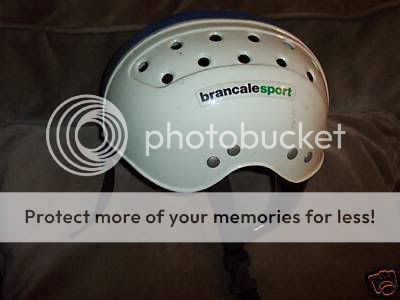
The Brancale Sport helmet, which many riders had, from here:

Many of the Sports I saw had a blue sticker over the top.
I remember these as "the white and blue helmets".
Note that these have twice as many metal rivets. I probably thought that it'd be better to have fewer rivets.

The Brancale Giro is about the thinnest, most fragile helmet you could possibly imagine. From what I can tell it's made with ABS plastic and it has some comfort foam pads, like the ones inside normal helmets to pad the styrofoam.

There is zero crush zone in this helmet. If it was a car it'd have a zero star crash test rating.

Case in point. One of my first bike mentors, I think it was Tom (or Ken, but I think it was Tom), he and I did a training ride where we finished by doing a sprint.

It involved hammering down the main road in our town, a pretty big artery road. We'd normally wind it up just before the high school which had a crit-like two-90 degree bend one-way driveway. We'd fly into the first 90 degree turn off the main road, accelerated down the short, 2 lane, one way 100 meter straight there, blasted into another 90 degree turn, then sprinted along the three lane, one-way, 120 meters to a crosswalk over the driveway. It was a perfect way to practice a two corner crit finish while at the limit and in a somewhat controlled environment.

The problem was that on that day we came around the second corner and had to slam on the brakes. A wall of school buses blocked the way. Apparently there was some after school activity requiring a dozen or so busses and the parked buses forced us to slow to a walking pace.

We threaded through the buses and crossed the road at the end of the driveway, rolled into a parking lot, climbed off our bikes, and sat on a wood fence lining the lot. Tom (or Ken) theatrically hit his helmet on one of the wood fence posts, a light hit, expressing his frustration at this whole miles long effort to get to the "final two turns" only to be thwarted by the unexpected busses.

Crack.

We both jumped, startled.

His helmet tap had cracked the thing straight across.

He looked up, now more glum than mad.

"I guess I need to buy a new helmet."

Or, as the case may have been, just glued it back together, because that would have been okay back then.

1984 Uniroyal Training Series, in Southbury or Middlebury, CT.
I'm wearing the Brancale Giro.
The other guy, Nathaniel Ruhlman (younger brother to Paul Ruhlman) is wearing a Brancale Sport.

When I started racing I had gotten the "aero" Brancale Giro, over the ubiquitous and hockey-helmet looking Sport. Even back then I really enjoyed geeking out over the technical stuff. I dreamed about owning a Miyata-Aero road bike (in 1983!). I wanted ovalized tops on my road bars, available at the time, and only got them a few years ago when I got my FSA Wing Compact bars. I wanted aero wheels in 1984, after Francesco Moser blew away the Hour Record using disk wheels, and my dream was to have the first set of tall profile wheels I'd seen (not Zipps, I can't remember the brand, I want to say Aero-something or something-Comp). 

As far as helmets went it was all about ventilation because in those days ventilation was a significant problem. I thought that it would be beneficial if I had more ventilation in my helmet. I couldn't afford a Dura-Ace AX group or an aero Miyata bike but I could increase ventilation in my helmet - all it would take is a sharp knife and some time.
Therefore I enlarged the vents already there while adding four more vents (two on each side up front).

I remember thinking as I was carving the vents, "Okay, I think that's about it, I don't think I can take more out without weakening the helmet."

Heh.

Now I look at my cut outs and think "Wow, every corner is a stress raiser!"

I was also in some Rising Sun stage of my life and I wanted to put the Rising Sun on my helmet. I didn't realize it wasn't really a good thing, but at the time I didn't know. It's not quite as bad as putting a swastika on your helmet but it's sort of similar.

I asked my mom to write down the Kanji for various words. I don't know the list (I'll have to ask someone that knows Kanji) but I think they were things like Speed, Strength, Victory, Endurance.

Bike race things.

I even used my primitive sewing skills to embroider the strap with my name in Kanji.

Then, for two years or so, I raced the helmet. Its time came to an end when the USCF passed the helmet rule where the helmets actually had to work. I believe that was 1986.

Right side.
My Rising Sun wasn't planned well so this beam had to end abruptly.

You can see the two extra vents, compared to the stock Brancale Giro at the top of the post. You can also see how big the vents got. Big is relative, of course, but compared to the helmet up top the vents are like the "bold" version of the "normal" vent.

Does that make sense?

Front.
Note that the two outermost vents in the front were hand cut.
All the vents were enlarged.
My name in the front, as the "head badge" if you will.

I cut the center vents pretty deeply. I debated cutting vents across the middle but I was doing all the cutting with an X-acto knife and it was very slow going opening a new vent. Therefore I nixed the idea of adding two more vents in the center.

The "good side".

The left side was where I hand painted the Sun part of the Rising Sun. It's what I'd consider to be the good side. Again, note the vents.

I vaguely recall enlarging the vents on one side only, riding outside, and "comparing" the difference in ventilation from left to right.

I'm sure there was a substantial difference.

Right.

The Back.
All vents were enlarged.

In the back I knew I needed to let the air out. Therefore I enlarged the vents a bit. However, after all the agony of adding vents to the sides, I decided to leave the vent count alone.

"Kamikaze" is not really an appropriate thing to put on the helmet. I wouldn't do it again.

Close up.

I'll update when I know what the Kanji means.

The rear.

You can see my attempts at neatening up the red beams. The helmet faded, exposing the white touch up paint. It was all hand painted. Since I built a lot of plastic models, generally in the 1/72 scale range (so a tank was a couple inches long, a big plane might be 10 inches long), I only had small paint brushes. It wasn't an ideal way to paint a helmet.

My name in Kanji

I wonder if anyone does this. I forgot I did this until I saw it. Makes me want to do it again.

The inside.
In this picture the right two vents I carved out, and all of them got enlarged.

You can see the rough cuts, my attempts at making the cuts the same angle, etc.

The foam padding is all the padding in the helmet. Soft foam, not structural.

Rear vents. Again, enlarged.

The rear vents were shaped to the outside, not inside, so they didn't look as big from the  inside. I remember convincing myself that the larger vents made a difference.

Carving the vents was sort of a cathartic thing. I'd sit at home and carve out the vents a bit more before some of the big races because "another millimeter of ventilation would help". Or, probably more accurately, another hour of me sitting quietly and carving my helmet would calm me down a bit and help me focus.

The other evening, when I pulled out the helmet, the Missus asked me to put it on. She cracked up when I did, so I had to run to the bathroom to see what I looked like. It was a bit ridiculous because it fits so closely to my head. Aero, though, I have to admit.

I went back and joked to the Missus that I should put it on and roll up to the start line of a race, just to get a reaction from people.

Then I realized I'd be fined for not wearing an approved helmet while riding a bike.

Ah well. I think it'll go into my glass door bookshelf, where I have my various bike trophies on display. I'm not one that has a lot of trophies so luckily (?) I still have room.

I'm glad circumstances allowed me to reunite with my first real racing helmet. It was obviously very personalized, I'd put a lot of sweat equity into it, and really, when I saw it again, it felt like I'd reconnected with an old friend.