Tuesday, October 08, 2013

Training - 2013 in Review

For me it's time to start thinking about next year. I mean, okay, I've been doing that for a year already, but this season is pretty much done. No more racing for me this year. I'm going to start training for next year, deal with some equipment maintenance, possibly hone some equipment choices (minor changes), and think about how to get back some of my lost speed.

I post everything to Strava nowadays. It's easy to access from anywhere, the offer a great "synopsis page", and I can get a quick snapshot of what I've done (and, similarly, what others have done). I still maintain some offline power data in Golden Cheetah and, prior to moving to Macs, I used WKO to store my power data. Strava, though, is the quickest way for me to get an overall view of my riding.

This is my 2013, which I probably should have "ended" at the end of September. Still, though, it's impressive to me.

Snapshot of the Training page from Strava

You can see some trends here. First, January is a high hour month. My hours drop off quickly because I got sick and stayed sick for a while (I'll blame it on Junior picking up colds at day care for a few months). I had no SoCal training camp so no 25-30+ hour week in there.

February I almost didn't ride - 8 hours for the month isn't great for me, and no rides in the second half of the month. I hurt my back, sleeping on a couch while holding Junior who was coughing up so much phlegm I was worried he'd choke. In fact for a while I was convinced he had whooping cough, and even though the doctor said no it was still kind of panicky sometimes, with him choking on phlegm while on his back. Laying on my chest helped so therefore that's what I did.

March and April I don't ride much - I basically race Bethel, do an easy ride here and there, and that's it. Bethel consumes my off-bike time, stresses me out, and basically forces me to do a very light two months of riding. This year I went into March weighing 181 pounds, a lot for post-2009 me. From 2004 and 2009 I sometimes hit Bethel at 200 lbs or even a touch more. In 2010 it was 158 or so. I gained weight steadily, I think entering 2011 at 168 and 2012 at 175 or so (I forget). At my higher weight, with virtually no riding in the prior 4 weeks, I knew the races wouldn't go well for me.

May through August normally is the heart of the season. Unfortunately once Bethel ended there weren't a lot of races for a while - a few were canceled, others had been moved up the schedule so they were on the same weekends as Bethel (but on Saturday), etc. I rode to pick up the van at Bethel (that's that spike in April), but otherwise I got into "summer mode", which is doing a day or two of training a week plus race on Sunday. Weather played a big role too - a lot of the Tuesday Night races got rained out so I lost an hour or so of riding each week there. I still managed to do 13-17 hours a month from May through August, with a few glimmers of hope amongst a myriad of DNFs.

September was unusual this year. We went away for a week to visit in-laws (to me). The Missus, having watched me get shelled regularly, encouraged me to train a bit, so I did. Not only did I train a lot, I did about a third of my total annual elevation in four days of training. I hoped that this would give me some fitness for a tough, end of season race in Hartford.

This didn't happen. I had a terrible race, shelled in less than 3 laps. This worked to give me solid motivation to keep training, keep losing weight, and to focus on my next race, the first race at Bethel in March 2014.

Wednesday, September 25, 2013

Racing - Getting A Sponsor

It's that time of year, the time when clubs and races need to re-up for next year. Some racers/riders even start thinking about starting up their own club/team/race. Inevitably the whole topic of money comes up. It costs money to hold a race. It costs money to buy race kits. It costs money just to buy club jerseys.

So the question is, can we get sponsors to help offset the costs?

Well, that's a good question.

Okay, first off, sponsors can give you either money or merchandise or discounts on merchandise you buy. Money sponsors are the Holy Grail - that's what makes teams and clubs work. Merchandise sponsors, not as much. If it's a shop that's offering a discount they're losing potential profit but as long as the riders pay whatever they're supposed to pay there usually isn't any cost to the shop, especially if the shop makes an agreement with their vendor/s.

This isn't to undervalue shop sponsorships, it's just pointing out that selling stuff at close to cost is very, very different from giving that stuff away, and significantly different from writing a check.

Clubs, especially the larger ones, may work out a deal with the custom clothing companies to get a break on price. Such discounts can be passed on to the members, saving the members money.

That's all good but there will still be costs. Typically you'll need to do some artwork, they may/will be some legal/federation fees to make the club/team official, and you may want to start up a website (domain and hosting fees).

To pay for that stuff you either need to charge dues, make money for the club/team through some kind of activity (bike race, bike ride, bake sale, whatever), or find a money sponsor.

Money sponsors come in two flavors:

1. Loves cycling, just wants an excuse to spend money to see their logo/name on a kit.

Usually this is a rider who also happens to own a business, or whose employer decides that part of that employee's expense could be some money thrown at a bike team. Typical are the sponsors of a club I ran many years ago - the car place was owned by a rider's dad. The tooth place was owned by a rider. A clothing designer (Alexander Julian) designed the colors - he was a client of a team member.

The jersey described above.

The sponsor doesn't expect to get anything out of it. This kind of sponsor might be good for a small club, where it's relatively small amounts of money, $500 here, $1000 there. In our case we needed to cover very expensive artwork fees. Any leftovers went to reducing the cost per piece to the members. The clothing wasn't free but it was certainly less expensive than it could have been.

These charitable sponsors also works for ultra-huge teams, like BMC (Andy Rihs, CEO of Phonak, also owns BMC) or Mapei (whose owner was a cycling fanatic). High Road was personally sponsored by Bob Stapleton; Slipstream is Doug Ellis. These people have money and passion and decided to put some of their money up to do what they wanted to do, what they thought was right, or because they wanted a bike team.

It's sort of like a cheap version of sponsoring an F1 driver - some drivers have personal sponsors to the tune of millions of Euros. Currently at least one of those drivers is sponsored by his dad, and since his dad is essentially buying the team, the son may/will get one of the two cars in 2014.

2. Actual business sponsor. This kind of sponsor wants a return on their money.

You don't need to know the sponsor - you just need to make them a lot of money. Sometimes a sponsor may be a combination of both, but a charitable sponsor won't be as demanding as an actual business sponsor.

How do you attract an actual business sponsor?

Show them the money.

Go to your local bank, ask for $10k in sponsorship. They'll ask you, what will you get me? If you can show them that you'll get, say, 10 times as many eyeballs on their logo if they give you the $10k instead of taking out 10 ads in local papers then they might give you the money. Figure around here a typical newspaper might have a 100,000 circulation number, so 10 ads is 1,000,000 pairs of eyeballs (at least in terms of marketing).

Now think of how you'll get 1,000,000 pairs of eyes on the bank's logo if they gave you the $10,000. If you figure that out with a cycling club and you can prove it to the bank then you'll probably get sponsorship. A long time ago a friend tried getting sponsorship from a bank and that's the response he got from an understanding manager.

Another example - go to a large corporation, like a GE or similar. A lot of times they'll give you, say, $50k, no problem, with one catch - you have to donate the same amount to a charitable organization. It's not really sponsorship, right? Or is it? It's basically seed money to earn more than $50k so you can use the change to cover costs or even make money. This is how it worked a little while ago, in a city chock full of big corporations. They were very free with their "charitable" money but I had to donate that amount to a charity to get the money. Since I couldn't really do much with the money if I had to give it all away I decided not to pursue that avenue.

So how do you get sponsorship?

First you need to think small or big. I'm defining small as anything under $10,000, and realistically anything under $5,000. Big is anything over $10,000 and realistically anything over $30,0000. For some reason I never hear of a sponsor that gives $10,000. It's either $1,000 or $30,000. That may be me, though, so don't take it as a rule chiseled in stone.

Anyway, if you're thinking small then it's not too bad. Find a cycling nut who can throw $500 or $1000 your way. The guy that drives the S8 to the group ride might want to put his favorite business on the jersey, or maybe just a bird or his son's artwork or something. Whatever, if you can make it work then so be it.

For example one of our sponsors was a nightclub owned by a really serious mountain biker. He didn't like TV so he had a "No TV" logo (TV with the red circle and slash through it) on our jerseys. That's what he wanted and he paid for it. I should point out he had logos on the side of our jersey but those, too, were hard to figure out.

The "No TV" symbol on my shoulder, sometime between 1989 and 1992.

If you want something a bit more then you need to do some work. Figure out what kind of market your club would appeal to and go to those business. For example, the guy that shows up on the club ride driving his landscape business pick up truck, see if he'll sponsor the club. See if there are riders who use a landscaping business for their home or business and see if they'll switch.

Do you meet at a coffee shop every Saturday morning? See if they'll throw something your way. Ask them to pay for the artwork (usually it's a major unexpected-to-new-clubs cost), maybe help pay for some of the kit. If you're looking for a merchandise sponsor this may be the thing - can they give you free coffee with every egg sandwich?

Look around the parking lot when you do a club ride. Do you see a lot of Lexus/Acuras? Pick up trucks? Big SUVs? Start thinking creatively. Approach a Chevy dealer, tell them, "Look, when I look around our group ride parking lot I used to see a lot of Suburbans but now I'm seeing cars like the Prius. You want to sponsor our club? $1000 cash to the club to be on our jersey plus a substantial discount on Suburbans or any other Chevy if a club member buys one. We all ride $3000-10,000 bikes so a $50k Suburban is not out of reach, it's just they need an excuse to buy one. What do you say?"

Think of how much money the dealer makes. If they get one sale out of it they'll pay for their sponsorship. Maybe you should ask for more!

Seriously, though, you need to consider the sponsor's side of the equation. If you can make the sponsor at least as much profit as they're giving you (so if they give you $1000 then you sell enough stuff that they make $1000 profit), it makes it easy for the sponsor to give you money.

Heck, if someone said to you, "Hey, if you front me $1000 I'll make you $1500 by the end of the summer," it'd be worth thinking about.

Well, as long as that someone isn't in Nigeria.

If you're thinking big then you have a lot of work ahead of you. Since I'm not qualified to address big sponsorship deals (I'm saying anything into the 5 digits, and definitely 6 digit range) I really can't say much about it.

It's easy to get sponsorship if you make that business money. It's harder if you can't show that they'll make way more money back then they give you.

Sunday, September 22, 2013

Racing - 2013 Aetna CCAP Hartford Criterium Cat 3-4

Saturday during the Aetna Silk City Cross Race I kept checking the weather. Rain until noon or so on Sunday, maybe 1 PM, maybe 2 PM, but that was that.

The Cat 3-4 race in Hartford, scheduled for 10:15 AM, didn't look likely. I didn't want to risk racing a technical circuit in the rain, and I thought about, and decided against, doing the 3:30 PM P-1-2-3 race. I felt it so unlikely that I'd race that I didn't bother doing a short spin on the bike, I didn't pack my gear bag, I didn't do anything to prepare for a race the next day.

Sunday morning I briefly woke up when Junior got up earlier than normal, maybe 5 AM. I fell back asleep, still tired from the long day at the cross race.

Then, having drifted back into a semi-conscious state, the Missus woke me up with an alarming voice.

"You have to get up now!"

My first thought was that Junior was choking on phlegm (he's teething and coughing up a bunch of the stuff). I sprang awake, hurried to get to where ever the Missus was, and hollered out what was wrong.

"It's clear outside. You're going to race today! We have to get ready!"

Oh.

Well now.

I checked on Junior just to make sure that he wasn't choking on phlegm because the thought still stuck in my mind. He wasn't. Then we set about trying to get ready to go within the hour. Since it takes me 45 minutes to get out the door with Junior, an hour to get Junior and my bike stuff would be cutting it close.

I started making the various trips to the car, Junior wanting to join me. Since I don't leave every morning he got pretty agitated watching me go out into the garage without him. The Missus corralled him, distracted him, and I could make the trips to the car. I got the race wheels, bike (it was in the office), gear bag (ditto), clothing (laundry room), helmet (on a credenza - I plugged it into a USB port in the car because I couldn't remember when I last charged it), SRM (table), HR belt (desk), shoes (office), gloves (desk), a couple bottles (not insulated due to the cool temperatures), so on and so forth.

The Missus got Junior's bag together, we got in the car, and we were off at 8:30 or so, literally an hour after I thought Junior was choking on phlegm.

We got a bit lost in Hartford but we used the "where are we" GPS powered map on the phone and navigated by feel (i.e. compass direction) to the parking lot.

"Isn't it the lot by Black Eyed Susan's? Where we ate that one time?"
"Black Eye Sally's"
"Right, Sally's."

When we pulled into the lot I looked around.

"Hey! There's Black Eyed Susan!"
"Black Eye Sally's"
"Right."

I got dressed and went to find registration. Thumping music drew me across the street. I saw a huge tent marked "Registration" but when I turned the corner to enter the tent I didn't see any bikes. I looked around for a bit then went to the tent marked "Information". I knew something wasn't right because, first off, there were too many tents with too many signs. And second, I didn't see a single bike.

At the Information Tent I asked where the bike race registration was.

"You're not doing the Walk?"

Oh. Wrong event.

I tried a different tact.

"Where's Asylum (Avenue)?"
Three people pointed in three different directions.
"Over there." "There." "I think it's that way."
"Thanks!"

I headed over in the direction of the average of the three directions. Less people. Not good. I turned around and headed over for some police officers.

"Hi."
"Hey, how you doin'?"
"Good, you?"
"Good."

Politeness out of the way I got down to business.

"You guys know where the bike race is?"
"You mean there?"

The office pointed about 50 yards up the road. I saw orange metal crowd control barriers and racers zipping by.

"Yeah, that'd be the one. Thanks."

I left the officers shaking their heads. Sorry bike racers visiting Hartford, I made us look bad.

(If you look at my Strava data you'll see all the meandering - I turned on Strava at the car so I could put my gloves on earlier than later.)

I found registration, got a number, and then set out to find a bathroom. I saw a bazillion of them at the Walk but none around here. After a few laps of the course I realized that, yeah, just on bathroom. I didn't know about the Home Suite bathrooms, the nice indoor ones. As sponsors they opened their bathrooms to the racers.

I headed to the Walk, used one of their basically "just cleaned" portapotties, and headed back. I did a few more laps on the course - the first turn (a right hand turn) really made me feel sketchy, the wet pavement, significant crown, and my front wheel catching the gust of wind combining to make the bike go left.

I needed to get my heart rate up and then back down since I didn't ride yesterday. I figured on this next lap I'd make a huge effort. 5 or 10 minutes to go, plenty of time.

I rounded the last turn and an official was waving us all over. They were shutting down the course to do the staging for our race.

So much for my big effort.

My race... there isn't much to tell. I started at the back, the first right turn wasn't fun, I couldn't make up that much ground without going into the red, and in the course of moving up I blew up. It sounds like that took place over 15 or 30 minutes but that all took about two laps.

Lining up.

Sean, who sort of accidentally got 4th in the 4-5 race, is a friend and former teammate from a long time ago. He's to the left, in the Pawling colors. I told him the first turn made me a bit sketchy so he half-seriously asked that I stay to his outside. I moved to the other side of the road before the start so I'd hit the turn slower than if I was on the outside.

The cornering wasn't great in the field. I don't think I was good either, but there were others way worse than me. I did what I could to move up but it was hard on me. 

The closest I got to the front.

If I had some fitness I'd have been okay. I got to about 20-25th spot, give or take, and at that point I should have been okay. In the old days these kinds of tough, technical, attrition crits were my favorite. They hurt like mad, they were super hard, but if 20 guys finished a hard crit I'd be in there (in 17th or something, but still). I remember a few races where this stuff happened. In one race, out of 127 starters, there were 13 finishers (I was 12th but got the only money prime); another had 125 starters, 14 finishers, I was 8th or so (and got every money prime - no placing money due to the rules); yet another 125 starters, 24 finishers, I was 22nd or so (20 places for money but I got gapped on the last lap - that was an 8 corner course on a half mile - half the length of this race - and it was pouring rain the whole time).

Without an elastic heart rate (that, for me right now, comes with fitness, a spin the day before, and an effort or three just before the race) I couldn't go into the red zone, for me that would be anything over about 158 bpm. I don't have super high heart rates anyway, with 175 about my max, but I spend a lot of time in the 164-168 bpm zone. With a capped heart rate I was doomed.

(Note: I have yet to check the SRM data so I'm just theorizing here on my HR - I don't look at the SRM until I download the data. I'm not letting a number on a cyclometer limit my riding/racing.)

My bike after I stopped.

Once I blew I did much of the lap slowly then got on the sidewalk on the final straight. I headed for the Missus and Junior. She'd seen my throat-cutting motion a couple laps earlier (I made the motion when I knew my fate) so she expected to see me pretty quickly.

Junior was a bit puzzled by my appearance.
You can see some stragglers flying past the barriers.

I was out of the race in four laps. I was fine by the time I rolled onto the sidewalk but that was obviously too late. Next time, next year. My mantra for 2013.

CCAP banner in the sky!

As we got ready to go home after my race a plane slowly flew overhead. A CCAP banner! Junior loved it. "A dieu" which is what he says when he sees a plane.

My number after a few laps of use.
Long finger gloves for safety.

Any wrinkling was from me taking the jersey off. I did the same number of laps in warm up as I did in the race.

Tegaderm

I saw one of my teammates, Heavy D. An eternal optimist, super outgoing, super supportive, he had just a 99% grin on his face instead of 100%. I wasn't sure what was wrong but he wasn't himself. I found out from someone else that he'd hit the deck in the first race, when it was still really wet on the course.

I saw him again and asked him if he had Tegaderm and such, if he knew about road rash. He's a former motorcycle racer guy so I figured he knew about this kind of stuff. He admitted he didn't know much about road rash - his knowledge was more about dislocated joints and such.

Right. Motorcycles weigh hundreds of pounds, not tens of pounds.

I went into my road rash spiel. He told me his significant other had gone to get Tegaderm. I told him I'd give him some that I had in the car. I went through the road rash care steps with him, cut up a bunch of Tegaderm (I buy it in 100+ sheet rolls, for Bethel, and it costs about the same as buying 12 sheets at CVS), and sent him on his way.

Just in case you need a refresher the road rash guides are here (not illustrated), here (illustrated and a bit gross), and some before/after here (illustrated and not very gross). Most regular road rash will skin over in 4-5 days if you take care of it right. In fact it will heal quicker than a little scratch on your hand or whatever.

With that we headed home. Junior was missing his morning nap and was an absolute wreck. He was so tired that we could transfer him from car to crib without him complaining, one of maybe three or four times that's happened (and usually well into the night, like 1 AM or something, not noon).

He slept for two hours, a very long nap for him and indicative of just how exhausted he was. We took the time to settle down, unpack the bike race stuff, and I tried to get some of the data off all my devices and onto the computer or into the intraweb.

When Junior woke up we changed him, dressed him, put him in the car, and headed back. We'd get there just in time to see the Juniors finish their race.

"Our" parking lot was a pay-by-license-plate-for-24-hours so we drove in and parked "for free" since we'd already paid until the next day. We got out of the car, walked toward the race instead of the Walk, and saw the Juniors zip by.

Junior Triumph

I went specifically to watch one Junior race but I didn't see him. I have to find out if he started and had a problem, or if he was a no show. Disappointed not to see him we decided to watch the rest of the race. The Juniors had all levels of racers, from kids on 3-speeds, kids on bikes way too small, really young kids, to about 6 kids that were riding like Cat 2s or 3s.

I didn't get shots of it and now I regret it but during the Junior race I watched a real class act. The Farm Team had three riders in the field, two of them super strong and clearly superior to the rest of the field (the third was a much younger rider and although the two older kids eased a bit when they lapped the younger one they had to keep going eventually). The two ended up alone, time trialing together off the front.

The Missus and I watched the pair. I sort of knew one of them, the older of the two at 17. The two had lapped virtually all the field save a couple riders, and in the closing laps they shed one lapped rider that had managed to stay with them.

As they hit the bell I wondered out loud how the finish would work out. Two teammates, one stronger than the other. The older one I think will be a Senior next year so this would be his last year as a Junior. It would be understandable if he took the win - he was stronger, this was his last year, and he'd done a lot of work.

I briefly contemplated the idea that he'd let his teammate win, but I didn't give him enough credit to do that. Such a prestigious race, his last year as a Junior, of course he'd want to take the win.

Sure enough, on the last lap, he dug a bit deeper and opened a tiny gap to his teammate. It was only a length or so but it was in stark contrast to the precision formation flying they'd been doing until that point.

Even as they rounded the third last corner, visible from where we stood in the middle of the figure 8 course, he'd maintained that slight gap. He was working super hard, emptying the tank on this last lap, and his teammate looked to be struggling to hold onto his wheel. The older rider rounded the last turn in the lead, that same gap there, still working hard, determination etched on his face.

Then he sat up and looked back. I didn't take pictures as they were too far away but you could see the gestures he made to his teammate.

"Come on up. Yeah, come on."

They soft pedaled down to the line, the stronger lead rider obviously sitting up, the second rider gaining rapidly without even trying.

They cross the line not quite side by side, the win officially going to the teammate. The older, stronger, and wiser rider had given away a chance for glory to help his teammate take a huge win.

Although I feel impressed when I see a rider do incredible tricks on the bike, although I am in awe of the mountain bike downhillers, that was nothing compared to the pride I felt for the 17 year old. I've watched him beat me, he's won at least a few of the Tuesday Night Worlds, but this move was by far the most impressive. His class, his humility, his respect for his teammate... Incredible.

He showed wisdom far beyond his years. As a new dad I struggle with how I'd deal with difficult future conflicts with Junior. Obviously whatever this kid's parents had done worked well.

Pro-1-2-3

Saturday the forecast called for rain in the morning, i.e. during the 3-4 race, and sun in the afternoon during the P-1-2-3 race. I thought about doing the later race to avoid the potential wet pavement. When I saw some of the names - at least two ex-pros, one real pro, plus a slew of high level NYC riders as well as some of the Adam Myerson guys, I decided that an out of form Cat 3 would definitely be out of place.

Therefore I'd resigned myself to not racing (until the wake up call from the Missus).

Of course now that I saw the course I really wanted to watch the P-1-2-3 race. It would be absolutely intense with the tight corners and short straights. I wanted to watch the race stretch into single file and then shatter into pieces, now that I knew that I wouldn't be one of the fragments cast off to the side.

Local racer, now pro for Jelly Belly, Ben Wolfe.

Ben put on a proper show. He ramped up the pace on the second lap, blew the field apart, and then gathered some riders to form the winning break. Some non-cooperation caused fractures in the break, with the most noticeable loss, at least to me, being the ZipCar rider Sam R. He'd bridged to the break, did the work to get there, then ended up sawed off the back.

Ben took off, did a few laps solo, but the rest of the break knew he could hold a gap once he had it. They worked super hard to bring him back and that was the race.

Rolling around the course with two bells.

The Missus and I decided to walk the course backward, mainly so we could see the riders coming toward us. We stuck to the inside loop so we wouldn't have to cross streets. As a bonus we'd get the inside view on most of the corners.

Local Junior Austin leading the field.

There were a few Juniors in the field. Although I grew up racing a few Juniors who would then sit at the front of the later-in-the-day Cat 1-2 races in those days gear limits didn't apply once you entered a Senior race. To see the Juniors take the start was impressive, and to watch them make moves that their older peers couldn't make, that was even more so.

Local Junior sensation Austin was out there in force. He's won two national titles, the 'cross and the 'crit, a couple years ago. He's obviously really strong and very talented. It'll be interesting to see how he goes in the next few years.

Watching the racers go by.

Running with his bells.

 We picked up one bell from the street, the other came from a nice woman handing out bells.

The "Adam Hansen" approach to fit - this dude was fast!

The above rider, who started the race with twin deep profile wheels, had what had to be the most radical position of any of the riders out there. The combination of narrow bars, extreme drop, and very high and forward position looked super aggressive, just like Adam Hansen (currently on Lotto-Belisol).

I wasn't sure how to judge his position but in the end his legs spoke volumes. Although he missed the big move of the day, triggered by local hero Ben Wolfe, he made the second move, the big chase group. He did a lot of pulling, at least as far as I saw. Eventually, though, the second group seemed resigned to its fate of not bridging.

The break, in the meantime, had lapped the field.

Suddenly the Adam Hansen lookalike took off on his own. He worked relentlessly and managed to cross the gap to the break/field, the only rider to bridge to the break after it got established.

Whatever the effect of his position, that guy can ride a bike.

As Junior got tired we kept him in the stroller more.
He's eating here, the Missus feeding him.
Note his firm grip on the bells.

When the break lapped the field I thought that Ben's chances had gone out the door. He wasn't a sprinter as much as one of those super powerful motors. He needed to get clear of everyone to win, and unfortunately there wasn't a lot of long drags on the course where he could really put his motor to work.

Therefore when the break lapped the field the New York City teams took over, keeping things together, keeping their sprinters to the front. They let Ben sit near the front but on the last lap they aggressively moved him back. I could see, but couldn't capture, significant contact down the main straight.

I felt bad for him, knowing that really they didn't need to do that. They could have gone against him head to head with a pretty good chance of beating him. He's not a sprinter so he'd definitely go early. They could work off of him instead of trying to shove him back into the depths of the field.


The winner, with the yellow shoes, going into the sprint.
Ben is in the center of the picture.
Note the "power slide" by the rider from Champion, on the orange bike.

The sprint was almost anticlimactic for me. I was rooting for Ben. I've seen other pros, on their own, trying to fend off a swarm of lessor riders, and it's tough. In one race a long time ago I tried to help a pro friend of mine, built more for the long hard miles of a pro rather than the shorter bursts of power that amateurs dish out, and I watched as my pro friend got beaten. Therefore I hoped that Ben could break the field and go on his own.

Too heavily marked, he ended up finishing a bit back in the sprint, at least for a favorite, getting 5th I think.

However, I think it appropriate that the NYC teams came away with 2nd at best. The winner races for the team that local racer/hero Adam Myerson runs. Although the racer was heavily outnumbered in the finale he rode smart, jumped later in the severe headwind final straight, and clearly won the race.

With that we headed back to the car. Junior was getting tired again, we were tired, and we had a lot of stuff to do at the house.

All in all a great day at the races. I wish I'd ridden better but I can't not train and then expect the world in a race. It was fun watching the pros deal with that super technical course. Next year I hope to return with a bit better form. The race taught me just how fit a racer can be, needs to be, to compete at the higher amateur levels. I hope to hit something close to that, at least in terms of speed. I can't imagine competing at a much higher level but it happens. Crazy.

Saturday, September 21, 2013

Event Services - 2013 Aetna Silk City Cross Race

Saturday September 21 was the date of the 2013 Aetna Silk City Cross race. It's the team race for Expo Wheelmen, at least the race on this weekend. Expo Wheelmen already held a TT series as well as an ongoing 'cross training series. This weekend would be the main event for the team.

The venue is close by, about 30 minutes drive for me. Since I only handle registration I didn't need much equipment. This meant loading the Expedition with just "a lot of stuff", not "a crap ton of stuff". I could see out the windows and I didn't need the trailer that I don't have. Good thing, right?

I met up with the guys at a breakfast place before the race, getting there early enough that a police car pulled up next to me. I had just put our new insurance card in the glove compartment, I had my license, so I was okay.

The officer was simply waiting for the breakfast place to open, like me. No interest in the Expedition next to him.

Early enough that the moon was out.

When we rolled over to the race course I decided that I'd park the Expedition on the other side of the tent, out of the way. Best way to do that?

Drive through the tent.

Driving into (and through) the tent at the beginning of the day.

With that little fun thing done the real day started.

We unloaded the stuff - desks, chairs, printer, cords, start lists, stuff like that. After a bit of set up we were ready and started getting numbers to the riders.

With the help of Barbara H the registration desk ran pretty smoothly. The system works well enough that I just need to type well, remember how to set print area, and print using the full option command, not just hit the print icon (else the stuff prints on multiple pages).

Although we had that first initial rush where it was really busy, the registration area calmed down quite a bit afterward.

We posted results too. With the stuff all set up in the spreadsheet it became a game of "Can I get the spreadsheet results printed before the handwritten ones get taped up?" I never quite managed to actually beat the handwritten notes but the spreadsheet results were done within maybe 30 seconds of that time.

Not bad if I do say so myself.

The Missus showed up with Junior for a bit. Junior was flagging a bit, tired. He's really needed his naps recently so we figure he's busy growing teeth (a bunch are about to pop through), growing height, growing brain, all that stuff. He's progressing in leaps and bounds to our delight.

I took a short break during the last race, then did the end of day number crunching stuff - calculating insurance surcharges, adding up One Days and Annuals, stuff like that. At some point in there I uploaded the results to USA Cycling.

Our final Expedition loading got interrupted by a little guy that was trying to camouflage itself on the tan chair. It sort of worked but not really.

Praying mantis, with chair for size reference

Close up

Front view
After a few of us took pictures I got it to get onto a bin lid and took it to a safer spot. The Missus actually let it crawl around on her hand, Junior watching in fascination.

Maybe he'll grow up a bit more tolerant of bugs than his dad.

The Missus decided to take Junior home at this point - he was tired and needed some good, solid recovery time.

I stayed and partook in the hanging out after the race stuff. I didn't partake in any beverages or foods but that was okay, the company was what I wanted. After a bit of time I figured that, yeah, I should get going. I said my good-byes, got into the Expedition, and turned the key.

Whrrr-whrrr-whrrr.

I guess the MiFi broadband modem does take a lot of juice. As does leaving some of the doors open for much of the day.

Before I could digest what had happened a bunch of the guys had gathered around the front of the Expedition. They pushed it back a bit so that someone else could pull up an appropriate jump vehicle.

I, of course, took a picture.

My view as the Expo crew finished pushing the drained Expedition.

"You run down the batteries and then take pictures of us?"

What struck me was that it was Kurt's wife that got up, without a word, got in their white SUV, and turned it around. When the guys pushing the truck told her that we'd end up over here and she should be over there she just replied, "Yeah, that's what I figured you were doing." I thought that was great, that she had the routine down. The guys hooked up the cables, no one got electrocuted, no suspicious smoke or anything, and they told me to go give it a try.

"Thanks for the jump!"

The Expedition roared to life and by the time I got out the jumper cables were gone. I headed out and home, without too much incident (just observing some dumb driving).

When I opened the door to the house Junior stood up from the Missus's lap, raised his arms, and ran over to me.

All was good.

Thursday, September 19, 2013

Life - Event Services for Silk City Cross and stuff

With my current life's "non-schedule" I tend to think in terms of macro cycles, to use a training term, instead of micro cycles. In training a micro cycle would be your weekly schedule, your daily routine. You'd think about intervals on Tuesday, the long ride Wednesday, the hill repeats Thursday. The fact that I'm listing Eddy B's standard schedule automatically, almost 30 years later, tells you how long it's been since I've trained in any kind of structured way. If you want to compare it, moving two analogies away from my life schedule, it's like doing reps of a weight lifting workout. "10 curls".

Anyway that's a micro cycle. A macro cycle revolves around a set of micro cycles, like 4 or 6 weeks of training. In cycling it may consist of pushing really hard at the end of a 4 week training block, doing 25 or 30 hours in a furious week of training, then taking a few days off before starting the next macro cycle. It's sort of the whole "off season" thing also - the off season splits your annual macro cycles. In weight lifting it's like a set. "5 sets of 10 curls".

So in my life I'm more macro oriented now. Whereas I used to focus on a few days ahead - "Tuesday night is the race"; "Wednesday is my day off"; "Saturday I can do stuff in the yard"; etc - I now focus on more widely spaced events. My summer consisted of thinking of upcoming races, a trip, and the event services gigs I had.

Earlier this summer my schedule tailed off so I fell into this scheduling limbo. It got to the point where the Missus would ask me what I was going to do while Junior was at day care and I'd realize only at that moment that it was Tuesday.

As far as how macro I went... To put things in perspective I abandoned my goals of doing a good Bethel early this year when I got sick. I thought about what I might be able to accomplish in 2013. That process is sort of like imagining macro cycles into the future, understanding what I can and can't accomplish in each cycle. It's like trying to think about future moves in chess - if I move my bishop here then they can move their knight there.

I concluded that based on a year and change of not-super-productive macro cycles that it would take a tremendous amount of work to return to any kind of racing shape. It was bad enough that I went into March 2013 with my focus on March of 2014.

Yeah.

This summer progressed with my focus on everything except racing. I mean, okay, I'd think about a race in the days leading up to it, but all the races I did were a "take it or leave it" sort, meaning if I missed one it wasn't a big deal. I never thought about a race more than a couple weeks ahead of time, instead just doing whatever I needed to do day to day, hour to hour. In my head I was thinking of 2014 so a race on some random summer day in 2013 wasn't really critical.

I mention all this because my next macro cycle is coming to an end, and I have a lot of stuff focused into less than a week of days.

It started earlier this week with an all-day (after dropping Junior off at day care at 1 PM) road trip to meet up with some people. I knew I'd be back long after Junior fell asleep (his standard time is 8 PM) but I didn't think I'd be arriving home well past 1 AM.


This weekend is a double header - Silk City Cross on Saturday and the Hartford Cycling Festival on Sunday. I'll be working registration at Silk City and hopefully be racing in Hartford.

Working registration for the third time at Silk City (in the three years Expo has held it) has taught me a few things about cross. One, your start position actually matters. Two, to keep bullies from bullying their way up to the front of the line, cross racers get lined up based on rank. Racers want their ranks updated if they do well, so the top finishers at a cross race want their results as fast as possible.

This means leveraging the system we developed for the Bethel Spring Series to get results up as soon as possible. My minimum expectation is to upload everything before I leave the venue. The best case scenario is that the results go up while the next race is going on.

That doesn't come for free. There is some back end stuff I need to set up. Even though we've built the basic system I still need to customize it for each race. This has occupied me for a bit and will be my main non-Junior focus for the next two days, basically until I drive to the cross race.

I also need to prepare the Event Services vehicle, aka "The Expedition". Each race requires a slightly different load out. For example I won't need to bring extra black and white duct tape for a cross race finishline. When working a pavement race I'll bring the tape.

 Expedition, back when we got it in May

I'm debating using one of the VWs instead but I'm not sure. I don't want the Expedition to sit too much - I last drove it to the Tokeneke RR (and I realize now I never posted about that race) - and the next time I'll drive it is either to Bethel in March or to do some maintenance (plugs, tires, some touch up paint, and possibly brakes).

Since I need to be able to drive to/from the storage unit without a babyseat I have to accomplish this today while Junior is at day care (he only goes two half days a week, and I sacrificed the other day to do my road trip).

Hartford is a bit simpler - it's just a race for me. I want to go and hang out a bit too, but a number of things may prevent some of that. The main thing is the forecast - it's supposed to rain. The forecast has been improving daily so I'm hoping that the storm ends up hitting the area late Sunday.

In the old days I'd do a rainy race because I figured that a lot of guys wouldn't show up, a bunch of the ones that did show up would fall, and I'd have a better chance. Back then I was reasonably fit so I could stay near the front of a race, even a figure 8 race on a 1/2 mile loop (like at Tour of Michigan).

Nowadays I'm not that fit, I'm more risk averse, and I tend not to do well in rainy races. Plus if I hit the deck then it compromises my ability to parent. Typing at a desk is one thing. Catching Junior as he tears around a corner and starts clambering up a chair... that takes some physical agility.

Where does that leave me?

Playing with Junior.


I let Junior play with his chair for the first time today


Cutting oranges in the kitchen, preparing Junior's food for day care.

Learned a trick about cutting oranges to keep the white stuff off.

Then after I drop him off it's on to getting some prep work done for the cross race Saturday.

Monday, September 16, 2013

Equipment - End of Season Maintenance

Not to be confused with "Beginning of Season Maintenance", naturally.

The end of each season sees the normal wear and tear on the bike, the stuff that you think, "Well, it should be okay next week". My thought process usually goes a bit more like, "Well, I'll replace that part next week".

In Maine I don't think I mentioned it in the post but right before I left for the last Kingman Loop I switched out the cleats. It's one thing to break a cleat at home, no more than about 20 minutes away from home base, with so little elevation changes that it takes me 40 hours of riding to climb the same amount as 8 hours of "flat" riding in Maine.

It's another thing to break a cleat in a place where I may not have a cell signal, there aren't any bike shops around, and where I may be a couple hours ride away from home base. Even if I had a signal it may be that the calvary, i.e. any potential help, may not have a signal.

Finally there's the off chance that I run into some wolf or something, even get bitten by a couple of dogs.

With these factors in mind I felt it prudent to swap out the cleats. I didn't know when I'd last replaced the cleats but I thought it was in the spring. However, checking back on Strava, it seems that I replaced the cleats last June. Based on my Strava log I have about 200 hours on the cleats. This includes a bit more walking around than normal at some points, especially at Bethel, and a bit less than normal, like my trainer rides. Whatever, 200 hours is pretty good. I'm at 140+ hours for 2013 and I did 75 hours in 2012 on them after June 2012.

I also took the opportunity to twist the left cleat a touch. Usually I like my heel to miss the crank by about 10 mm. For whatever reason I had my heel a bit closer and I found myself twisting my foot outward all the time. This didn't do much for my clipped in confidence as I unclipped somewhat regularly. With short rides and races I kept forgetting about it, but in Maine, with lots of time, I thought about it a lot.

Therefore when I replaced the cleats I adjusted the left one. Of course I then had a really fast ride (for me) immediately after. No knee pain either, and I have really, really fragile knees.

I kick myself when I realize stuff like this.

I mean, I knew it before, but it didn't seem important enough to deal with it. When I finally deal with it I'd think, "Why didn't I do that earlier?"

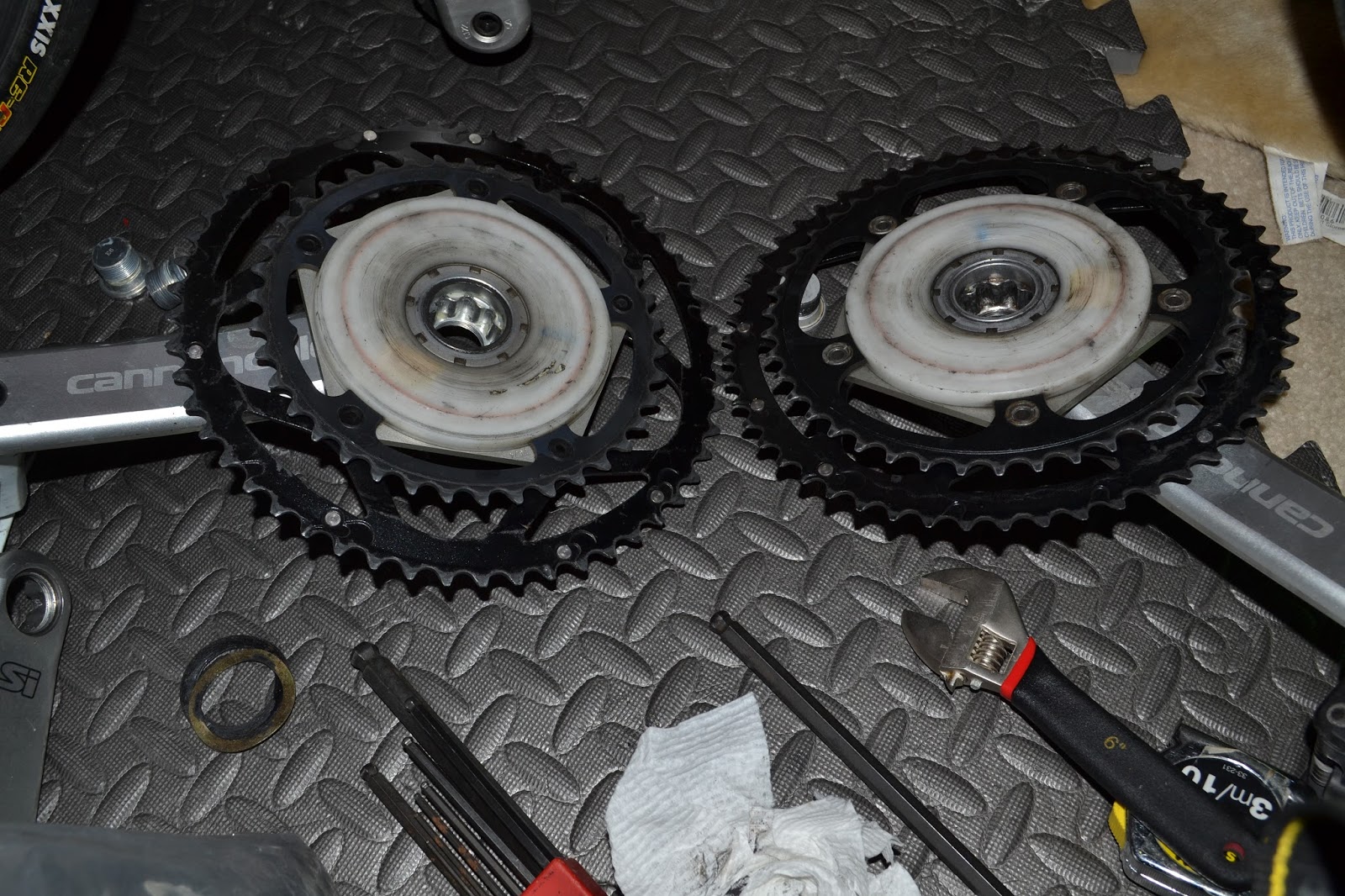
Along those lines I switched out my cranks. My SRM battery died in July or something and I've been too lazy to fix it. First I needed to find my Cannondale SI crank tools, which I lent the shop when they faced the BB shell. Ends up I buried it in my gear bag so I'd never forget it. Next I needed to stage a new battery (I have it and I know where it is) and solder it in. Finally I wanted to make a decision on crank length.

This year I committed to the 170 cranks. In 2010, my best recent year, I was on 175s, and I was on them since 2004 (minus a break in 2008) after I dropped a friend and returning to racing road rider while on my 175mm crank mountain bike. I then went to do sprints with a 175 mm road crank and went 10 mph faster than my previous 170mm sprint. I wasn't in shape but I figured that some of that 10 mph had to have come from the longer cranks.

I wanted to try 170s again because in my heyday, back in the 80s and 90s, I rode 167.5s and I was literally 6-8 mph faster in my fastest sprints. I thought I could regain that speed by getting shorter cranks.

Unfortunately aging 20 years had something to do with my loss of speed, and 170s actually made me slower than the 175s. In similar circumstances (tailwind sprint on the same course) I was about 3 mph slower on the 170s. Also I haven't even gotten a whiff of those heyday type speeds while on the 170s.

Therefore I gave up on the 170s.

Instead of doing a new battery and stuff I just put the other SRM Cannondale SI cranks on, the ones from the black bike. The battery is good, I have a second head unit so no calibrating, and it has both the 175s and my best-so-far Keos, the Carbons.

BB axle looks fine

The two right side crank arms.

That's another thing. The Keo Max2 pedals feel really loose, like really loose. The Carbons, allegedly possessing the same retaining force, are much more decisive in their grasp of the cleat. I made the assumption that the Keo Max2s would have the same retaining power due to the same newton-meter rating, but alas the pedals easily give up the cleat.

So my overall changes are as follows:
1. New cleats on my shoes (and they didn't change the retention feel on the Keo Max2s).
2. 175mm crank arms, instead of 170mm. This involves dropping the saddle 5mm to keep the saddle-pedal distance consistent.
3. Second SRM spider with newer/working battery.

I approached my first ride on the 175s with some caution. Longer cranks means a bit more stress on the knees, not because of the higher leverage but because your leg closes more with a longer crank. It opens the same amount, based on the same saddle height, but your knee closes up more. This means more pressure on the knee cap at the top of the pedal stroke.

Well I got on the bike, did some spinning while deliberately not looking at the SRM headunit, and then peeked when things felt okay.

110 rpm.

Whoa.

I expected 90 rpm or lower, after coming from the 170s. Apparently I'm more used to the 175s, even after a season on the 170s.

For 15 minutes I averaged over 100 rpm on the 175s.

No knee twinges, no weird aches, nothing.

I geared up and slowed down my pedaling speed.

One concern with the 175s was that my legs would come up a bit more, a total of 1 cm, based on the fact that my saddle dropped 5mm but the cranks come up 5mm more as well. In my 2012 fitness levels, or even my early 2013 fitness level, I was basically too fat to ride the 175s without gut punching myself with my quads on each pedal stroke.

Now, at the end of 2013, having dropped 12-13 pounds since March, I can pedal the 175s fine.

If I can continue the trend and get down another 10 pounds or so, I'll be back at or close to my 2010 weight. That was a good year, and I hope to at least start 2014 in a similar fashion.

Friday, September 13, 2013

Equipment - Frame Pump Mounting Point

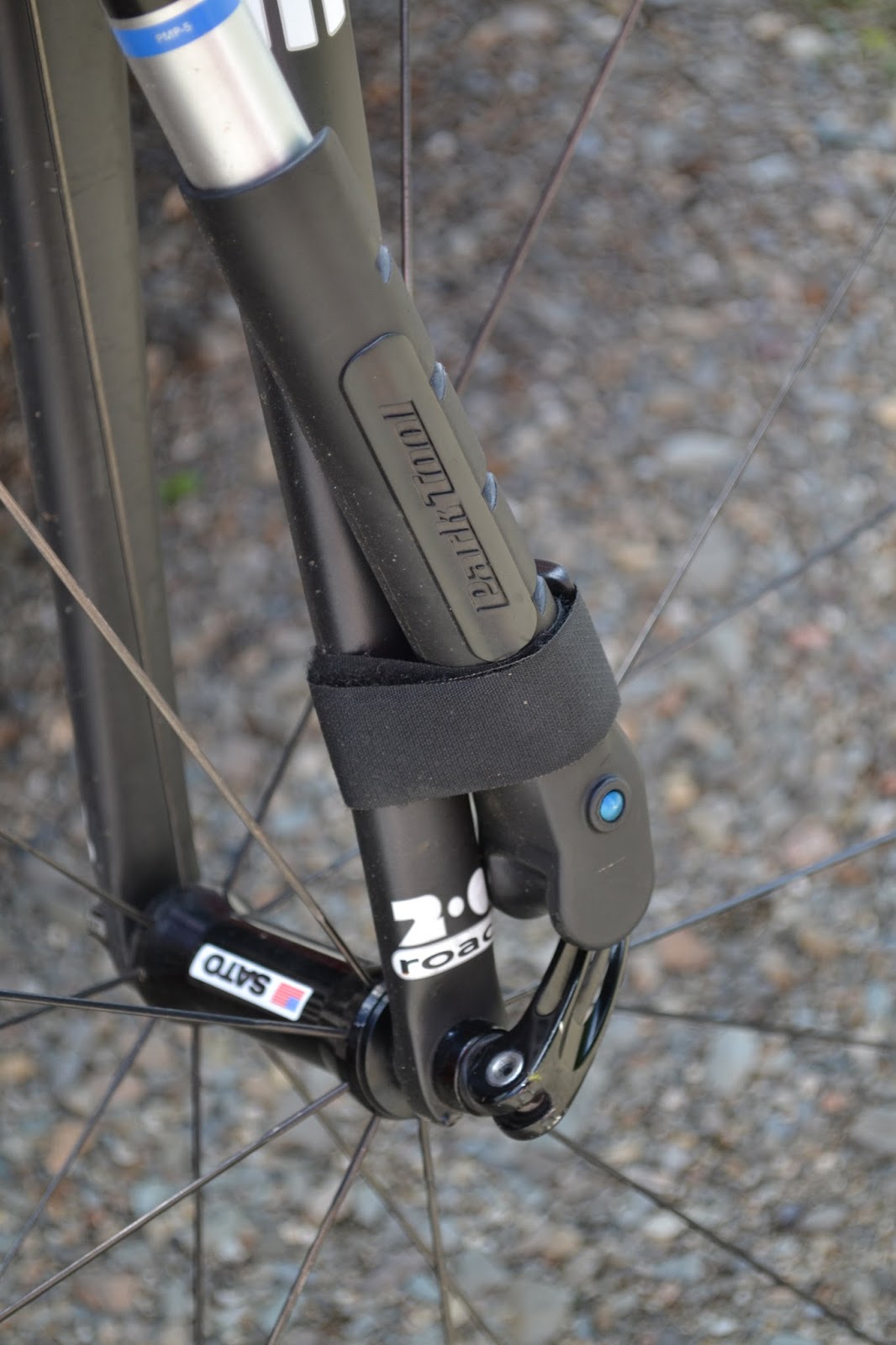
A while back I alluded to the Park PMP-5 that I carry with me when I train. It's a great pump, a full size frame pump that allows you to adjust the size for different size bikes.

The only problem is that I'm not that tall. You cannot shrink this pump below a certain length.

On the black bike the pump fits nicely under the top tube. The red bike... not so much. I tried putting it on top of the top tube but I managed to really gouge the paint when I accidentally jammed the pump sideways and slid it off the frame while applying great pressure down and back on the pump.

I tried creative solutions - rigging it up between the rear skewer and the seat post (heel hits it), stuff like that.

I returned to the "front skewer mount", something that I've tried on and off since I had my first Silca pump. I first saw this pump mount position in use by the uber-cool Cat 2 that rode with us, Morley. As a very impressionable kid in total awe of all that was Cat 2, I eagerly took in this most "out of box" approach to carrying a frame pump.

When I tried it, though, I managed to drop the pump. One of the last significant times I tried it took place something like 9 years later, when I was doing some long rides into northwestern Connecticut. I distinctly remember bombing down a fantastic descent, lots of curves and steep drops, when the pump went skittling across the road.

I had to slow down, laboriously climb back up the steel bit that I'd just blasted down, get my pump, and continue on. With my "pump security" shaken I took it easy on every rough surface until I got home.

Not fun.

Fast forward about 20 years and I'm back it again. I still have the fascination for the "outside of the box" solutions like the skewer pump mount. With my age and experience I am much more risk averse, so instead of relying solely on the pump's internal spring to keep things stable I've added two straps. I haven't had a problem, even with really fast or really bumpy descents (I haven't yet done a really fast AND really bumpy descent, meaning a bump 55+ mph descent).

View from the rear quarter.
Note the notches in the lower black area - that's how you adjust the length.
My pump is at the shortest possible length.

The above view really shows how I carry the pump. With the older skewers the pump had a better surface on the lower side - a rounded bar, basically a very thin frame tube, perhaps an ultra skinny seat stay. The HED skewers offer a poor profile - two flat bars that meet at the tip - so I tilt the skewer a bit to make it perpendicular to the pump and then use the strap to hold the pump to the fork. This way the pump's spring simply has to keep the pump from moving around too much. The strap actually holds it in place.

I bought an old-school Zefal pump peg. It's a plastic hose clamp that has a nub on it for the pump. In the old days of brazed steel frames the Zefal pump peg allowed you to "install" a pump peg under your top tube or on your seat tube, letting those with undersize frame pumps to carry such pumps. The fancy bikes had brazed on nubs but most of us had to use either frame-size specific pumps or, if using a fixed length pump like the Zefal HPX, we used the nub thing.

Well I thought I'd use the nub on the fork instead of using the skewer as the nub. Problem was that when I thought about it, meaning when I got the Zefal gizmo and held it up to the fork, I realized that the fork tapers. This meant that the Zefal nub thing would just slide down until, at some point when I had the front wheel off, it'd just fall off the fork.

Not good.

The Zefal nubs (I think they're called DooHickeys but I'm not sure) stayed in their plastic bags and the pump stayed strapped to the skewer.

Detail of the skewer end.
Skewer angle is not correct here.

It seems precarious but the pump is on there pretty tight.

Sideways detail of the bar end of things.

Up top I thought of putting something under the tape, a nub of sorts, so that the top of the pump would have a snug spot to sit. I contemplated using part of the Zefal DooDad, the spacer thing, and using the thing in the middle so it sat between the bar and the pump.

Ultimately I decided to just leave it. Maybe on some long training rides I'll think about it again but for now this works fine.

Monday, September 09, 2013

Helmet Cam - 2013 NE Masters Crit Champs, M35+

A surprising race for me, riding well beyond my expectations, riding with 4 much stronger Expo Wheelmen teammates, and then getting a little help at the end from a friend and Bethel Spring Series Clinic instructor Shovel. Race report is here, but watching is probably easier.


A still picture for thumbnail purposes
 
Enjoy!