Showing posts with label aerolite. Show all posts

Wednesday, June 20, 2012

Equipment - Aero Road - Giro Air Attack

Giro announced that they'll be introducing an aero road helmet for 2013. It's not just a time trial helmet - it's meant for mass start races.

Image stolen from their site because inevitably the site will change.

A while ago I started thinking of aero road helmets. It started a long, long time ago when someone (Cannondale? Specialized?) tested a couple riders and a slew of helmets in some wind tunnel. It was probably in the early/mid 90s since they were testing foam-and-mesh helmets as well as the "new" plastic shelled ones. My take away from that presentation was that a rider's posture/body makes a huge difference in selecting an optimal aero helmet. In the case of the presentation one of the riders (he had a shorter neck) was most aero with a normal, slightly tailed road helmet. Other riders, with longer necks, tested best with proper aero helmets.

Regardless, a rider's helmet (and head I guess) create a tremendous amount of drag and is a place to gain a "secret" edge. These secret spots give you a chance to make subtle but significant changes, sometimes making quite a difference in performance. This is especially true, relative to other racers, when the others get distracted by other aspects of your gear. In car racing such "hide through distraction" works really well - a team will carefully cover its "secret" design wings and such when in fact their performance gains come from elsewhere, like a floor design or something. The other teams, seeing the wings get covered, expend a lot of energy photographing the wings, examining just what makes them different from theirs (made more difficult because they're not that different), and after countless hours of analysis will say, "Daggummit, they led us on a wild goose chase."

For me, too, I tried to use any advantage I could through equipment choice.

It started with the Cannondale frames in the mid-late 80s. As a big gear stomper, especially in sprints or up short power hills, I felt the Cannondale frames gave me a huge advantage. I know I would climb in at least one cog smaller, and I knew I could jump as hard as I could and not make the rear derailleur shift.

See, in the old days frames were really, really flexible. One of the "flex tests" was to jump/accelerate really hard while you were just riding the bike. If the frame flexed enough then the rear derailleur cable would loosen (the cable would literally hang limp) and cause the derailleur to shift into the next cog inadvertently. Magazine reviews would talk about "... and the bike wouldn't shift up no matter how hard I sprinted". The Cannondale was stiff enough that such nonsense was never an issue.

I used other equipment choices to my benefit. For many years, before any shift/brake lever integration, I raced with a right side bar end shifter. This allowed me to shift rapidly during a sprint, giving me an edge over my rivals with a normal set of downtube shifters. I could jump in a low gear and sprint in a high gear, the best of both worlds. Others would debating jumping in a bigger gear (in order to max out top speed) or a lower gear (to get a better jump). Sadly, after STI came out, guys I could regularly beat became untouchable - my equipment choices had given me a huge advantage in this case.


I also used super light Aerolite pedals, 38 grams each (with cleat and hardware), 76 grams for the heavier steel version. Combined with a lightweight and super stiff wood soled shoe (criticized for being "too stiff"), I had a super light shoe/pedal weight. Although I never had a definitive "test" like with the shifter in the previous paragraph, I can tell you that when I finally went to a normal pedal it felt like someone strapped weights to my ankles.


I also adopted aero wheels in the early 90s, racing frequently with a rear disk wheel and front TriSpoke (aka HED3). Given the chance I rode on a pair of TriSpokes. When Zipp came out with their first rims (the 440 and 340, precursors to the 404 and 303), I used them as well. Nowadays everyone uses aero wheels - my 2 or 3 mph advantage at top speed disappeared. Interestingly enough I no longer sprint the fastest. I mean, okay, I'm getting old and stuff, but it used to be ridiculous, me on TriSpokes and everyone else on 32 spoke box section wheels. Okay, if they had "super duper" wheels they'd be on 28 spoke versions of the same.

And, because I felt aerodynamics really helped with the bike, I'd take other approaches to reducing my overall drag. For example I know that the body is the least aerodynamic part of the bike racer unit. Therefore I worked on reducing my own drag as much as possible, through posture and equipment.

I used Scott Rakes whenever I felt fit enough to justify putting them on the bike. They gave me a super aero position with my elbows close together. I tried other aero bars too but found them less helpful - the Spinaccis (kind of short aero bars but illegal for USCF use), the copycat 3ttt product, some bar that connected the drops (think of a towel bar connecting your two brake levers), Scott DropIns (the end of the drops had extra tubing that turned inward). All had their disadvantage for me - the Spinaccis were more TT than sprint, the bar that connected the drops were unwieldy to use, the DropIns put my hands too far back.

Nonetheless I understood the importance of taking advantage of these things. The Rakes were always close to the surface of my "extra parts" box and they went on whenever I thought I'd need to chase (bridge to a break or just chase after getting shelled).


Note the Zipp 340 wheels and the Scott Rakes (the "extra" bars at the center of my normal bars).
Note also that no one else has aero stuff.

Final note: the Zipp 340 wheels weighed the same as my slightly higher spoke count 280g rimmed wheels, so they were light too. Most riders at the time were running 400g rims, 28 spoke up front, 32 spoke in the rear. I ran either the 28 spoke 280g rims or the 24 spoke Zipp 340s (which were about 320 grams). They were quick on acceleration and gave me about 1 mph more top end. By now everyone is using a brake/shift lever so no more advantage there.

In the picture above Keith Berger, for whom the Keith Berger Crit is named, is on my wheel. He was still a Cat 3 at the time and he won the 3-4 race (the picture was taken during the 1-2-3 race). Keith launched when the field was already at its limit, bridged to a break, and won the sprint. It shows that even with equipment it doesn't matter if you're not able to use it. I won the Series either the year before or the year after, mainly through the sprint. In that particular year's Series I removed the Rakes after this first week - I had enough teammates to chase things down so the Rakes became unnecessary.

Along those lines of "subtle changes" I sometimes taped the vents closed on my old Giro Air Attack, reducing both the ventilation (when temperatures plummeted) and decreasing drag. Later I did that to almost all my helmets, usually for the Bethel Spring Series races (like here, for example). I used either clear packing tape or, later, black electrical tape. The black tape was more discrete and easier to remove when the weather got warmer.

Eventually I started thinking of getting a helmet that was more aero. I was thinking more in terms of the Bethel Spring Series, a race series normally held in cold conditions. At that point a racer doesn't need a lot of ventilation; in fact, when I did one week with a brand new, super ventilated helmet, my head hurt from the cold air hitting the now-insufficient skull cap I wore under the helmet.

Since I decided that since I really don't want air flow I should be able to get by with a rounder helmet, one more conducive towards my head tilted down sprint position. This would also work on the track, but that wasn't part of my thinking yet.

I contemplated, but couldn't bring myself to wear, BMX/skateboard helmets. I tried them on a few times at a local shop, probably prompting questions about me ("Is he going into BMX?"). I ended up getting such helmets but mainly for my brother. He does skate and skaters fall a lot more frequently than cyclists.

Recently I thought of the ski helmets, with vents you could open and close while you rode. As a bonus they had goggle strap indents in the back, so when it was really cold I could wear goggles to protect my eyes. For me, riding in bitterly cold weather hurts my eyes, and with prescription glasses I can't wear regular eye protection type glasses. As a bonus if I went skiing I'd have a helmet (and at some point I do want to downhill ski again and I won't do it if I don't have a helmet). The problem with these helmets was that with rapidly changing helmet standards I wasn't sure if the ski helmet would be legal for use in a bike race. I nixed the sliding vent closure Giro helmets at that point.

My favorite helmet thus far was one that I couldn't buy locally and I don't think passes the right safety regulations for use in USAC. It's made by Kask and I saw it at Interbike in 2009.


"City" helmet

Apparently the helmet was made for commuting. What caught my eye was the built in face shield, a huge factor in the aero-ness of a human head.

I'd have gotten it simply for the cool looking liner inside.

As you can see ventilation is a bit low on the list of requirements. At a Bethel Spring Series race it would be fine, but in 90 degree summer crits this helmet would probably see you head to the hospital after having heat stroke.

Now Giro has a helmet due to be released for 2013. I'm sure we'll see it in action in the Tour and at the Olympics - that's why they "released" it now, so people like me would go, "Oh, cool, look, an aero road helmet!" and talk it up.

I'm such a sucker.

Seriously, though, an aero road helmet is huge. I haven't looked at any stats or anything but I bet that such a helmet will save at least as much as an aero road frame. Okay, probably more. Maybe close to an aero front wheel. Whatever, it's going to be a huge savings relative to cost. At the $200 price point it'll be less than a top of the line "regular" helmet, weigh within 50-90 grams of said "regular" helmet, and probably be worth the same as a $1000 front wheel as far as aero is concerned, and way more than a $4000 frame.

For me that's a win-win so I'm signing up.

Now to wait for the next team Giro ordering window. Hopefully before the 2013 Bethel Spring Series.

Monday, September 08, 2008

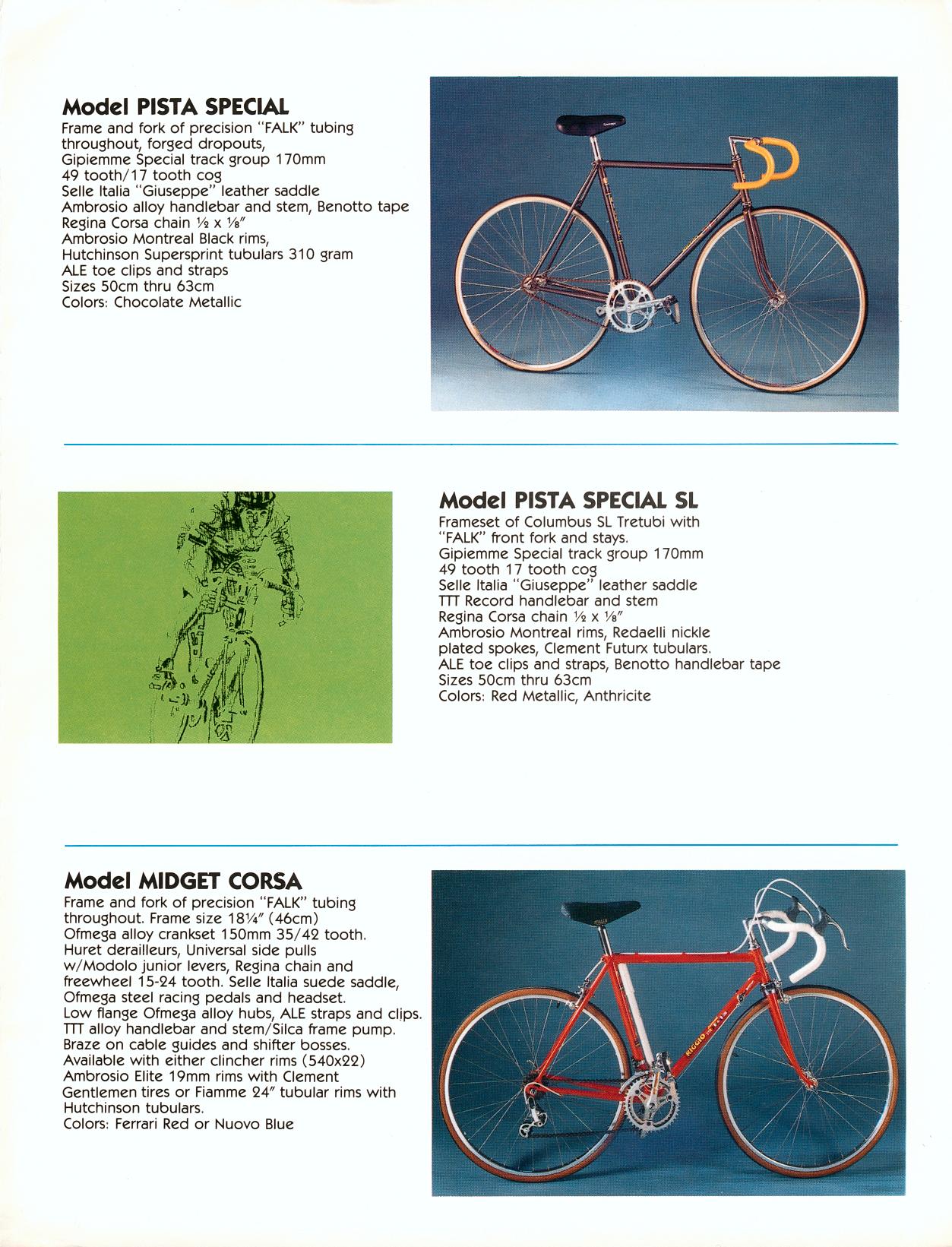
Equipment - Riggio Track Bike, Part 1

I've mentioned on rare occasion that I actually own a track bike. I've alluded that I've raced it. And, in the near future, I hope to be able to have the track bike whole once again and even get to race it. It's called a Riggio.

What it's called. Pretty brown, right? I should race for UPS.

I took a picture of the frame decal but it didn't come out. It's basically a chrome color sticker with something like "special tubing" on it in some foreign looking language. It's nothing special.

Superbe Pro rear hub, with the heaviest spokes known to mankind connecting it to the Sun M17 rim. I don't know why I used those spokes.

I had a Fiamme Gold Label front wheel but it got lost somewhere. Or maybe it was the rear wheel and I relaced it. Either way, the Gold Label is gone.

The other side. Note the dust accumulation. I've basically stored this bike for 15+ years.

As a testament to how old it is, I had just clipped the harness for an Avocet 45 computer. For those of you that don't know Avocet computers, consider yourself lucky. For many years a certain Greg Lemond rode with an Avocet on his bars. However, I doubt it worked because for many years, every single Avocet computer would go blank. Usually this happened in the middle of that century you were doing and now you had no idea how many miles you had left.

The 45 was one of the Avocets that actually worked, and I relagated it to the track bike when I became a big Cateye fan. So the 45 harness was a NOS harness (I have a spare, still in the bag, just in case). I saw the 45 computer during the move but it's gone for now. So I will get by with a yellow Cateye that I won last year.

No rear brake. The rear tire is new, been on rollers a couple times. Lots of dust. I took the tire I had on it originally to use it on one of my race wheels.

Fork crown to tire clearance is minimal. No brake hole either. Note Aerolite pedal.

Superbe Pro crankset, with a broken Aerolite pedal frozen in the crank.

I need new cranks. I lost one of my blue chainring bolts (BMX pieces from the fab 80s) so there's a normal one in there. I also don't have a 15 mm thinwall socket wrench anymore so I can't get the stupid crank off. Grr. I do like the "UDrillM" super light chainring. Combine a bike racer with more chainrings than he knows what to do with, a drill press, and lots of time allocated to "making my bike better" and you end up with a number of drilled out chainrings. Unfortunately only one came out right.

The left side. Not as pretty as the right side.

Bike in its glory.

It's a 51 cm although the headtube looks more appropriate for a 54 cm. Level top tube track bikes do that for some reason, I think this is because the top tubes are usually shorter, the front end (front hub to BB distance) is shorter due to steep head tube angle.

The front wheel is a new one, got it yesterday as I can't find my track axle for my TriSpoke. I also put on an uncut Michelin Pro2 tire on it since I figure I won't see too much glass on the track. I even went and looked for a short valve stem tube so I don't use a precious long valve tube on a box section wheel.

The bike, with "race wheels", weighed 17 pounds back in the day. When I finish it up I'll see how it is now. The front wheel, I have to tell you, is an anchor - no blowing around on that thing.

Thursday, January 04, 2007

Aerolites, the struggle

Kind of appropriate. Struggling with Aerolite pedals. If it wasn't a struggle to set them up or to walk around on their cleats, we'd all be riding Aerolites. Well, I think a bit of float would help the cause too.

Yesterday I spent a couple hours grinding and filing various pieces of plastic to try and make myself an Aerolite cleat mount for a Sidi shoe. I started out with some polycarbonate but then found four Sidi SPD (i.e. the mountain bike SPD) adapters in my shoe bin. I decided to use them as the base and grind away the little cleat protecting ridges.

My goal is to use the adapter plate to get myself about 5-10 mm of shoe height. In this day and age of "reducing the foot to pedal axle distance", what possesses me to raise my foot higher? It's fit. I want to increase the delta between my seat height and bar height by 5-10 mm (more if possible). This is part of my plan to return my bike position to my "fit" days. It involves trying to either jack up my seat or dropping my stem. When I gained weight during 2000-2003, I ended up so heavy my belly hit my legs when I pedaled. You know you're heavy when that's happening. I had to raise the bars to clear my stomach. Now that I'm getting a bit better again, I'm looking to return to that blazing Cat 3 form I had back in the day. hahahaha.

(Just to clarify, I'm still a Cat 3)

Since I can't jack up the seat (seat-pedal height is correct) the reasonable alternative is to drop my stem. But it's already down low, it's a 73 degree stem, and I don't feel like milling my headtube like I did on my first Cannondale (to increase the headtube angle, if you can believe that). A deeper drop bar would work but there are none with a crit bend upper, so I'm stuck with my current bars (and they're not shallow at least).

Using a shorter crank would do it - I dropped my seat 5 mm when I put my 175's on. As I used to run 170's, I could go back to them and raise my seat 5 mm. Get more pedal speed, lose some power. I've debated this internally ever since I went to 175's and have decided that for now I'll stay with 175's. My rational is that BMX guys use super long cranks for good acceleration and they can spin pretty quickly. I haven't broken 250 rpm with 175's but I've gotten within a few rpms of that, and my max on 170 mm cranks is 286 rpm, so I'm close enough. I use the 175mm leverage on short power hills and since they're all over the crits I do, I want to keep them.

Changing pedals would do it, if the pedals were taller. Aerolites are not tall. But an adapter plate would add the height I want. And it would drop some absurd amount of weight. Even with plates etc, the pedals should be about 100-120 grams for the pair.

Anyway, with all this in mind, I've been trying to get my Aerolites back into working order.

I ended up covering a bit of my very cluttered garage with plastic shavings and got pretty good at milling with the Dremel. When I went to put on the cleat, I found that Aerolite made another boo-boo - the "SPD" holes are spaced a little too far apart. The screws don't fit squarely, and if it was a regular cleat, it wouldn't be a big deal. But the screw juts out into the actual pedal body and will muck it up. I tried different things - like other Sidis, various combinations of putting in the screws at the same time, but nothing worked.

For now, my Aerolite project is on hold. I'll probably pick it up Saturday as tomorrow is my finacee's birthday.

Tuesday, January 02, 2007

Aerolites, history and pics

So as promised, I'm putting up some pictures of my Aerolites. Actually of my shoes with Aerolite cleats. There were a couple more shoes but I must have tossed them.


The first shoe is a classic. (Please no comments about the shoe laces - remember, we're talking about the Pastel 80's and Miami Vice and all that.) Duegi 101's - wood soled shoes with a leather top. Talk about natural materials. First I used their normal cleat and toe clips and toe straps. I never resorted to nailing them down, the single bolt worked fine. But when the Aerolites showed up, I had to adapt.

You can see the strap that I put in place. Initially I simply wrapped it around my foot. You notice that all shoes have their straps at an angle? It's because having them straight up and down doesn't work. In those days, the industry assumed that laces allow for "fine tuning" tightness while the strap is for holding the foot in general.

Mostly the shoes had laces with some sort of leather cover held down by velco, kind of like the first Lake shoes out there. The leather cover stretched and made the shoes feel really sloppy. This gave clipless pedals a bad name so it took a couple years for people to make the switch.

This is what I did:
I put the straps in place but could not figure out a way to anchor them. I thought about super glue (onto a leather covered sole, no good), sewing it with my tubular tire repair kit (have you seen the size of those needles?), but nothing worked. Finally, in frustration, I put ShoeGoo down and held the straps in place with thumbtacks. And guess what? They held.

The cleats were easy, I simply mounted them so the back edge of the red Aerolite cleat lined up with the original cleat marks (from the pedal cage). The axle lined up perfectly. The wood screws provided with the pedals dug in perfectly into the hardwood sole.

There was no float since that was an unknown concept. The Time guy still worked for Look (before he broke away to make the "float" pedal come to life).

Eventually shoes went the way of shorts - away from natural materials and migrating towards petroleum based products. Duegi was on the outs so I went with Diadora. By then Aerolite came with Look bolt pattern adapters. They had one fatal flaw - the adapters placed the cleat about 20 mm too far back.

To remedy this, I drilled holes in the shoe about 20 mm in front of the regular Look mounting nutserts (? not sure what they're called but they are a threaded insert so you can drill out a shoe and put in mounting inserts). They came with Look pedals since, back then, most shoes didn't have the Look bolt pattern.

The end result:

You can see how far forward the cleat sits - it's because it's centered around the axle, not offset like most cleats. I drilled out three sets of shoes over the years, and each time I prayed there were no spring steel plates in the sole to deflect my drill bit. There never was.

The last shoe represents the beginning of the end for Aerolite. Instead working on things like perfecting their cleat setup, making it easy to install/remove Aerolites (it required a 5/16" allen key), or sponsor some racers, they tried to branch off into shoes. Their shoes were innovative - carbon and kevlar sole, predrilled for Aerolites, and super light.


They also had an innovative heel strap which allowed you to really snug up the shoe. Due to the strap angles and placement, the rest of the shoe was not really necessary - sort of like a sandal. So a minimalist rip-stop mesh covered your foot. Note that the outer edge is a bit damaged on my shoe? I had a pretty bad crash and scraped the shoe on the ground. My foot ended up getting badly scraped up. I learned then that the "thick and unnecessary" uppers of a shoe do more than just support your foot - they also protect them.

I think they would have worked but innovative design doesn't mean the shoe is comfortable. Somehow the things didn't fit very well - the sole was too flat and had no support. It's too bad because it was about 10 years ahead of its time.

As I've mentioned before, I'm working on setting up some Aerolites on some new Sidis. But today has been a dismal failure so far. I thought I'd rout the polycarbonate plate but the plate simply starts to melt. So I will have to put the project on hold until I get a jewelers saw or something similar so I can cut the plate up.

Thursday, December 28, 2006

Aerolites

They say things go in cycles. And with bicycling, well, heh, the word cycle is in bicycle.

In the mid 80's, when Look came out with its "Look Safety Bindings" (also known as the Look clipless pedal), another clipless pedal existed - the Aerolite pedal.

Nowadays, Aerolites are used only on the super light bikes at trade shows, you know, the ones that weigh 8 or 9 lbs and are "fully functional road bikes"? I suspect the builders would not probably bomb down a descent or mix it up in a field sprint on their own super light bikes. Those show bikes may be light and the pedals fine, but some of the other parts are a just a touch sketchy.

Aerolites are simple affairs - a sleeve rotated on bearings around an axle, and the cleat actually grabbed the sleeve. If you picture a drill bit holder, the pedal was the drill bit and the cleat the case. If you push a drill bit into the case, it pops right in. But to pull it out straight is virtually impossible. If you pull it on one end though it comes out easily. Likewise, you stepped into Aerolites (it took about 150-200 pounds of force to so so) and rolled out of them. A strong rider cannot lift 200 lbs with their hamstrings so accidental "pull-outs" didn't happen. Well as long as the rider kept their cleats tight.

They were odd though. It looked like you had just an axle sticking out of the crank. It was virtually impossible to ride them without Aerolite cleated shoes - your foot simply rolled off. I forgot this in my excitement in test riding a new stem or something. I coasted down my driveway, accelerated a little, and, imagining I was sprinting for the line, threw the bike forward. Well, with slippers and roly-poly pedals, my feet slipped right off. My crotch landed on my rear wheel, the momentum rolled me into the rear brake, and my shorts got jammed in between the brake and the tire. And yes, my privates were in there somewhere. Very painful, in case it wasn't obvious.

Anyway, the inability to ride them in slippers aside, the pedals did have some redeeming features. They weighed about 145 grams for the steel set (76 grams for the Ti set). Mind you, that's the PAIR of pedals WITH cleats and hardware. They offered pretty good cornering clearance (37 or more degrees cornering clearance) and even if you dug a pedal, it was the soft plastic cleat you dug and so you didn't have the wheel-lifting shock like a normal pedal dig when metal hit the pavement. They were non-sided so you never worried about up or down - you just stepped down into the pedal.

At my office, where we write financial-type software, we say that the final testing environment is production. And it's true - because until you test things with paying end-users in a real environment, it's not "real". And like software, Aerolite released a pedal for final testing. And it was apparent that the product had severe technical flaws.

There were some doozy's - like the screw holding the pedal together was plastic, and sometimes it just broke in half, releasing the pedal (the sleeve) from the axle. Your foot went flying off the pedal. Actually, your foot was fine. The *pedal* went flying off the axle with your foot still attached to it. If you were lucky you landed your thigh on your top tube. Unlucky... well suffice it to say that my slippered bike throw was worse by just a bit.

A few revisions later the pedal actually stayed together. There was an adapter plate for Look mountings (the plate cracked after a year or so and it mounted your cleats 1 cm too far back, but still, better than nothing), a rethink on how the pedal held together (Turcite, a plastic bearing material, became the pedal body, and there were no more bearings), then cleats adapted to the SPD two bolt pattern. A round of legal problems (the company was Zerolite for a while, but then reverted to Aerolite) and you have the current pedal.

I have a new set which is now 2 years old, won by a pro friend's pro friend out west somewhere. It has titanium axles, the SPD holed cleats, and no Look adapters.

I was looking for places to buy parts and stuff and stumbled across a great bike shop site up in Maine - www.bikeman.com. But I realized that the best fix would be to actually make new cleat adapters.

So I went to the best website for inventors who need construction materials - www.mcmaster.com. Last night I ordered two polycarbonate plates. $8 shipped. They arrived this afternoon. They will become my Look or whatever other bolt hole adapters which exist on my new Sidis (I'll probably use the 4 widest spaced inserts as the basis for the adapter plate).

The next step is to use my Dremel with its "routing kit" to replicate the cracked Look adapter plates I have on my 10 year old shoes. And if things go well, I'll have a nice set of shoes that will work with my nice set of new Aerolites.

My bike isn't like one of those super light show bikes, even if it will share the same pedals. It has too much aluminum and not enough carbon. But there's a big difference between those show bikes and my bike.

My bike will bomb down descents and partake in some furious field sprinting.