A long time ago I went through a period where I either raced or did a race-like training ride during the week, usually on Tuesdays, also known as "sprint days" for anyone following Eddy B's basic schedule of training. I had the best cycling years of my life but there were so many variables it's hard to say if the Tuesday evening workouts were critical for developing good race form.
Other factors included things like my unending enthusiasm, racing at every opportunity, and being sort of poor so I didn't eat as much as I could have eaten. My enthusiasm stretched my racing year from February to November, and I trained through the winter. I only took time off when I was sick.
I raced all the time, or so it seemed. I tried to race twice a weekend, sometimes managing three races if the categories and times worked out. Other weekends I'd race an early race in NYC then drive over to Gimbles and do the group ride afterwards.
Finally, as a starving bike shop guy, it helped that I was a relatively lean rider, rarely breaking 145 lbs (5'7") and staying under 140 for long stretches at a time.
With life and work intruding on my cycling, a number of things have happened. I went through a few years where I rarely raced, doing perhaps 8 or 10 races a year. My training time drooped severely, aided by frequent 9-10 day breaks where I didn't even look at my bike. I even took three weeks off in the middle of the summer, an impossible layoff when I was younger, even for a winter month.
At the same time I rose above the poverty level (based on income). I could afford to eat. Unfortunately I ate like I was still training and racing a lot, ultimately ballooning to over 190 lbs. (Recently I discovered my scale is off by as much as 7-8 lbs at 175 lbs, so my 190 lbs could have been - and probably was - more like 200 lbs).
I committed to trying to re-find myself in the sport in the last few years, spending oodles of time on the trainer, lifting, taking trips to warmer climates to train in the winter months. I've had varying successes but I've never quite recaptured that "immersed in cycling" feeling.
One problem was the lack of racing. Although racing is much easier as an experienced racer (versus a new one), it still hurts, and I have a hard time remembering how much I suffer in the more difficult races. In my serious days my early season schedule used to include some very fast Cat 1-2-3 races so that I'd remember how to go fast. This in turn would make a Cat 3 race feel much more manageable. Over the past ten years or so I've sort of missed those faster races.
Time is a factor as well. Cycling is not quite as important as some other things, a situation simply unimaginable when I was younger. It's difficult to regularly spend a whole weekend focused just on racing or training or both. My weekends used to be "Friday - eat and spin; Saturday - race or do Gimbels or do both, then eat; Sunday - race or do Gimbels, then eat". Hard to do that now.
I suppose another problem is that my training became "serious". I like saying that it's important to go out on a training ride with a goal in mind, something to focus on while you ride. If you're doing intervals, go do intervals. If you're working on pedal speed, focus on cadence. This utilitarian approach to training is good in some ways but it makes cycling less fun. If you approached all your fun things like that they stop remaining fun.
A couple weeks ago I found myself in that "enjoying cycling" mode again. There is one main reason why, accompanied by a less "significant" but just as important sidekick. The idea is not that earth shaking, but since it took me a few years to figure it out, here it is:
The Tuesday Night Series at Rentschler Field.
In the last two weeks I did this race twice, bridged twice, got shelled twice, got lapped more than twice, and had a blast both times.
The course is pretty simple, a tri-oval if you will, flat, nice pavement. There are three actual "turns" where you would normally coast (but where you can pedal if you want to do so). The sprint starts off on a long sweeping bend, the "4th turn" if you will. It's a short course, half a mile, and the whole course is visible from any standpoint around it. Because of the large stadium alongside the backstretch there is some wind direction/speed changes, making for a neat obstacle in an otherwise featureless race.
Okay, it'd be nice if I don't get dropped every time I go there but the race is so informal, the atmosphere so casual, it's hard to race "seriously". So if my momentum takes me to the front and there's a group away, it's hard to resist doing a few pedal strokes and rolling off the front of the field. At that point I'd feel kind of dumb if I didn't try to bridge, so I would. The first race I did it was less a bridge and more like closing a huge gap. The second was a true bridge, with about 2/3 of a lap of effort (remember they are 1/2 mile laps so my effort was not too long).
Both times my efforts killed me.
I'd pedal until the field dropped me and then I'd circle slowly, catching my breath, wondering how much harder I could have gone without becoming an uncoordinated and dangerous rider, and then, when the field lapped me, I'd jump back in.
Then I'd think, "Boy, this isn't that hard. Why didn't I just sit in?"
A few laps later my legs would be hurting and I would start worrying about becoming that uncoordinated and dangerous rider, affecting actual racers, the guys (and gals) on the lead lap. I'd sit at the back, carefully letting everyone in before me, making sure I didn't gap off a contender.
The bell would ring for soda primes, a nice reward on a hot summer night, an appropriate prime for a fun race. The pace would pick up and I'd start seeing daylight between wheels.
Finally, after struggling at the back for a while (but before I inadvertently gapped anyone), I'd sit up, unwilling to take the chance that I may affect the race's outcome.
I'd roll over to the car, try and rinse some of the sweat away. Talk with friends. Move over when someone makes a U-turn with their car and I'm in the way.
It's fun, it's informal. All smiles, no swearing. Some good natured kidding. But all in all a fun race, a fun ride.
Coincidentally both times I had dinner with friends afterwards. Part of racing is rehashing what happened, listening to what other people experienced, listening to what they saw you do (as opposed to what you think you did).
It helps that the race is close to home - less than 30 minutes away, maybe as little as 20-25 minutes. The series ends in August but I hope to be able to do them until they finish up.
Of course tonight I went there, eager to ride, eager to race.
And...
I forgot.
No race this week.
The guy at the parking lot smiled as I drove up. I knew something was wrong because there were no other cars there and a lot of TV camera vans and stuff. I rolled down my window.
"How's it going?"
"Good, you?"
"Good."
"I take it there's no bike race."
Smile. "Yep, sorry, no bike race."
"Thanks."
I laughed at myself as I turned the car around. No one in my way, of course, so easy to do. The promoters told us a few times last week that there wouldn't be a race this week. What am I, hard of hearing or something?
I guess so.
Tuesday, August 05, 2008
Monday, August 04, 2008
Racing - Pro vs Cat 3 vs non-licensed
This year I discovered some Eurosport TV feeds thanks to cyclingfans.com, and I got to watch the two man break yesterday cruise to the finish 10 minutes ahead of the field. Two things impressed me watching those guys ride.
First, they worked effortlessly. Their pedaling remained fluid and fluent - except for the occasional stretch, it was impossible to tell if it was 100k to go or 10k to go. It's painfully obvious when I'm a bit tired - my form deteriorates rapidly, reducing me to a bobbing, weaving rider resembling a boxer more than a cyclist.
Second, they seemed to take frequent breaks from pedaling. Part of it was that the course was mainly downhill, I'll give them that. But the other reason they'd be standing and coasting while following their break companion is that they weren't "going that fast".
In other words their 40 kph pace, 25 mph, was sort of like a training ride.
Based on all their standing and coasting I expected the four man chase group to come flying up to the break. But, no, they didn't. The break kept the chase at bay, maintaining a 4 minute gap to them, a 10 minute gap to the field.
And though I'm sure the break worked hard, they didn't seem to suffer, they never needed to extend, never really bury the needle in the red. For that I'd look to Museeuw in his over-long breaks at the 2000 Paris Roubaix or the 1998 Tour of Flanders.
This contrasts greatly with my experience in lowly Cat 3 races where the breakaways require insane amounts of effort and a very high sustained rhythm. Yes, the races are shorter, but I think that the relative effort (compared to the racer's abilities) is higher in such breaks. Once a break is established it's not quite as hard, but getting to that point is a rarity in Cat 3 racing.
This idea came back to me last week when I joined in on two rides from a relatively young local shop, Granby Bicycles. The rides would probably be considered a B ride for most clubs, going pretty easy most of the time, regrouping frequently.
For once I felt like the pro of the group. Only one other guy raced and he was taking it easy on one day because he was doing a crit the next day. Incidentally I was going to do it too, but that's another post for another day. The rest of the riders were mainly recreational. One guy might have been handicapped by the fact that he was looking after his young son who rode with us, but I know for a fact that the kid will be destroying me in a year or three so it'll all come back full circle. Another guy remembered me from 25 years ago when we rode for the same club. I was a scrawny 15 year old and I must have looked like a blimp on that day to him, being 80 or 90 pounds heavier than back then.
Just like I noticed the pros riding with fluid ease, I noticed (other) things with this recreational group. It occurred to me that some of these differences were what made "racing" different from "riding". Racing is a different type of riding, initially painful beyond belief, then suddenly becoming somewhat comfortable. What racers don't realize (because after you start racing you rarely train with non-racers, unless you're like me and not that strong) is that racing elevates a rider to a whole different level.
One of the main things I noticed is that non-racing riders lack a certain depth of power. I'm by no means a power rider, and I regularly get shelled by those who can turn over insane gears really fast, but it was obvious that in this group my somewhat average racing power was pretty good for the group.
The non-racing riders seemed to spin up lower gears but didn't seem to be able to handle turning over the bigger gears. Since I had the benefit of having some wattage numbers to look at, I noted the numbers as I alternately made efforts or sat in (or actually more like "sat next to"). When I was sitting in on some of the hills, I'd be doling out my power at about 200-220 watts, something even I can sustain for a while. But when it came time to bridge up to someone, the wattage climbed to the 500-1000 watt range. Although not earth shattering for a racer, this was enough to gap my non-racing ride companions.
Some of the riders there were much more fit than me, able to ride at higher sustainable wattage levels. One guy surprised me with a steady 15 minute long pull on the second ride. The group had split up a bit and I gamely clung to his wheel, waiting for I don't know what. I was dying though, pouring out 250+ watts, well over my threshold. Eventually I came off, exhausted, with only 30 minutes of hard climbing as a reward. But at a later point, when I jumped kind of hard, he simply didn't have that effort in his legs to do anything. It was foreign, this "attack" thing.
The difference between the recreational riders and a low-level Cat 3 is the ability to dole out huge wattages on a semi frequent basis. Doing a few 700 watt jumps every mile or so is sort of standard operating procedure for a Cat 3, but for a recreational rider, such efforts would border on insane.
Or obnoxious, one or the other. Depends on the situation I guess. On one of the rides I did a few jumps. The second, harder ride? Not so many.
The step up to pro is a little different - it's the sustainable power numbers which impress. 500 watts threshold? I struggle to do 500 watts for a minute, and I've only done it inadvertently at races. On my own I have not consciously broken that barrier. Yet for Rabobank pro Gesink that's his threshold.
So those pros in the break in the Tour. Granted, they were probably at or close to their peak fitness. They were extremely motivated. But nevertheless it doesn't change the fact that they were probably cruising at about 25 mph, which, for me, would take about 400+ watts. Trading pulls, they were probably able to keep their average under 400 watts, figure maybe 400-420 watts when pulling, 350 or so when sitting on.
I'd have lasted maybe five minutes in that break, with no pulls. Pulling I'd have made it for about a minute and a half.
I reiterate this over and over again but I'm going to say it again. I'm so glad I'm not that good at racing bicycles. I have an admiration for the pros, the way you might admire a guy trekking across the desert or up the side of an icy mountain. You admire the spirit and the commitment but you also thank your stars that it's not you doing it, at least not exactly like that.
So, for me, it's not Mount Everest calling. It was the Gunks in New York, and I went and climbed some easier routes over a weekend and had a blast. Likewise I don't need to go hiking across the Sahara. Instead, I went hiking in Devil's Den, a couple thousand acre park in southwestern Connecticut. My hike consisted of walking about a hundred yards into the park with a long time friend Lisa (this is about 15 years ago), laying down on a really big flat rock next to the water (there were no mosquitoes else I'd have run back to the car), closing my eyes, and falling asleep. We woke up a couple hours later, refreshed, relaxed, and walked back to the car.
Likewise, it's the Tuesday night crits that call me, the Monday flat group rides, the Wednesday hilly group rides, not the Olympics or the Tour or whatever. And based on what it takes to get to those big races, I'm glad I don't have to even try. I don't race everything, crash every month or so, suffer through epic 6 hour races, do 19 hard days in 21 days, none of that. I rest when I feel like it, race when I want to, and train when the urge hits me.
I like it like that.
And I hope it's dry out this evening because then they'll have the Monday evening ride.
First, they worked effortlessly. Their pedaling remained fluid and fluent - except for the occasional stretch, it was impossible to tell if it was 100k to go or 10k to go. It's painfully obvious when I'm a bit tired - my form deteriorates rapidly, reducing me to a bobbing, weaving rider resembling a boxer more than a cyclist.
Second, they seemed to take frequent breaks from pedaling. Part of it was that the course was mainly downhill, I'll give them that. But the other reason they'd be standing and coasting while following their break companion is that they weren't "going that fast".
In other words their 40 kph pace, 25 mph, was sort of like a training ride.
Based on all their standing and coasting I expected the four man chase group to come flying up to the break. But, no, they didn't. The break kept the chase at bay, maintaining a 4 minute gap to them, a 10 minute gap to the field.
And though I'm sure the break worked hard, they didn't seem to suffer, they never needed to extend, never really bury the needle in the red. For that I'd look to Museeuw in his over-long breaks at the 2000 Paris Roubaix or the 1998 Tour of Flanders.
This contrasts greatly with my experience in lowly Cat 3 races where the breakaways require insane amounts of effort and a very high sustained rhythm. Yes, the races are shorter, but I think that the relative effort (compared to the racer's abilities) is higher in such breaks. Once a break is established it's not quite as hard, but getting to that point is a rarity in Cat 3 racing.
This idea came back to me last week when I joined in on two rides from a relatively young local shop, Granby Bicycles. The rides would probably be considered a B ride for most clubs, going pretty easy most of the time, regrouping frequently.
For once I felt like the pro of the group. Only one other guy raced and he was taking it easy on one day because he was doing a crit the next day. Incidentally I was going to do it too, but that's another post for another day. The rest of the riders were mainly recreational. One guy might have been handicapped by the fact that he was looking after his young son who rode with us, but I know for a fact that the kid will be destroying me in a year or three so it'll all come back full circle. Another guy remembered me from 25 years ago when we rode for the same club. I was a scrawny 15 year old and I must have looked like a blimp on that day to him, being 80 or 90 pounds heavier than back then.
Just like I noticed the pros riding with fluid ease, I noticed (other) things with this recreational group. It occurred to me that some of these differences were what made "racing" different from "riding". Racing is a different type of riding, initially painful beyond belief, then suddenly becoming somewhat comfortable. What racers don't realize (because after you start racing you rarely train with non-racers, unless you're like me and not that strong) is that racing elevates a rider to a whole different level.
One of the main things I noticed is that non-racing riders lack a certain depth of power. I'm by no means a power rider, and I regularly get shelled by those who can turn over insane gears really fast, but it was obvious that in this group my somewhat average racing power was pretty good for the group.
The non-racing riders seemed to spin up lower gears but didn't seem to be able to handle turning over the bigger gears. Since I had the benefit of having some wattage numbers to look at, I noted the numbers as I alternately made efforts or sat in (or actually more like "sat next to"). When I was sitting in on some of the hills, I'd be doling out my power at about 200-220 watts, something even I can sustain for a while. But when it came time to bridge up to someone, the wattage climbed to the 500-1000 watt range. Although not earth shattering for a racer, this was enough to gap my non-racing ride companions.
Some of the riders there were much more fit than me, able to ride at higher sustainable wattage levels. One guy surprised me with a steady 15 minute long pull on the second ride. The group had split up a bit and I gamely clung to his wheel, waiting for I don't know what. I was dying though, pouring out 250+ watts, well over my threshold. Eventually I came off, exhausted, with only 30 minutes of hard climbing as a reward. But at a later point, when I jumped kind of hard, he simply didn't have that effort in his legs to do anything. It was foreign, this "attack" thing.
The difference between the recreational riders and a low-level Cat 3 is the ability to dole out huge wattages on a semi frequent basis. Doing a few 700 watt jumps every mile or so is sort of standard operating procedure for a Cat 3, but for a recreational rider, such efforts would border on insane.
Or obnoxious, one or the other. Depends on the situation I guess. On one of the rides I did a few jumps. The second, harder ride? Not so many.
The step up to pro is a little different - it's the sustainable power numbers which impress. 500 watts threshold? I struggle to do 500 watts for a minute, and I've only done it inadvertently at races. On my own I have not consciously broken that barrier. Yet for Rabobank pro Gesink that's his threshold.
So those pros in the break in the Tour. Granted, they were probably at or close to their peak fitness. They were extremely motivated. But nevertheless it doesn't change the fact that they were probably cruising at about 25 mph, which, for me, would take about 400+ watts. Trading pulls, they were probably able to keep their average under 400 watts, figure maybe 400-420 watts when pulling, 350 or so when sitting on.
I'd have lasted maybe five minutes in that break, with no pulls. Pulling I'd have made it for about a minute and a half.
I reiterate this over and over again but I'm going to say it again. I'm so glad I'm not that good at racing bicycles. I have an admiration for the pros, the way you might admire a guy trekking across the desert or up the side of an icy mountain. You admire the spirit and the commitment but you also thank your stars that it's not you doing it, at least not exactly like that.
So, for me, it's not Mount Everest calling. It was the Gunks in New York, and I went and climbed some easier routes over a weekend and had a blast. Likewise I don't need to go hiking across the Sahara. Instead, I went hiking in Devil's Den, a couple thousand acre park in southwestern Connecticut. My hike consisted of walking about a hundred yards into the park with a long time friend Lisa (this is about 15 years ago), laying down on a really big flat rock next to the water (there were no mosquitoes else I'd have run back to the car), closing my eyes, and falling asleep. We woke up a couple hours later, refreshed, relaxed, and walked back to the car.
Likewise, it's the Tuesday night crits that call me, the Monday flat group rides, the Wednesday hilly group rides, not the Olympics or the Tour or whatever. And based on what it takes to get to those big races, I'm glad I don't have to even try. I don't race everything, crash every month or so, suffer through epic 6 hour races, do 19 hard days in 21 days, none of that. I rest when I feel like it, race when I want to, and train when the urge hits me.
I like it like that.
And I hope it's dry out this evening because then they'll have the Monday evening ride.
Sunday, August 03, 2008
Training - Quarry Road Loop at Night
Ever since we've moved to this apartment I've been doing what I call the Quarry Road loop. It consists of a loop that, oddly enough, has a section on Quarry Road. It basically follows the Farmington River, and since there are no waterfalls in the Farmington River (at least near my loop), it follows that the loop is mainly flat.
When I first got here it took me just about an hour to do the loop. The first time took about 1:10 but that's because I got lost twice. When I "got in shape" I regularly hit 54-55 minutes, and a nice hard effort would get me down to 51 minutes. I have my landmarks, my efforts, and I have an idea of how well I'm going when I hit my marks.
Today I did the loop on my road bike, equipped with all the lights I described previously. When I rolled out of the parking lot a couple kids driving in called out, "Cool bike!"
 Reminder of what my bike looks like at night.
Right, the Fast and Furious look. I think it's cool in one way but I think most people think of it as a Fast and Furious look.
Anyway the start of my loop is always a bit deceiving since I start from the apartment parking lot. In other words, like most of my riding, I have no warm up.
Predictably I almost always go out too hard, doing a sharp 600-800 watt effort to get up to speed, throttling back to "only" 400 watts and start cruising at about 25 mph. Then, after a few hundred yards, I realize I'm going way too hard, ease up, and back it off to about 200 watts, maybe 18 to 20 mph. I huff and puff until I get to one of the cool spots on the loop, the first turn.
It's a nice right turn, great if I have a green, a disappointment if I have to stop, and unfortunately it seems to be red about two thirds of the time I get there. It's tempting to blow the "right on red" red but I haven't ever, even though it's only one of two real corners on my almost-hour long loop.
The right turn dumps you out onto a nice road, wide shoulder, smooth pavement. It rapidly narrows down to a normal 18 inch shoulder but it's a flat fast road and I usually do some pretend "pulling the field" here. You know, the little Walter Mitty thing where you imagine that your team leader just tapped you on the shoulder and said, "Okay, we need you to do 40kph for the next 100k."
So you get to the front, put it in the big ring 14, and start rolling.
Tonight was no different, doing about 1/200th of my fantasy 100k pull at 40 kph, my blue halo the only "team leader" accompanying me. A car came up behind me cautiously, and when I signaled a right turn the driver eased back even further, coming to almost a complete stop. The SuperFlash blinky and dual Down Low Glows make for a pretty conspicuous night bike.
This is the second (and last) real turn, a nice sharp uphill turn. No stop, no light, so it's always taken at full speed. A short rise follows so it's always big ring, stand, and go. The missus dropped me here once - I was tired, not paying attention, and she scampered up the rise. I had to do a 650+ watt effort to bring her back and vowed to pay more attention from there on. Tonight I rolled up the rise, trying to stay on top of the pedals. Usually I blow before the trees open up but tonight I rolled right through to the slight curves, big ringing it no problem.
There's a bit of a lull then a stop sign. At the stop sign I beat a car there by about 30 yards, stopped, and rolled on. I could see the hesitation in the car's lights until I wiggled my handlebars (where my NiteRider headlight is mounted). Then the car braked firmly to a stop. Since most people roll through that stop at about 20 or 30 mph, I wanted him to stop.
One trick I've learned is to ride "swervy" at night. My bike slaloms down the road, the headlight scanning a 10-15 degree arc, my bike swerving about six inches on every downstroke. This is because the human eye sees motion first, color second, and shape third. A wiggling head or tail light attracts attention because it's moving, and although I sometimes accidentally smooth out, I try and purposely wiggle the bike the whole time I ride at night. This is especially true if I know a car is coming up behind me or approaching from the front. I'll stand up to swerve a bit more, add more motion. When the passing cars go well over the yellow line I know I've succeeded. When I forget to swerve and the pass within a few feet, I get reminded real quick to be a bit more swervy.
I do a similar tactic during the day, flapping instead of swerving. I wear an unzipped windvest if it's a bit cool out. The flapping vest attracts a lot of attention, more so than a "still" back. I got this idea from a motorcycle-riding volunteer fireman. He told me he rides his motorcycle with a flapping rag thing tied to the back (a bandana or something). It attracts attention. I queried him on the need to do so. He told me about a call where a guy ran into the back of a fire truck at a fire - flashing lights, hoses everywhere, all that and the guy drove right into the truck. He wasn't drunk, he wasn't high, he was "thinking about my golf game". And very apologetic.
So, flapping vest when it's cool, and wiggly riding at night. Remember that.
Anyway, right after that stop sign there's a short sharp hill that is, well, short and sharp. Although normally I shift into the small ring, tonight I rolled over in a pretty big gear. I couldn't see if I was in the 53x23 (meaning I only had the 53x25 left, and I prefer not to use the big-big combo) so I didn't want to shift down. Based on my speed I think I was in something like a 19 - the advantage of not knowing what gear you're in due to the darkness behind the blue glow DLGs.
Then there's some slight undulations, ending in a long false flat. A pair of new houses sit on one side, a tiny farm on the other. The false flat is tough, deceiving, and much of the time I end up exploding dramatically as I hit the tree line. Tonight, with no references for gearing, afraid to shift down, I hammered up to, and into, the tree line. No detonations.
A truck pulled out way behind me at some point, and with a Y intersection coming up (with me veering to the left), I wanted to make it to the intersection before the truck got close to me. I made a strong sustained effort, not shifting down like normal, and after a minute of effort managed to get to the intersection well before the truck. Lo and behold the truck veered right, probably to get away from the two blue shoes and calves bobbing down the road in a wiggly fashion.
As soon as I veer left there's a tough little hill. It's extremely short but there are only two ways to take it - out of the saddle, 25-30 mph, or shifting down and easing over it, 10-15 mph. I grunted over it without going too hard, aiming at the 25 mph rather than the 30 mph.
Bonus was I could maintain some effort afterwards. I got high beamed at this point, aiming my light back at the car. It slowed but never turned down its blatant high beams so as it passed I hollered, "High beams!"
Maybe next time they'll turn them down. I was thinking of pretending I was blinded and veering at them. One time I sort of did that and the car came to a complete halt but the driver never turned down his high beams. Just stopped in the road and waited. I guess s/he thought I was going to car jack them. Whatever.
With a bunch of blue spots in my vision I continued on, adding an extra foot of distance from the edge of the road until the spots went away. There's a "you yield" stop sign and then some more flat stuff. That was uneventful, I started to ease a bit, going wide of the shoulder where there's an invisible pothole - the light hits it just right so there is no shadow so suddenly your bike just thumps hard. I've hit it maybe 20 times and I've learned to avoid that part of the road now.
A right turn at a stop, followed by a left at a light. Easy effort, not too hard.
Then rolling by the two gun places, the state police one and the private one. They fly RC planes at the state police range so I think they don't shoot there anymore. The other range I've heard full automatic ("machine gun") as well as silenced weapons, so the folks there are pretty serious. It's a wooded area, the river right next to the road (yes it floods regularly, and the state police are looking for a shooting range that doesn't require canoes to check the targets when it rains), and I rolled through there, turning the gears effortlessly. Beautiful.
The golf course hill was the next obstacle, a slight rise followed by a sharper one, leveling out at the golf course's parking lot. Sometimes I explode here and crawl past the parking lot but tonight I rolled easily over and through the busy area. The high beam blue spots were gone but the parking lot lights made up for them. Arg.
I did my one trackstand at a big intersection at the bottom of what they call Avon Mountain. No right on red and for good reason - lots of people have died here in the past 5 or 10 years. I did my trackstand, waited for green, checked for runaway trucks, and turned right.
I made it to my next light, slowly because of a short climb just before the light. I had a chance to check out my wattage - 144 watts - as I rolled up to the turn. Not very hard.
I bumped up the volume a bit after the right and rolled up to the first rise, maybe half a mile away. The bottom is protected from the wind but the top isn't, and as I crested the wind hit me.
Ah. Headwind on the return leg. Drat. That meant I felt good because I had a tailwind coming down to Avon Mountain.
I dropped down to the drops. Scooted forward on the seat. Started stamping out a good rhythm on the pedals. Lots of long straights, a couple rises, and I found myself able to go pretty hard, not blowing up. On the downhills I was careful to shift up aggressively - your heart rate can accelerate based on your cadence, so if I started pedaling too fast on the downhills I'd blow up. It worked, I didn't blow. I focused on pulling up, pulling over the top, and doing a complete power circle.
It occurred to me that I only do this when I'm feeling good, when I'm relatively fit. It also occurred to me that I forgot that this abs thing occurred to me. I hate it when I forget things and learn them all over again. I have to remember to work on this so I can do it for longer periods of time.
I also remembered another thing - I usually get this feeling in May or June. Okay, so it's August, but hey, I'll take "relatively fit". This realization encouraged me and I focused on working my abs - when my legs feel good my abs get recruited pretty hard. And tonight my legs were recruiting my abs to help out. Sort of an anatomical tap on the shoulder with the request to pull 100k at 40k per.
The rest of the ride was a blur. I knew I was on a 51 minute type ride, not a 55 or 58 minute. I started easing as I got a few driveways from the apartment. The street light switched from the far side to my side so I could finally see the elapsed time on the (unlit) SRM.
48:04
What?
Must be 48.04 miles and I didn't download my last ride (it resets when you accept a download). I checked again. 48:30-something.
Wow. That's for real.
I signaled to turn left into the driveway. The car about 50 yards back almost stopped - I guess the blue glow shoes and calves biker signaling was too much for them. I rolled into the parking lot, onto the sidewalk, and up to the door.
The missus opened the screen door (it's nice out, not too hot), let me and my glowing-blue bike in. She retrieved and fed me a piece of just made zucchini bread (think molasses bread taste, can't tell there's a vegetable in there).
Yum.
What a nice ride.
When I first got here it took me just about an hour to do the loop. The first time took about 1:10 but that's because I got lost twice. When I "got in shape" I regularly hit 54-55 minutes, and a nice hard effort would get me down to 51 minutes. I have my landmarks, my efforts, and I have an idea of how well I'm going when I hit my marks.
Today I did the loop on my road bike, equipped with all the lights I described previously. When I rolled out of the parking lot a couple kids driving in called out, "Cool bike!"
Reminder of what my bike looks like at night.Anyway the start of my loop is always a bit deceiving since I start from the apartment parking lot. In other words, like most of my riding, I have no warm up.
Predictably I almost always go out too hard, doing a sharp 600-800 watt effort to get up to speed, throttling back to "only" 400 watts and start cruising at about 25 mph. Then, after a few hundred yards, I realize I'm going way too hard, ease up, and back it off to about 200 watts, maybe 18 to 20 mph. I huff and puff until I get to one of the cool spots on the loop, the first turn.
It's a nice right turn, great if I have a green, a disappointment if I have to stop, and unfortunately it seems to be red about two thirds of the time I get there. It's tempting to blow the "right on red" red but I haven't ever, even though it's only one of two real corners on my almost-hour long loop.
The right turn dumps you out onto a nice road, wide shoulder, smooth pavement. It rapidly narrows down to a normal 18 inch shoulder but it's a flat fast road and I usually do some pretend "pulling the field" here. You know, the little Walter Mitty thing where you imagine that your team leader just tapped you on the shoulder and said, "Okay, we need you to do 40kph for the next 100k."
So you get to the front, put it in the big ring 14, and start rolling.
Tonight was no different, doing about 1/200th of my fantasy 100k pull at 40 kph, my blue halo the only "team leader" accompanying me. A car came up behind me cautiously, and when I signaled a right turn the driver eased back even further, coming to almost a complete stop. The SuperFlash blinky and dual Down Low Glows make for a pretty conspicuous night bike.
This is the second (and last) real turn, a nice sharp uphill turn. No stop, no light, so it's always taken at full speed. A short rise follows so it's always big ring, stand, and go. The missus dropped me here once - I was tired, not paying attention, and she scampered up the rise. I had to do a 650+ watt effort to bring her back and vowed to pay more attention from there on. Tonight I rolled up the rise, trying to stay on top of the pedals. Usually I blow before the trees open up but tonight I rolled right through to the slight curves, big ringing it no problem.
There's a bit of a lull then a stop sign. At the stop sign I beat a car there by about 30 yards, stopped, and rolled on. I could see the hesitation in the car's lights until I wiggled my handlebars (where my NiteRider headlight is mounted). Then the car braked firmly to a stop. Since most people roll through that stop at about 20 or 30 mph, I wanted him to stop.
One trick I've learned is to ride "swervy" at night. My bike slaloms down the road, the headlight scanning a 10-15 degree arc, my bike swerving about six inches on every downstroke. This is because the human eye sees motion first, color second, and shape third. A wiggling head or tail light attracts attention because it's moving, and although I sometimes accidentally smooth out, I try and purposely wiggle the bike the whole time I ride at night. This is especially true if I know a car is coming up behind me or approaching from the front. I'll stand up to swerve a bit more, add more motion. When the passing cars go well over the yellow line I know I've succeeded. When I forget to swerve and the pass within a few feet, I get reminded real quick to be a bit more swervy.
I do a similar tactic during the day, flapping instead of swerving. I wear an unzipped windvest if it's a bit cool out. The flapping vest attracts a lot of attention, more so than a "still" back. I got this idea from a motorcycle-riding volunteer fireman. He told me he rides his motorcycle with a flapping rag thing tied to the back (a bandana or something). It attracts attention. I queried him on the need to do so. He told me about a call where a guy ran into the back of a fire truck at a fire - flashing lights, hoses everywhere, all that and the guy drove right into the truck. He wasn't drunk, he wasn't high, he was "thinking about my golf game". And very apologetic.
So, flapping vest when it's cool, and wiggly riding at night. Remember that.
Anyway, right after that stop sign there's a short sharp hill that is, well, short and sharp. Although normally I shift into the small ring, tonight I rolled over in a pretty big gear. I couldn't see if I was in the 53x23 (meaning I only had the 53x25 left, and I prefer not to use the big-big combo) so I didn't want to shift down. Based on my speed I think I was in something like a 19 - the advantage of not knowing what gear you're in due to the darkness behind the blue glow DLGs.
Then there's some slight undulations, ending in a long false flat. A pair of new houses sit on one side, a tiny farm on the other. The false flat is tough, deceiving, and much of the time I end up exploding dramatically as I hit the tree line. Tonight, with no references for gearing, afraid to shift down, I hammered up to, and into, the tree line. No detonations.
A truck pulled out way behind me at some point, and with a Y intersection coming up (with me veering to the left), I wanted to make it to the intersection before the truck got close to me. I made a strong sustained effort, not shifting down like normal, and after a minute of effort managed to get to the intersection well before the truck. Lo and behold the truck veered right, probably to get away from the two blue shoes and calves bobbing down the road in a wiggly fashion.
As soon as I veer left there's a tough little hill. It's extremely short but there are only two ways to take it - out of the saddle, 25-30 mph, or shifting down and easing over it, 10-15 mph. I grunted over it without going too hard, aiming at the 25 mph rather than the 30 mph.
Bonus was I could maintain some effort afterwards. I got high beamed at this point, aiming my light back at the car. It slowed but never turned down its blatant high beams so as it passed I hollered, "High beams!"
Maybe next time they'll turn them down. I was thinking of pretending I was blinded and veering at them. One time I sort of did that and the car came to a complete halt but the driver never turned down his high beams. Just stopped in the road and waited. I guess s/he thought I was going to car jack them. Whatever.
With a bunch of blue spots in my vision I continued on, adding an extra foot of distance from the edge of the road until the spots went away. There's a "you yield" stop sign and then some more flat stuff. That was uneventful, I started to ease a bit, going wide of the shoulder where there's an invisible pothole - the light hits it just right so there is no shadow so suddenly your bike just thumps hard. I've hit it maybe 20 times and I've learned to avoid that part of the road now.
A right turn at a stop, followed by a left at a light. Easy effort, not too hard.
Then rolling by the two gun places, the state police one and the private one. They fly RC planes at the state police range so I think they don't shoot there anymore. The other range I've heard full automatic ("machine gun") as well as silenced weapons, so the folks there are pretty serious. It's a wooded area, the river right next to the road (yes it floods regularly, and the state police are looking for a shooting range that doesn't require canoes to check the targets when it rains), and I rolled through there, turning the gears effortlessly. Beautiful.
The golf course hill was the next obstacle, a slight rise followed by a sharper one, leveling out at the golf course's parking lot. Sometimes I explode here and crawl past the parking lot but tonight I rolled easily over and through the busy area. The high beam blue spots were gone but the parking lot lights made up for them. Arg.
I did my one trackstand at a big intersection at the bottom of what they call Avon Mountain. No right on red and for good reason - lots of people have died here in the past 5 or 10 years. I did my trackstand, waited for green, checked for runaway trucks, and turned right.
I made it to my next light, slowly because of a short climb just before the light. I had a chance to check out my wattage - 144 watts - as I rolled up to the turn. Not very hard.
I bumped up the volume a bit after the right and rolled up to the first rise, maybe half a mile away. The bottom is protected from the wind but the top isn't, and as I crested the wind hit me.
Ah. Headwind on the return leg. Drat. That meant I felt good because I had a tailwind coming down to Avon Mountain.
I dropped down to the drops. Scooted forward on the seat. Started stamping out a good rhythm on the pedals. Lots of long straights, a couple rises, and I found myself able to go pretty hard, not blowing up. On the downhills I was careful to shift up aggressively - your heart rate can accelerate based on your cadence, so if I started pedaling too fast on the downhills I'd blow up. It worked, I didn't blow. I focused on pulling up, pulling over the top, and doing a complete power circle.
It occurred to me that I only do this when I'm feeling good, when I'm relatively fit. It also occurred to me that I forgot that this abs thing occurred to me. I hate it when I forget things and learn them all over again. I have to remember to work on this so I can do it for longer periods of time.
I also remembered another thing - I usually get this feeling in May or June. Okay, so it's August, but hey, I'll take "relatively fit". This realization encouraged me and I focused on working my abs - when my legs feel good my abs get recruited pretty hard. And tonight my legs were recruiting my abs to help out. Sort of an anatomical tap on the shoulder with the request to pull 100k at 40k per.
The rest of the ride was a blur. I knew I was on a 51 minute type ride, not a 55 or 58 minute. I started easing as I got a few driveways from the apartment. The street light switched from the far side to my side so I could finally see the elapsed time on the (unlit) SRM.
48:04
What?
Must be 48.04 miles and I didn't download my last ride (it resets when you accept a download). I checked again. 48:30-something.
Wow. That's for real.
I signaled to turn left into the driveway. The car about 50 yards back almost stopped - I guess the blue glow shoes and calves biker signaling was too much for them. I rolled into the parking lot, onto the sidewalk, and up to the door.
The missus opened the screen door (it's nice out, not too hot), let me and my glowing-blue bike in. She retrieved and fed me a piece of just made zucchini bread (think molasses bread taste, can't tell there's a vegetable in there).
Yum.
What a nice ride.
Thursday, July 31, 2008
Training - Summer Night Ride
My first year of training a lot has resulted in a rediscovery of such forgotten things as burn out, fatigue, and general malaise.
Part of this is due to the fact that I've been doing way fewer races in the last 5 or 10 years compared to the glory years of the 90s and 80s. Instead of 45-55+ races, I've been doing perhaps 10 or 12. The lack of racing is a direct result of two things: fewer available crits and a shorter acceptable drive time. I used to drive an hour for 10 minutes of racing, so an hour crit in Baltimore was worth 5+ hours each way, but now my ratio is more like an hour for half an hour of racing. As a Cat 3 that rarely does races over an hour, this limits my travel radius to about 2 hours.
And, yes, road races would extend my range, but since I'd race the first 5 or 10 miles and train the rest, it's sort of like paying to have marshals at the corners of a training ride. Not something I'm willing to do anymore.
Another "malaise" factor is the solo training. I rarely race, rarely sit on a wheel, and rarely get to actually talk to someone when I train. I've taken to talking to our cats at home in somewhat normal voices and I figured that is a bad sign.
I've managed to get out a couple times with a very local ride. Unbelievably it's the first group ride I've done while I've been up here (it took 10 months to do the first one and an additional month to do the second one) if I don't count the random riders I've met while out on a solo ride.
To fix the lack of racing as well as the lack of social interaction, I've taken to doing a weekday night crit series. That's worth a post in itself so I'll talk about that some other time.
Another fix for the social interaction thing is to do a local group ride. There happens to be one right up the road, low pressure (my 205 watt ftp is at home here), and reasonably long - I think we end up spending about 2 hours out there. Combined with the 30+ minutes for the round trip there (I ride there - no driving involved) it makes for a nice ride. My ambitious self has thought about doing an hour or two beforehand, a la pro, but the most I've done is about 30 minutes.
The final thing I've done to break up the training routine is to ride a little bit after the group ride, i.e. after the ride has ended. This has a number of effects on my riding.
First, it's getting dark so it introduces that whole "riding at night" thing. It's cooler (literally), cool (figuratively), and simply a lot of fun. Night riding also allows me, for some reason, to maintain a much steadier tempo. It might be related to the fact that I don't have a good speed reference since the pavement makes it look like I'm going fast the whole time and I don't see much else. Night riding also helps me focus on pedaling, handling, and my overall attitude with my bike. I've alluded to this before but it helps to rediscover it.
Second, if I know I'll be riding at night, I have to carry all the lights and stuff so I'm prepared to do so. Since most of the group ride is in daylight, the extra gear helps to tone down my naturally jumpy riding (sprinting after trucks and such). This helps keep me from being too much of an obnoxious, elitist "racer" when riding with the group.
It also starts to make my bike look like a "winter bike" rather than a summer bike. Winter bikes have lots of gear and resemble a grand touring car whereas a summer bike resembles a bare-boned race car. A few months of either set up and I'm ready to return to the other one. Since it's virtually August that means I'm getting ready to revert to "winter bike" mode.
Finally, night riding means getting some cool gear out of their storage bags and hanging them on the bike. As a total bonus the bike looks frickin' awesome with all the light gear on it.
To wit:
What you see from the side at night.
I'll have clearer pictures below but the bike had three sets of lights. A NiteRider front light (10v halogen, no longer made, I think it's called a TrailRat), a Down Low Glow pair of blue lights (dual light set), and a SuperFlash rear blinky. The blue halo from the DLGs are the best and I have people slowing just to check them out. I call them my "Fast and Furious" lights.
 A front quarter shot, the headlight is starting to die. Fast and Furious bike. I feel like the car needs them now too.
Note: the two above pictures had a shutter exposure that is about 1/2 second and I'd just finished my ride so there is a heartbeat "bump" in there blurring things up. Sorry about that.
 Even with the flash the DLGs are super bright. The headlight is not as bright but it projects more, i.e. before my uncharged battery started to give up the light would let me see road hazards before I stumbled into them.
From this angle you can see just how bright the DLGs are, how much attention they attract. It's a very, very good thing when riding in the dark. At dusk they don't do too much, just put a blue glow on your legs, bottles, and frame, but when it gets darker they put a blue halo around your bike. Since they mount under tubes the rider doesn't see it and therefore doesn't see blue lines everywhere they look. Or would they be yellow? I don't know, but you know what I mean, you don't have the DLG tube burned into your retinas.
I feel like a bike racer in Pro Cycling Manager with the "selected rider" halo on the ground around me.
 Note the round "halo" on the pavement around your team's riders in Pro Cycling Manger.
Anyway, the set up is really cool. It does take some time to set up - yesterday I had this idea to "pre-ride" a bit, perhaps 1-1.5 hours, then go to the shop to meet up with the ride. Instead, with my small frame and correspondingly limited places to put all my lights, I spent that whole time (and more) getting things hooked up just so. As it was I had to time trial to the shop and barely made it there before the ride left. So much for my 1.5 hour "pre-ride".
If you want to fit all this stuff on a 52 cm Cannondale, read on.
 What I have on the bike and a clearer picture on how it fits.
From the front:
1. NiteRider headlight, mounted upside down on the bar mount. The SRM head got in the way so this was a puzzle for me to work out. I tried to put the light on the helmet, trying one helmet, then another (both weren't really stable), then went back to the bars and decided to mount the light upside down on the wrong side of the bars. That worked and it helps that the light has no up or down, it's just "a light". Plus it was getting late and I needed to get going. As a bonus I have nothing sticking up above the bars so the bike retains its low front end look (critical part of a Winter Bike look - low front end with tons of gear everywhere else). I like that.
2. Valve adapter #1, taped to the bottom of the stem. My Blackburn floor pump is fine with the little of the valve it can grab but my Blackburn AirStik is not. I carry a valve adapter (or extender, I guess) so I can use the AirStik.
3. SRM head, because, you know, I want to see stats on my ride. This caused problems because the headlight would sit in the same spot but it all worked out. Yay!
4. Battery pack for NiteRider mounted on downtube. It's on there pretty tight and didn't move even on some very fast and bumpy descents. It's heavy, relatively speaking. It didn't fit under the top tube and although I've mounted it under my stem on other bikes, I didn't like the way it made the bike handle. The down tube worked out well, and the battery has some anti-skid things on them to keep it from moving.
5. DLG blue lights - one under the top tube, one under the downtube. The top tube one is supposed to go on the left chainstay (it elongates the blue halo) but my cranks and spokes hit it. This is what you get with a close clearance design. On my mountain bike it's fine, on the road bike I had to fiddle and put it under the top tube.
6. Two bottles. I forgot to fill one, sort of on purpose, because my bike was getting really heavy with all the stuff on it. My tall bottle only fits on the seat tube since it doesn't clear the NR battery. The short bottle sits fine on the down tube.
7. DLG thing, it's a black box about 1/3 the size of the DLG battery. It transforms the battery stuff into the blue stuff so that the blue stuff glows from the sticks. Okay, it's probably just some electrical converter, but I think of it as a "Blue Glow Compiler". It turns electricity into Blue Glow. The BGC works well but I had to find a place for it - it sits to the left of the seat tube bottle cage, and it's the reason for the excessive electrical tape on the seat tube. There is no strap for it, normally you'd stick a piece of velcro on the frame and use another on the BGC. Since I didn't want velcro on the frame I decided to just tape the BGC in place.
8. Valve adapter #2, taped to the right seat stay up top. Just in case, you know?
9. DLG battery pack. This is lighter than the NiteRider battery but still not a freeby. It weighs about as much as my saddle bag, maybe a bit less. I put it on the seat tube between the seat stays. It looked like it wanted to slip so I put some antiskid tape (i.e. electrical tape looped so it's double sided) so it wouldn't migrate downward with each bump. The ploy worked successfully and the battery didn't move at all.
10. SuperFlash blinky. The best ever blinky. No tools to change the batteries (AAA, I use rechargables), a screwdriver to tighten onto the post (standard and oversize with one clamp).
11. Saddle bag. It has a tube of course but it has more. I have a Ritchey tire lever that also has a screw driver, 5 mm allen, and something else. There's a multi tool that has an 8mm allen, chain tool, and the rest of the allen wrenches. I have a small chain tool (just in case, I have two chain tools). And some normal tire levers and some tube box cardboard for booting severely cut tires. On very long rides (over 80-100 miles) I'll stuff a second tube in there, and in very long rides where there is no cell coverage I'll carry a third tube.
12. I'm missing my pump from this picture which I carry in my jersey pocket for now, but it would normally get tied to the bottom of the saddle bag. Alternatively I'll strap it to the side of the seat tube cage. I didn't do either because I lost the mounting strap for it.
I got back from the ride when it was pretty dark (I grabbed our camera and took pics right when I got home) and it was a great ride. I have to charge the NR battery because it's pretty much dead but the DLG battery is good for a while. Too bad I'll have to wait a bit to do my next night ride.
Till then...
Part of this is due to the fact that I've been doing way fewer races in the last 5 or 10 years compared to the glory years of the 90s and 80s. Instead of 45-55+ races, I've been doing perhaps 10 or 12. The lack of racing is a direct result of two things: fewer available crits and a shorter acceptable drive time. I used to drive an hour for 10 minutes of racing, so an hour crit in Baltimore was worth 5+ hours each way, but now my ratio is more like an hour for half an hour of racing. As a Cat 3 that rarely does races over an hour, this limits my travel radius to about 2 hours.
And, yes, road races would extend my range, but since I'd race the first 5 or 10 miles and train the rest, it's sort of like paying to have marshals at the corners of a training ride. Not something I'm willing to do anymore.
Another "malaise" factor is the solo training. I rarely race, rarely sit on a wheel, and rarely get to actually talk to someone when I train. I've taken to talking to our cats at home in somewhat normal voices and I figured that is a bad sign.
I've managed to get out a couple times with a very local ride. Unbelievably it's the first group ride I've done while I've been up here (it took 10 months to do the first one and an additional month to do the second one) if I don't count the random riders I've met while out on a solo ride.
To fix the lack of racing as well as the lack of social interaction, I've taken to doing a weekday night crit series. That's worth a post in itself so I'll talk about that some other time.
Another fix for the social interaction thing is to do a local group ride. There happens to be one right up the road, low pressure (my 205 watt ftp is at home here), and reasonably long - I think we end up spending about 2 hours out there. Combined with the 30+ minutes for the round trip there (I ride there - no driving involved) it makes for a nice ride. My ambitious self has thought about doing an hour or two beforehand, a la pro, but the most I've done is about 30 minutes.
The final thing I've done to break up the training routine is to ride a little bit after the group ride, i.e. after the ride has ended. This has a number of effects on my riding.
First, it's getting dark so it introduces that whole "riding at night" thing. It's cooler (literally), cool (figuratively), and simply a lot of fun. Night riding also allows me, for some reason, to maintain a much steadier tempo. It might be related to the fact that I don't have a good speed reference since the pavement makes it look like I'm going fast the whole time and I don't see much else. Night riding also helps me focus on pedaling, handling, and my overall attitude with my bike. I've alluded to this before but it helps to rediscover it.
Second, if I know I'll be riding at night, I have to carry all the lights and stuff so I'm prepared to do so. Since most of the group ride is in daylight, the extra gear helps to tone down my naturally jumpy riding (sprinting after trucks and such). This helps keep me from being too much of an obnoxious, elitist "racer" when riding with the group.
It also starts to make my bike look like a "winter bike" rather than a summer bike. Winter bikes have lots of gear and resemble a grand touring car whereas a summer bike resembles a bare-boned race car. A few months of either set up and I'm ready to return to the other one. Since it's virtually August that means I'm getting ready to revert to "winter bike" mode.
Finally, night riding means getting some cool gear out of their storage bags and hanging them on the bike. As a total bonus the bike looks frickin' awesome with all the light gear on it.
To wit:
 What you see from the side at night.
I'll have clearer pictures below but the bike had three sets of lights. A NiteRider front light (10v halogen, no longer made, I think it's called a TrailRat), a Down Low Glow pair of blue lights (dual light set), and a SuperFlash rear blinky. The blue halo from the DLGs are the best and I have people slowing just to check them out. I call them my "Fast and Furious" lights.
 A front quarter shot, the headlight is starting to die. Fast and Furious bike. I feel like the car needs them now too.
Note: the two above pictures had a shutter exposure that is about 1/2 second and I'd just finished my ride so there is a heartbeat "bump" in there blurring things up. Sorry about that.
 Even with the flash the DLGs are super bright. The headlight is not as bright but it projects more, i.e. before my uncharged battery started to give up the light would let me see road hazards before I stumbled into them.
I feel like a bike racer in Pro Cycling Manager with the "selected rider" halo on the ground around me.
Note the round "halo" on the pavement around your team's riders in Pro Cycling Manger.Anyway, the set up is really cool. It does take some time to set up - yesterday I had this idea to "pre-ride" a bit, perhaps 1-1.5 hours, then go to the shop to meet up with the ride. Instead, with my small frame and correspondingly limited places to put all my lights, I spent that whole time (and more) getting things hooked up just so. As it was I had to time trial to the shop and barely made it there before the ride left. So much for my 1.5 hour "pre-ride".
If you want to fit all this stuff on a 52 cm Cannondale, read on.
 What I have on the bike and a clearer picture on how it fits.
From the front:
1. NiteRider headlight, mounted upside down on the bar mount. The SRM head got in the way so this was a puzzle for me to work out. I tried to put the light on the helmet, trying one helmet, then another (both weren't really stable), then went back to the bars and decided to mount the light upside down on the wrong side of the bars. That worked and it helps that the light has no up or down, it's just "a light". Plus it was getting late and I needed to get going. As a bonus I have nothing sticking up above the bars so the bike retains its low front end look (critical part of a Winter Bike look - low front end with tons of gear everywhere else). I like that.
2. Valve adapter #1, taped to the bottom of the stem. My Blackburn floor pump is fine with the little of the valve it can grab but my Blackburn AirStik is not. I carry a valve adapter (or extender, I guess) so I can use the AirStik.
3. SRM head, because, you know, I want to see stats on my ride. This caused problems because the headlight would sit in the same spot but it all worked out. Yay!
4. Battery pack for NiteRider mounted on downtube. It's on there pretty tight and didn't move even on some very fast and bumpy descents. It's heavy, relatively speaking. It didn't fit under the top tube and although I've mounted it under my stem on other bikes, I didn't like the way it made the bike handle. The down tube worked out well, and the battery has some anti-skid things on them to keep it from moving.
5. DLG blue lights - one under the top tube, one under the downtube. The top tube one is supposed to go on the left chainstay (it elongates the blue halo) but my cranks and spokes hit it. This is what you get with a close clearance design. On my mountain bike it's fine, on the road bike I had to fiddle and put it under the top tube.
6. Two bottles. I forgot to fill one, sort of on purpose, because my bike was getting really heavy with all the stuff on it. My tall bottle only fits on the seat tube since it doesn't clear the NR battery. The short bottle sits fine on the down tube.
7. DLG thing, it's a black box about 1/3 the size of the DLG battery. It transforms the battery stuff into the blue stuff so that the blue stuff glows from the sticks. Okay, it's probably just some electrical converter, but I think of it as a "Blue Glow Compiler". It turns electricity into Blue Glow. The BGC works well but I had to find a place for it - it sits to the left of the seat tube bottle cage, and it's the reason for the excessive electrical tape on the seat tube. There is no strap for it, normally you'd stick a piece of velcro on the frame and use another on the BGC. Since I didn't want velcro on the frame I decided to just tape the BGC in place.
8. Valve adapter #2, taped to the right seat stay up top. Just in case, you know?
9. DLG battery pack. This is lighter than the NiteRider battery but still not a freeby. It weighs about as much as my saddle bag, maybe a bit less. I put it on the seat tube between the seat stays. It looked like it wanted to slip so I put some antiskid tape (i.e. electrical tape looped so it's double sided) so it wouldn't migrate downward with each bump. The ploy worked successfully and the battery didn't move at all.
10. SuperFlash blinky. The best ever blinky. No tools to change the batteries (AAA, I use rechargables), a screwdriver to tighten onto the post (standard and oversize with one clamp).
11. Saddle bag. It has a tube of course but it has more. I have a Ritchey tire lever that also has a screw driver, 5 mm allen, and something else. There's a multi tool that has an 8mm allen, chain tool, and the rest of the allen wrenches. I have a small chain tool (just in case, I have two chain tools). And some normal tire levers and some tube box cardboard for booting severely cut tires. On very long rides (over 80-100 miles) I'll stuff a second tube in there, and in very long rides where there is no cell coverage I'll carry a third tube.
12. I'm missing my pump from this picture which I carry in my jersey pocket for now, but it would normally get tied to the bottom of the saddle bag. Alternatively I'll strap it to the side of the seat tube cage. I didn't do either because I lost the mounting strap for it.
I got back from the ride when it was pretty dark (I grabbed our camera and took pics right when I got home) and it was a great ride. I have to charge the NR battery because it's pretty much dead but the DLG battery is good for a while. Too bad I'll have to wait a bit to do my next night ride.
Till then...
Sunday, July 27, 2008
Equipment - Time Trial Bike History
I've always been fascinated by the technology in bicycles. It started out with gearing and the idea of different ratios allowing someone to ride up and down hills without struggling too much. Before the 1984 Olympics my focus went to aerodynamics, and with the disc wheel first used that year, it seemed that there were all sorts of things to be done in this field.
Road Bike Action did a piece on The Most Significant Time Trial Bikes In History. A caveat - it didn't look at track or fixed gear bikes, so some extremely significant bikes got left out. "Road Bike Action" implies no track bikes so I'll go along with that. But they still left out some very, very significant bikes.
Since time trials indicate either an individual or team effort against the clock, aerodynamics plays the most important role. Prior to understanding this basic concept, racers went for light weight. And prior to that they strived to have gearing, brakes that worked, and other basic necessities. For the purpose of this post I'll skip the basics (i.e. derailleurs, recumbent vs "standard" position, etc) and the lightweight (titanium, carbon, and aluminum usage). Instead I'll focus on aero ideas and implementations.
In general it is relatively straight forward to pick out the really big influential bikes. There's Lemond's 1989 bike, the first to use aero bars. Of course the Lotus ridden by Chris Boardman, the first truly properly designed time trial bike ever, with aerodynamicists actually radically changing the original design (which had a basic flaw that even a junior aerodynamicist would have caught).
However, in what I perceive as a nod to their sponsors, RBA spend the rest of the article busily listing relatively current bikes that are built by, coincidentally, a bunch of their advertisers, Pinarello, Specialized, Litespeed, BMC, and Cervelo. RBA did have a handicap in that they published the article before all the new time trial technology came out for the 2008 Tour, so they missed things like Giant's TT bike (which I consider the most significant of the TT bikes unveiled there).
But as far as past time trial bikes, there are a bunch of machines that should have been included in the article, even if based only on aero type advancements. When an article uses the word "history" in its title, it takes on great responsibility. It would have been better to say "in the last 20 years" or something like that, but RBA didn't say that.
I do admit that in the post-"standard bike" UCI ruling, the BMC and Cervelo are perhaps the most significant ones out there.
For example, Cervelo has gotten a lot of press as the frameset that set the standard for time trialing, and a lot of their design gets copied by others. In a related topic Cervelo was the first company to really push aero frames for mass start races - witness CSC's favorite tactic of hammering at the front and using their strong time trialers and more aerodynamic bikes to literally ride most of the field off their wheel.
In 2009 we will see many more racers on aero frames for mass start races, and not just CSC racers. By 2010 I expect to see most racers on bikes that give some aero nod somewhere, whether it's a faired rear wheel, a narrower downtube, perhaps a odd curvy seat tube, or a waisted head tube. Aero frames will be like tall profile rims - all the pros will be using them, and with the UCI weight limit set at a relatively high 6.8 kilograms, there's a few grams of carbon available to make these framesets.
BMC's TT bike is pretty interesting, although, as RBA points out, the racers on it seem to have attracted way more attention than the bike (Tyler Hamilton and Alexander Vinokourov, the two top positives for blood transfusions so far). BMC assembled a bike that had its fork fairing the headtube, an innovative way of hiding the stem (since it really doesn't "hide" the head tube because it's simply replaced by an external steerer tube) and perhaps a cable or two.
Of course when I saw that bike I immediately thought of another bike, one that is perhaps 20 years old, the Look KG196. This is the predecesor to the aero "mass start" race bikes of today.
 A modernized KG196.
From this site, I stole the picture in case the "for sale" listing goes away.
 From this listing, picture stolen in case it goes away.
It had a faired in head tube like the BMC time trial bike, a faired in rear wheel "a la Cervelo", a bottom bracket rear wheel "fin" (Cannondale's Super Six has one, among others), a built in Ergo-stem, and aero shaped tubes. Due to the primitive use of carbon fiber back in the day (90s) it was heavy, I think over eight (?) pounds for the frame, fork, and stem. You'll notice the gaping hole between the front tire and the downtube, now acknowledged to be an area important to fill.
In addition, since at that time they didn't differentiate between vertical and lateral compliance, the frame had a very rough ride. I know because I desperately wanted to own one but I simply couldn't afford it. I did ride one for a week or two as a sort of "demo", but even after riding it around for a while I simply couldn't justify spending money I didn't have. The kicker was the non-replaceable derailleur hanger - I replaced my hanger about annually (or more frequently) and the KG196 frameset I rode didn't allow for that. This meant it'd be necessary to replace the whole frame, and I couldn't do that annually, or, as the case was one year, weekly for four weeks.
Look and ONCE teamed up to become the most successful time trial squad, in particular the team time trial. The standard picture of a TTT from that era was the ONCE team in full cry:
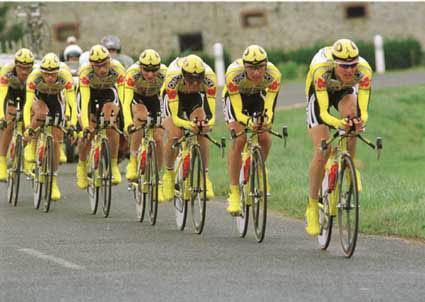 ONCE Team in full cry, albeit on Giant frames. It's hard to find the team in its pink outfit (when the Tour forbade too much yellow in a standard team kit).
This was the standard TTT picture for the era. When Lance was around it was the Discovery/USPS team, or nowadays it's the CSC team. ONCE, for all their problems once they became Liberty-Seguros, had the respect and admiration because of their team "professionalism", and it didn't get better than the TTT. For many years Manolo Sainz (Mister Operation Puerto) forbade his riders from contesting their respective National Championships so that the ONCE TTT squad would look uniform, such was the importance ONCE put on the TTT.
Appropriately Look pushed the limits with time trial bike technology. They never went bonkers - their designs seemed to make sense with reasons for various tube shapes.
 The most extreme TT frame from Look - I don't even know the name of it - banned immediately after Alex Zulle (pictured) won the prologue at the Tour.
The most radical Look frame pictured above was one of the first to try and fair the front and rear wheels. The downtube was very wide, bridging the gap to the front tire. Based on today's Wiliers, Specialized, and Felt designs, this is an important thing. The big downtube fin extended under the bottom bracket, fairing in the rear wheel below the bottom bracket. Note also the "integrated" seat post.
Based on my experience with the KG196, I can only imagine how heavy this frame was, but for the fast Tour prologue, it was fine. So fine that Zulle slayed all and won the prologue, and too fine for legality. They were probably Look's shortest and most expensive run of framesets.
Another bike that would have to be included in the list of significant historical TT bikes is the first one with disc wheels. Talk about a (racing) world changing innovation!
 Moser using his disc wheeled bike in the 1984 Giro.
(From here)
Road Bike Action did a piece on The Most Significant Time Trial Bikes In History. A caveat - it didn't look at track or fixed gear bikes, so some extremely significant bikes got left out. "Road Bike Action" implies no track bikes so I'll go along with that. But they still left out some very, very significant bikes.
Since time trials indicate either an individual or team effort against the clock, aerodynamics plays the most important role. Prior to understanding this basic concept, racers went for light weight. And prior to that they strived to have gearing, brakes that worked, and other basic necessities. For the purpose of this post I'll skip the basics (i.e. derailleurs, recumbent vs "standard" position, etc) and the lightweight (titanium, carbon, and aluminum usage). Instead I'll focus on aero ideas and implementations.
In general it is relatively straight forward to pick out the really big influential bikes. There's Lemond's 1989 bike, the first to use aero bars. Of course the Lotus ridden by Chris Boardman, the first truly properly designed time trial bike ever, with aerodynamicists actually radically changing the original design (which had a basic flaw that even a junior aerodynamicist would have caught).
However, in what I perceive as a nod to their sponsors, RBA spend the rest of the article busily listing relatively current bikes that are built by, coincidentally, a bunch of their advertisers, Pinarello, Specialized, Litespeed, BMC, and Cervelo. RBA did have a handicap in that they published the article before all the new time trial technology came out for the 2008 Tour, so they missed things like Giant's TT bike (which I consider the most significant of the TT bikes unveiled there).
But as far as past time trial bikes, there are a bunch of machines that should have been included in the article, even if based only on aero type advancements. When an article uses the word "history" in its title, it takes on great responsibility. It would have been better to say "in the last 20 years" or something like that, but RBA didn't say that.
I do admit that in the post-"standard bike" UCI ruling, the BMC and Cervelo are perhaps the most significant ones out there.
For example, Cervelo has gotten a lot of press as the frameset that set the standard for time trialing, and a lot of their design gets copied by others. In a related topic Cervelo was the first company to really push aero frames for mass start races - witness CSC's favorite tactic of hammering at the front and using their strong time trialers and more aerodynamic bikes to literally ride most of the field off their wheel.
In 2009 we will see many more racers on aero frames for mass start races, and not just CSC racers. By 2010 I expect to see most racers on bikes that give some aero nod somewhere, whether it's a faired rear wheel, a narrower downtube, perhaps a odd curvy seat tube, or a waisted head tube. Aero frames will be like tall profile rims - all the pros will be using them, and with the UCI weight limit set at a relatively high 6.8 kilograms, there's a few grams of carbon available to make these framesets.
BMC's TT bike is pretty interesting, although, as RBA points out, the racers on it seem to have attracted way more attention than the bike (Tyler Hamilton and Alexander Vinokourov, the two top positives for blood transfusions so far). BMC assembled a bike that had its fork fairing the headtube, an innovative way of hiding the stem (since it really doesn't "hide" the head tube because it's simply replaced by an external steerer tube) and perhaps a cable or two.
Of course when I saw that bike I immediately thought of another bike, one that is perhaps 20 years old, the Look KG196. This is the predecesor to the aero "mass start" race bikes of today.
 A modernized KG196.
From this site, I stole the picture in case the "for sale" listing goes away.
And again, but this time the frame set only, showing some of the details of the "years before its time" frameset.
 From this listing, picture stolen in case it goes away.
It had a faired in head tube like the BMC time trial bike, a faired in rear wheel "a la Cervelo", a bottom bracket rear wheel "fin" (Cannondale's Super Six has one, among others), a built in Ergo-stem, and aero shaped tubes. Due to the primitive use of carbon fiber back in the day (90s) it was heavy, I think over eight (?) pounds for the frame, fork, and stem. You'll notice the gaping hole between the front tire and the downtube, now acknowledged to be an area important to fill.
In addition, since at that time they didn't differentiate between vertical and lateral compliance, the frame had a very rough ride. I know because I desperately wanted to own one but I simply couldn't afford it. I did ride one for a week or two as a sort of "demo", but even after riding it around for a while I simply couldn't justify spending money I didn't have. The kicker was the non-replaceable derailleur hanger - I replaced my hanger about annually (or more frequently) and the KG196 frameset I rode didn't allow for that. This meant it'd be necessary to replace the whole frame, and I couldn't do that annually, or, as the case was one year, weekly for four weeks.
Look and ONCE teamed up to become the most successful time trial squad, in particular the team time trial. The standard picture of a TTT from that era was the ONCE team in full cry:
ONCE Team in full cry, albeit on Giant frames. It's hard to find the team in its pink outfit (when the Tour forbade too much yellow in a standard team kit).This was the standard TTT picture for the era. When Lance was around it was the Discovery/USPS team, or nowadays it's the CSC team. ONCE, for all their problems once they became Liberty-Seguros, had the respect and admiration because of their team "professionalism", and it didn't get better than the TTT. For many years Manolo Sainz (Mister Operation Puerto) forbade his riders from contesting their respective National Championships so that the ONCE TTT squad would look uniform, such was the importance ONCE put on the TTT.
Appropriately Look pushed the limits with time trial bike technology. They never went bonkers - their designs seemed to make sense with reasons for various tube shapes.
The most extreme TT frame from Look - I don't even know the name of it - banned immediately after Alex Zulle (pictured) won the prologue at the Tour.The most radical Look frame pictured above was one of the first to try and fair the front and rear wheels. The downtube was very wide, bridging the gap to the front tire. Based on today's Wiliers, Specialized, and Felt designs, this is an important thing. The big downtube fin extended under the bottom bracket, fairing in the rear wheel below the bottom bracket. Note also the "integrated" seat post.
Based on my experience with the KG196, I can only imagine how heavy this frame was, but for the fast Tour prologue, it was fine. So fine that Zulle slayed all and won the prologue, and too fine for legality. They were probably Look's shortest and most expensive run of framesets.
Another bike that would have to be included in the list of significant historical TT bikes is the first one with disc wheels. Talk about a (racing) world changing innovation!
Moser using his disc wheeled bike in the 1984 Giro.(From here)
Moser had shattered Eddy Merckx's Hour Record early in 1984. He used a dual disc wheel track bike (hence I'm not including that particular bike as a road time trial bike), then took the technology onto the road. His bike was pretty radical too, with a 650c front tire, 700c rear, an upward sloping top tube that necessitated the shortest of seat posts (another "integrated seat post" type of frame). The wheels were discs so the builder shaped the tubing to draft each other, the seat tube curving back dramatically to merge smoothly with the top tube. Although aerodynamically unsound (it would have been better to have a vertical tube that was aerodynamically shaped) it still represented a huge step in shaping a bike frame.
He took the pink on the final time trial of the 1984 Giro from Laurent Fignon while aboard an adaptation of his Hour Record bike. Fignon had been riding that Renault-Elf "aero" time trial bike (described below), but compared to the space machine under Moser, he was severely handicapped. It's debatable whether the wheels or a TV helicopter helped more. The whole Giro was biased to Moser's favor, with other Italian racers complaining about the "elevator of hands" helping Moser up each climb, the (Italian promoter's) cancellation of the Queen mountain stage due to non-existant snow (Moser was expected to lose time, elevator of hands notwithstanding). The final favor was a very low TV helicopter that hovered just behind Moser as he time trialed, providing a mega-strong tailwind (have you ever been near a helicopter that is landing or taking off?). Whatever the cause, Moser ultimately won the Giro and his return to cycling complete, with the Hour Record and the Giro to his name.
Fignon's Gitane time trial bike deserves a special mention. It is the first time that a team organized aerodynamic testing. They sacrificed light weight to get more "aero".
 The "aero" time trial bike used by Renault-Elf
(From here)
He took the pink on the final time trial of the 1984 Giro from Laurent Fignon while aboard an adaptation of his Hour Record bike. Fignon had been riding that Renault-Elf "aero" time trial bike (described below), but compared to the space machine under Moser, he was severely handicapped. It's debatable whether the wheels or a TV helicopter helped more. The whole Giro was biased to Moser's favor, with other Italian racers complaining about the "elevator of hands" helping Moser up each climb, the (Italian promoter's) cancellation of the Queen mountain stage due to non-existant snow (Moser was expected to lose time, elevator of hands notwithstanding). The final favor was a very low TV helicopter that hovered just behind Moser as he time trialed, providing a mega-strong tailwind (have you ever been near a helicopter that is landing or taking off?). Whatever the cause, Moser ultimately won the Giro and his return to cycling complete, with the Hour Record and the Giro to his name.
Fignon's Gitane time trial bike deserves a special mention. It is the first time that a team organized aerodynamic testing. They sacrificed light weight to get more "aero".
The "aero" time trial bike used by Renault-Elf(From here)
Although its aerodynamic benefits would be questioned today, back then it was a huge deal. The biggest thing was getting rid of the stem by putting the "stem" right through a hole in the head tube. It limited the bike's turning radius but I never heard of one of their racers crashing because he couldn't steer enough. Other points included aero profile tubes, aero brake cables (sort of controvesial at the time, considered to be less safe than non-aero cables), aero pedals, a very cool looking aero dynamic wing handlebar (the center portion resembled a huge wing about four inches front to back) and, probably most significantly as far as actual function, an aero waterbottle.
As an idea of weight, Sean Kelly's aluminum Vitus bike would have weighed about 17 or 18 pounds with the lightest stuff (i.e. in time trial trim), maybe an extra pound in normal trim. The Gitane weighed about 22 lbs.
Aero weighed a lot back in the 80s. Moser's disc wheels weighed about 5 pounds each, and Mavic even came out with a weighted disc (you'd put puck like weights in special holes located around the disc) so you could adjust the flywheel effect of the wheel.
Nowadays though aero is not heavy. The bikes are light, they push the limits of the UCI minimum weight, and yet they are loads more aero than some of the primitive bikes listed above. Racers use tall profile rims all the time, even in mass start races, and I expect to see more aero helmets, frames, and accessories as the pros look for any advantage to help them get that next win.
Aero started somewhere though, and it started in time trials. Its significant bikes started with the Gitane, continued with Moser, and then culminated with the Looks. I'm not counting the crazy stuff that got illegalized, and much of it, including the Superman position, were used almost exclusively on the track. RBA did hit the last of the weird TT bikes, the Pinarello "Huffy Toss" being one that comes to mind.
But RBA skipped all the aero development in time trial bikes and that's to their discredit. With articles like that one they will reduce their credibility. Someone called Bicycling Magazine "Buy-cycling" for all their wishy washy bike reviews that favor their advertisers. It would be a shame if RBA went down this road.
As an idea of weight, Sean Kelly's aluminum Vitus bike would have weighed about 17 or 18 pounds with the lightest stuff (i.e. in time trial trim), maybe an extra pound in normal trim. The Gitane weighed about 22 lbs.
Aero weighed a lot back in the 80s. Moser's disc wheels weighed about 5 pounds each, and Mavic even came out with a weighted disc (you'd put puck like weights in special holes located around the disc) so you could adjust the flywheel effect of the wheel.
Nowadays though aero is not heavy. The bikes are light, they push the limits of the UCI minimum weight, and yet they are loads more aero than some of the primitive bikes listed above. Racers use tall profile rims all the time, even in mass start races, and I expect to see more aero helmets, frames, and accessories as the pros look for any advantage to help them get that next win.
Aero started somewhere though, and it started in time trials. Its significant bikes started with the Gitane, continued with Moser, and then culminated with the Looks. I'm not counting the crazy stuff that got illegalized, and much of it, including the Superman position, were used almost exclusively on the track. RBA did hit the last of the weird TT bikes, the Pinarello "Huffy Toss" being one that comes to mind.
But RBA skipped all the aero development in time trial bikes and that's to their discredit. With articles like that one they will reduce their credibility. Someone called Bicycling Magazine "Buy-cycling" for all their wishy washy bike reviews that favor their advertisers. It would be a shame if RBA went down this road.
Saturday, July 26, 2008
Tour of California 2008 - Palomar Mountaintop Finish
Tour of CA announced that the race will finish its last stage at the top of Palomar Mountain.
Now we'll have a real race for the overall. It's a bit unfortunate there will be no "parade" stage for the overall winner to cycle around in an all yellow outfit, a crit in San Diego or something, but perhaps in 2010.
Not that I hold it against them. I have a slight clue as to how hard it is to organize a top level pro race in the US, and to get such a mountaintop for a day or two is incredible news. Logistically it'll be very challenging, with only two roads up, limited space at the top, and no real facilities (hotels, showers, etc). This is not like the Wintergreen resort in the Tour de Trump slash Tour du Pont. I don't envy those working the ToCA Palomar race, that's for sure.
I am looking forward to one thing though - I get to see exactly how slow I go up the mountain compared to the pros. I haven't seen pros climb a road I've done in training, not in a race. The couple times there was a Tour of CT I never saw footage and I didn't see any of the climbs, so I can't compare myself on those roads. Now, granted, I know I'm no climber, but I still have this morbid curiosity to see the delta between me and the pros. Of course it doesn't help my climbing case when "regular" riders ask me if I'm having mechanicals on a climb (I wasn't, it was just my legs).
If I was 25% lighter, I'm sure I'd be able to climb faster. It's like not having to carry a few bikes on my back while doing the climb. Granted I could lose perhaps a pound off my bike, but that's not really significant. Other than losing 40 or 50 pounds I don't know what to do to increase my climbing speed.
Let's see. Blood. My hematocrit varies from about 46% to just a touch under 50% - no room for improvement there. I'm carrying as much oxygen in my blood as possible.
(Incidentally I notice my cholesterol goes up when my hematocrit does, and vice versa - can that be related?).
Muscles. Power-wise I'm severely lacking. I know I can sustain 200-230 watts for a while, 200 watts long enough to get to the top of the long climb up Palomar. That wattage translates to something like 5 mph, 9 kph, dependent on the exact spot of course, but nonetheless a sloth-like pace in the world of pro cycling.
The pros sustain 300-400 watts on climbs. Apparently the "laughing group", i.e. the group of non-climbers intent simply on finishing inside the time limit, will climb at 320-330 watts.
Ouch.
I do that for a minute at a time, here and there, but for big long climbs? Forget it.
It's during these big pro races where you can see racer's wattage and heart rates that I get reminded, in a jackhammer way, that I'm not a pro. I know I'm not a pro, I don't have a pro license, but the information flowing from the websites just reinforce how far away I am from being a pro.
Now to go out and train and see if I can pretend to be a pro more than a couple hundred yards at a time.
Now we'll have a real race for the overall. It's a bit unfortunate there will be no "parade" stage for the overall winner to cycle around in an all yellow outfit, a crit in San Diego or something, but perhaps in 2010.
Not that I hold it against them. I have a slight clue as to how hard it is to organize a top level pro race in the US, and to get such a mountaintop for a day or two is incredible news. Logistically it'll be very challenging, with only two roads up, limited space at the top, and no real facilities (hotels, showers, etc). This is not like the Wintergreen resort in the Tour de Trump slash Tour du Pont. I don't envy those working the ToCA Palomar race, that's for sure.
I am looking forward to one thing though - I get to see exactly how slow I go up the mountain compared to the pros. I haven't seen pros climb a road I've done in training, not in a race. The couple times there was a Tour of CT I never saw footage and I didn't see any of the climbs, so I can't compare myself on those roads. Now, granted, I know I'm no climber, but I still have this morbid curiosity to see the delta between me and the pros. Of course it doesn't help my climbing case when "regular" riders ask me if I'm having mechanicals on a climb (I wasn't, it was just my legs).
If I was 25% lighter, I'm sure I'd be able to climb faster. It's like not having to carry a few bikes on my back while doing the climb. Granted I could lose perhaps a pound off my bike, but that's not really significant. Other than losing 40 or 50 pounds I don't know what to do to increase my climbing speed.
Let's see. Blood. My hematocrit varies from about 46% to just a touch under 50% - no room for improvement there. I'm carrying as much oxygen in my blood as possible.
(Incidentally I notice my cholesterol goes up when my hematocrit does, and vice versa - can that be related?).
Muscles. Power-wise I'm severely lacking. I know I can sustain 200-230 watts for a while, 200 watts long enough to get to the top of the long climb up Palomar. That wattage translates to something like 5 mph, 9 kph, dependent on the exact spot of course, but nonetheless a sloth-like pace in the world of pro cycling.
The pros sustain 300-400 watts on climbs. Apparently the "laughing group", i.e. the group of non-climbers intent simply on finishing inside the time limit, will climb at 320-330 watts.
Ouch.
I do that for a minute at a time, here and there, but for big long climbs? Forget it.
It's during these big pro races where you can see racer's wattage and heart rates that I get reminded, in a jackhammer way, that I'm not a pro. I know I'm not a pro, I don't have a pro license, but the information flowing from the websites just reinforce how far away I am from being a pro.
Now to go out and train and see if I can pretend to be a pro more than a couple hundred yards at a time.
Friday, July 25, 2008
Equipment - Why Deep Profile Rims Work in Mass Start Races
A question that comes up frequently is that of using tall profile ("aero") wheels in criteriums or road races. Such aero aids are a given in a solo effort like a time trial, but in mass start races the benefits can be a bit less obvious.
Road racing is a different kind of racing, one that I can't claim to be well versed, since I have yet to finish a road race with the main bunch. Criteriums though, I can talk crits.
And in crits, aero wheels help. There is one possible exception - the ones with super slow hairpin turns (say, under 15 mph). And this is dealing with the mass rider or peloton aspect - this whole "theorem" doesn't apply to breakaway or chase efforts where aero definitely matters.
If you're in any sort of a normal crit, you'll be going pretty fast most of the time. It's unusual to slow down a lot for turns, and if you ride smart, you don't have to actually sprint out of turns too much - and that's no matter where you are in the field, not just the top 10 or whatever. You'll probably cruise at 22-32 mph (turns and straights included) and spike up to 40-42 mph (for a mainly flat course - courses with rises and dips will be faster).
The aero wheels really help when the speed goes through the roof - a 5-10 mph surge for example, or you need to move up. If the field is already riding over the 30 mph range, you'll need to make a 35-40+ mph effort to move up. A box section wheel is hard pressed to go over 42 mph (just from experience, no backing data). However, it's not unusual to be able to move up at 44-46+ mph with aero wheels if you have a slight wind/draft or hill assist. Such a spike in speed is very difficult to make with box section wheels.
Aero wheels are especially helpful when the field is strung out or there's a crosswind (esp those wheels that do well in a crosswind). Once the field is strung out, the draft is not as significant as when the field is bunched up. You're going to have to work to keep your spot and an aero wheel will help you do that. I specifically bring my Specialized TriSpokes (HED3) for windy, flat airfield crits. I used to run a rear disk as well.
Finally, in a sprint, aero wheels could potentially increase your top speed by as much as 6 mph (personal experience). It seems that many riders have about the same wattage output in a sprint (i.e. 1500 watts peak seems sort of normal). Even if you jump at the optimal time, your 1500 watts only gets you a given amount of speed (frontal area, slope, wind, etc). If you can get even 2 mph by using more aero wheels, then you should.
I don't know for sure but I think the whole deep rim thing (and disks) have to do with limiting the speed the *spokes* hit the air. This is because the spokes are by far the fastest moving object on the bike. If you can reduce the spokes' drag, you'll reduce the bike's overall drag significantly since the rest of the bike is going at a much slower speed aerodynamically.
If your bike is going 30 mph, your tire is stationary on the ground (unless you're skidding). The top of your tire is going 60 mph. You can imagine your wheel sectioned so that the hub is 30 mph, 1/3 down is 20 mph, 2/3 down is 10 mph, all the way down is 0 mph. Then you go the other way - 1/3 up from the hub is 40 mph, 2/3 is 50 mph, top is 60 mph.
 A rough illustration of the concept of spoke speed relative to bike speed
Based on a standard wheel (with tire) height, going 30 mph, the top of the spokes for the following shape rims hit the wind at the following speeds:
There's various other factors like rim surface area, the way air flows, etc, but nothing can dispute the fact that if you have a 700c wheel and you're going 30 mph, the spoke (or perhaps the spoke nipples) will be traveling at the speeds above based on rim depth and a 19 mm tall tire. For reference sake I used 673 mm for overall wheel and tire height.
The spokes on the very deep section rim are hitting the air 5 mph slower compared to the box section rim. If you can go 30 mph on the box section rim (turn the wheels so the spokes hit the wind at 57.5 mph) and you switch to 66 mm deep rims, you'll be able to do about 33 mph for the same effort. Nothing except swapping wheels. Keep in mind this doesn't account for your body's drag - but it's a good way to compare spoke speeds to see what potential gains you might achieve by using different wheels.
On 50 mm rims, you'll be able to go 32 mph. Again, no additional effort. Same position, just gear up a bit for the higher speed.
On 22 mm rims, you'll go about 1/2 mph faster, about 30.5 mph.
I have a spreadsheet which does the calculations based on overall wheel height, bike speed, and rim heights you specify if anyone is interested.
 Screenshot of spreadsheet
The only time aero wheels don't work for you is if you have a very "jumpy" course - things like hairpins, wide straights dumping into a narrow and steep uphill, or a finish line less than the required 200 m from the last turn. Then accelerating to a very high speed in 1-2 less pedal strokes (from personal experience - 4 or 5 pedals strokes instead of 6 or 7) would be better than being able to accelerate to a higher top speed (which would take a total of perhaps 8-10 pedal strokes).
As for handling, aero wheels are definitely usable in crits with winds up to 30+ mph. You have to train on your front wheel so you get used to steering the wheel versus steering your hips - aero wheels get steered like a rudder. Once you do that you'll be comfy with aero wheels virtually all the time.
My helmet cam clips have me running either a DV46 (46 mm rim) or a Specialized TriSpoke in the front. You can see that my handling isn't affected by the wheels (and some of the races were quite windy).
(For those that race in CT, NY, NJ, MA, and RI Cat 3 criteriums, this advice does not apply to you, at least if I'm in the race!)
Road racing is a different kind of racing, one that I can't claim to be well versed, since I have yet to finish a road race with the main bunch. Criteriums though, I can talk crits.
And in crits, aero wheels help. There is one possible exception - the ones with super slow hairpin turns (say, under 15 mph). And this is dealing with the mass rider or peloton aspect - this whole "theorem" doesn't apply to breakaway or chase efforts where aero definitely matters.
If you're in any sort of a normal crit, you'll be going pretty fast most of the time. It's unusual to slow down a lot for turns, and if you ride smart, you don't have to actually sprint out of turns too much - and that's no matter where you are in the field, not just the top 10 or whatever. You'll probably cruise at 22-32 mph (turns and straights included) and spike up to 40-42 mph (for a mainly flat course - courses with rises and dips will be faster).
The aero wheels really help when the speed goes through the roof - a 5-10 mph surge for example, or you need to move up. If the field is already riding over the 30 mph range, you'll need to make a 35-40+ mph effort to move up. A box section wheel is hard pressed to go over 42 mph (just from experience, no backing data). However, it's not unusual to be able to move up at 44-46+ mph with aero wheels if you have a slight wind/draft or hill assist. Such a spike in speed is very difficult to make with box section wheels.
Aero wheels are especially helpful when the field is strung out or there's a crosswind (esp those wheels that do well in a crosswind). Once the field is strung out, the draft is not as significant as when the field is bunched up. You're going to have to work to keep your spot and an aero wheel will help you do that. I specifically bring my Specialized TriSpokes (HED3) for windy, flat airfield crits. I used to run a rear disk as well.
Finally, in a sprint, aero wheels could potentially increase your top speed by as much as 6 mph (personal experience). It seems that many riders have about the same wattage output in a sprint (i.e. 1500 watts peak seems sort of normal). Even if you jump at the optimal time, your 1500 watts only gets you a given amount of speed (frontal area, slope, wind, etc). If you can get even 2 mph by using more aero wheels, then you should.
I don't know for sure but I think the whole deep rim thing (and disks) have to do with limiting the speed the *spokes* hit the air. This is because the spokes are by far the fastest moving object on the bike. If you can reduce the spokes' drag, you'll reduce the bike's overall drag significantly since the rest of the bike is going at a much slower speed aerodynamically.
If your bike is going 30 mph, your tire is stationary on the ground (unless you're skidding). The top of your tire is going 60 mph. You can imagine your wheel sectioned so that the hub is 30 mph, 1/3 down is 20 mph, 2/3 down is 10 mph, all the way down is 0 mph. Then you go the other way - 1/3 up from the hub is 40 mph, 2/3 is 50 mph, top is 60 mph.
 A rough illustration of the concept of spoke speed relative to bike speed
Based on a standard wheel (with tire) height, going 30 mph, the top of the spokes for the following shape rims hit the wind at the following speeds:
box (9mm) = 57.5 mph
slight aero (22mm height) = 56.25 mph
50 mm rim = 53.8 mph
66 mm rim = 52.4 mph
slight aero (22mm height) = 56.25 mph
50 mm rim = 53.8 mph
66 mm rim = 52.4 mph
There's various other factors like rim surface area, the way air flows, etc, but nothing can dispute the fact that if you have a 700c wheel and you're going 30 mph, the spoke (or perhaps the spoke nipples) will be traveling at the speeds above based on rim depth and a 19 mm tall tire. For reference sake I used 673 mm for overall wheel and tire height.
The spokes on the very deep section rim are hitting the air 5 mph slower compared to the box section rim. If you can go 30 mph on the box section rim (turn the wheels so the spokes hit the wind at 57.5 mph) and you switch to 66 mm deep rims, you'll be able to do about 33 mph for the same effort. Nothing except swapping wheels. Keep in mind this doesn't account for your body's drag - but it's a good way to compare spoke speeds to see what potential gains you might achieve by using different wheels.
On 50 mm rims, you'll be able to go 32 mph. Again, no additional effort. Same position, just gear up a bit for the higher speed.
On 22 mm rims, you'll go about 1/2 mph faster, about 30.5 mph.
I have a spreadsheet which does the calculations based on overall wheel height, bike speed, and rim heights you specify if anyone is interested.
 Screenshot of spreadsheet
The only time aero wheels don't work for you is if you have a very "jumpy" course - things like hairpins, wide straights dumping into a narrow and steep uphill, or a finish line less than the required 200 m from the last turn. Then accelerating to a very high speed in 1-2 less pedal strokes (from personal experience - 4 or 5 pedals strokes instead of 6 or 7) would be better than being able to accelerate to a higher top speed (which would take a total of perhaps 8-10 pedal strokes).
As for handling, aero wheels are definitely usable in crits with winds up to 30+ mph. You have to train on your front wheel so you get used to steering the wheel versus steering your hips - aero wheels get steered like a rudder. Once you do that you'll be comfy with aero wheels virtually all the time.
My helmet cam clips have me running either a DV46 (46 mm rim) or a Specialized TriSpoke in the front. You can see that my handling isn't affected by the wheels (and some of the races were quite windy).
(For those that race in CT, NY, NJ, MA, and RI Cat 3 criteriums, this advice does not apply to you, at least if I'm in the race!)
Thursday, July 24, 2008
Racing - Teams at a Club Level
The other night I was deep in conversation with a fellow racer and one of the topics that came up was the whole thing with (bicycle) racing culture, tradition, and etiquette.
Specifically we spoke of the lack of all of the above things.
Although no fault of their own, nowadays teams pop up around sponsors, die off quickly, and recycle quickly and constantly. Okay, yes, a few teams maintain a tenacious grip on their multi decade existence but I don't know of any club in the immediate area that exists mainly due to promoting the richness of racing culture. Well, maybe Laurel in North Haven, CCB in the Boston area, but that's all that come to mind right away. Okay, I can name some other teams but they seem to promote much more aggressive riding (i.e. it's okay to body check someone in a race) and so I won't count them as promoting "etiquette".
The guy I was talking with is a relatively new racer - I think he started racing after I went carbon, 10 speed, and just before I went to measuring power. He pointed out that in other sports there is a history of tradition, of etiquette, and the information is out there for people to read and learn.
Except for a few forum threads, blog posts, or perhaps an isolated club article here and there, there is really nothing out there similar to this for cycling.
Although I hadn't thought of it prior, I theorized that the whole reason this is so is because clubs and teams are now in the commodity business.
When I started racing, teams were social and performance based groups. Now they are a vehicle for sponsors and racers to exchange product for marketing.
The old school teams actually had meetings, sometimes monthly, and planned out their riding and racing schedules. Performance because the same teams would "scout out" new racers (usually unattached ones) at early season races and see who they could lure onto the team with promises of good group rides, a cohesive group of racers at races, and, although I am guessing at this last one because I was 14 when I started shopping teams, the occasional night out at a bar or something.
Teams had dues, usually the cost of one jersey, and they had a mailing list, some officers, and hopefully a race to promote. Sponsors would include a local shop and some local businesses whose owners happened to race for the team.
I raced for a long, long time with the same set of racers, perhaps 15-18 years. We started out by meeting at the Westport YMCA, then, as the shop got more involved, we'd meet at the sponsoring shop.
The team had its official and unofficial leaders. The people who held meetings and such were sometimes not the actual officers, but they were the ones who made the team work. As usual there was maybe an 8:1 or 9:1 ratio of spectators and "doers", with the doers making it possible for everyone else to enjoy team clothing, the somewhat painful meetings that turned into trading war stories, and going out and racing as a collective and cohesive team.
The sponsorship was limited and didn't factor into the team's focus. It got sponsorship from its members, from businesses which the members frequently patronized (a deli for example), and sometimes, if someone struck gold, an actual parts supplier. The latter usually happened only if a new company was trying to get their product some air time, and they'd sell a shop's team members product at well below cost. When helmets became mandated by the USCF (now officially USA Cycling), new manufacturers were quick to offer discounted helmets to teams.
The team's captains were experienced racers, understood etiquette, had a rich repetoire of racing stories, and passed their knowledge on to their less experienced teammates. I benefited from one such captain, my original lead-out man. He taught me how to slither through non-existent holes in the field, taught me strategy and tactics, told stories about pros and amateurs alike, and demonstrated first hand how a teammate should sacrifice himself to help another with a better chance of winning.
Our rides were standard weekend rides from a local deli. We'd do some mutation of a standard loop, adding or subtracting from the basic route based on who showed up that morning. We'd practice doing pacelines, talked about how long to pull before pulling off (20 revolutions is a nice rule of thumb), and when all that went smoothly we'd try double pacelines. We sprinted for a couple signs, attacked in the hills, and chased one another up and around the hills in the area.
Racers who didn't know what to do were instructed and those that didn't feel like participating got chastised. We'd practice bumping when going easy, and during the slow, cold winter rides, we'd talk about different cornering techniques, tricks for attacking particularly stubborn little rises, and our various experiments with clean position or perhaps a new fangled toe strap.
Along with some official cultural reinforcements (i.e. Winning magazine), local club newsletters, and some of the stuff that racers-turned-promoters would tell their charges at the start line, it was possible to learn and delve into the culture of bike racing.
One thing that I remember is that Cat 2s were the ones who got "free stuff". They'd get uniforms (now called "kits"), maybe shoes, maybe tires, and the really, really good ones would get bikes. Cat 2s were demi-gods back then, untouchable, incredibly strong, and all of them could smash your legs into little pieces of minced up flesh.
The doughy boys (and one scrawny non-climber, me) were stuck as Cat 3s and 4s, and our penance was to have to pay for everything we raced on.
But we'd learn and pass on what we learned.
For example, any time someone attacked legitimately early in a ride, the Junior/s had to go chase them down. I guess everyone felt it important to make them get used to pulling along others at an early age, and plus, with the sometimes ridiculously low gearing they had to use, they wouldn't be able to participate in the faster, mainly downhill return bit to the deli.
Another thing was that if the ride had a "no attack" warm up zone, it was both well defined and well respected. None of this "what is up with that guy?" attacks 50 yards from the deli. If an interloper had the temerity to attack in the "no attack" zone, the immediate pursuit was relentless, thorough, and was followed up by a lot of choice Italian, "French", and sometimes even Swedish words.
I mention "French" because that's like "Pardon my French" French. Italian, well, we liked to swear in Italian. Of course I don't know if I was actually swearing or what, but someone who claimed to be Italian would use Italian sounding swears and we'd all use them too.
Swedish? We did that to puzzle outsiders, but as you will see, we weren't really swearing at them. When our strongest rider was a Swedish guy, we asked him for a key phrase to yell so that we'd know when he wanted us up front, something not English or any of the common other languages around (like Spanish, French, or Italian). He said something like "Yolksadie". Well, that's how we pronounced it. He grimaced when we said it but it was close enough. We'd know it when we heard it.
So at the big target race (New Britain, if you must ask), we got all our guys in this race, we shut down everything that moved, and when he wanted us to go to the front, he yelled out, "Yolksadie!"
The rest of us (I think we had 14 teammates in that race!) started yelling, "Yolksadie! Yolksadie!"
So if you know a Swedish or Scandanavian person who was around for that very odd New Britain race in the late 80s, you can explain to them why there was a bunch of guys screaming out a horrendous Swedish pronunciation of "I love you!". Unfortunately at that race our love didn't work. We streamed to the front, tried to push the pace, shelter our guy, and collectively exploded a few laps later. I think he got 5th or something, and it was devastating to have all our work go down the tubes.
But the fact was that this team had coagulated over many years, trained together, raced together, and even went to team meetings together. In that sense the team was a success.
Nowadays teams are less like those socially based organizations. Now they are based around sponsors, they communicate electronically, and for a number of them the only time they see their teammates is when they show up at a race.
It's definitely a more mercenary relationship between the racers and their teams. People regularly jump from one team to another to get free kits, discounted (or free?) bikes, massive discounts on parts and accessories, and various other benefits like sponsor provided schwag, free or discounted fittings, coaching, etc.
I think that it's great that teams and their sponsors are willing to give product to their members. But the whole thing lacks something, an intangible - the passing on of culture, of tradition, of knowledge. New racers usually don't have a grizzled veteran guiding them through their first group rides, their first race, their first stage race.
One of my friends summed it up perfectly when he described his new team, one where his one or two years of racing was considered a lot of experience. He helped run it and they floundered as one might expect.
"Dude, we had no frickin clue what we were doing. It was ridiculous!"
Unfortunate but true.
So as not to complain without actually offering a couple approaches to dealing with this "problem", it's important to ask how can we fix this? And I say "we" because those that grew up in the past generations of teams are the ones that need to try and get the tradition thing rolling again.
It starts off with the stories, the pro stories of sacrifice, of struggle. It's those stories that inspire others and they set an example for the next generation of racers. No one gets inspired by someone just sitting in all day and twiddling their pedals to victory. But when I read about Merckx's 130 km solo break in the Yellow jersey to win by almost 8 minutes... well, it's something else. He won that Tour by almost 18 minutes over the second placed racer, and the time gaps in the top ten racers yawned to almost 52 minutes!
CyclingRevealed is a site that has done a great job in selecting and describing a little bit of what makes cycling so revered in Europe. For example there is a "Top 25 Tour" article which briefly describes each Tour and why they were so great. These are the stories that need to be told on those long, cold November rides, the January LSD rides, the rides where you build the foundations of the upcoming season, both physically and mentally.
It's also important to practice riding technique, both individual and group skills. With online coaching and all sorts of cool devices to measure one's fitness, new racers are stronger and stronger and can sustain the effort required of them to stay in a race. In many cases, however, their riding skills are not up to their strength. What happens is that their fitness level allows them to get into situations that require good bike handling skills and group riding etiquette, but they lack the latter.
The result? Frustration from both the strong and unskilled racer as well as the weaker but skilled racers. And, unfortunately, inevitably someone somewhere crashes.
With skills it's very important to get either video or actual (in person) instruction. Once the racer knows what to practice, they can go and practice such things on their own free time, perhaps on their easy or rest days. This is not very difficult and a few videos, DVDs, or perhaps even YouTube clips would be enough to help with this.
Group riding skills are different because by definition they require an actual group of racers. This is where a team that actually has meetings would be handy - part of the team meeting might be to suit up in rough and tumble clothing, go out to a nearby grassy field, and practice various group riding skills. In extremely cold weather the meetings may emphasize etiquette type instruction, or how to approach various things one might see on a group ride. The material is easy to get - if you have a regular group ride, at some point someone will complain. Right or not, a meeting that goes over that incident and what is acceptable (or not) is a great way of clarifying expectations from both the group and the individual.
New racers should be introduced to this whole "club team" concept, the idea that it's both a club (i.e. friendly group of people with similar interests) and a team (i.e. a sporting group with specific sporting goals).
An excellent way of doing this would be doing it through collegiate racing teams. Those teams have geographically close students (they go to the same school and probably live within a mile or two of each other), they have a lot of free time (seriously), and they have youthful enthusiasm. Given a good approach, strong instruction, and education on how to continue on after they graduate, collegiate racers offer the best opporunity for promoting racing in a managed, cohesive way.
The key would be to combine each local team or area with a nearby "veteran" to create a great symbiotic relationship. On one side you have the veteran, able and willing to share his vast experience with his young charges, and on the other you have an enthusiastic, captive pool of raw recruits eager to learn and effectively training to disperse all over the country.
Within a few generations of racers (a generation being a four year period in this case) we'd have approximately 10,000 racers (based on the number of collegiate racers now) skilled in individual riding technique, trained in group riding skills, and a knowledge of both the racing tradition as well as the method for passing on those techniques and skills. Each year there would be an additional 2500 or more racers joining those ranks.
If USA Cycling can tap into this seemingly endless young and enthusiastic group of racers, they could raise the quality of racers and racing in a methodical and controlled manner in the next 10 to 15 years.
Specifically we spoke of the lack of all of the above things.
Although no fault of their own, nowadays teams pop up around sponsors, die off quickly, and recycle quickly and constantly. Okay, yes, a few teams maintain a tenacious grip on their multi decade existence but I don't know of any club in the immediate area that exists mainly due to promoting the richness of racing culture. Well, maybe Laurel in North Haven, CCB in the Boston area, but that's all that come to mind right away. Okay, I can name some other teams but they seem to promote much more aggressive riding (i.e. it's okay to body check someone in a race) and so I won't count them as promoting "etiquette".
The guy I was talking with is a relatively new racer - I think he started racing after I went carbon, 10 speed, and just before I went to measuring power. He pointed out that in other sports there is a history of tradition, of etiquette, and the information is out there for people to read and learn.
Except for a few forum threads, blog posts, or perhaps an isolated club article here and there, there is really nothing out there similar to this for cycling.
Although I hadn't thought of it prior, I theorized that the whole reason this is so is because clubs and teams are now in the commodity business.
When I started racing, teams were social and performance based groups. Now they are a vehicle for sponsors and racers to exchange product for marketing.
The old school teams actually had meetings, sometimes monthly, and planned out their riding and racing schedules. Performance because the same teams would "scout out" new racers (usually unattached ones) at early season races and see who they could lure onto the team with promises of good group rides, a cohesive group of racers at races, and, although I am guessing at this last one because I was 14 when I started shopping teams, the occasional night out at a bar or something.
Teams had dues, usually the cost of one jersey, and they had a mailing list, some officers, and hopefully a race to promote. Sponsors would include a local shop and some local businesses whose owners happened to race for the team.
I raced for a long, long time with the same set of racers, perhaps 15-18 years. We started out by meeting at the Westport YMCA, then, as the shop got more involved, we'd meet at the sponsoring shop.
The team had its official and unofficial leaders. The people who held meetings and such were sometimes not the actual officers, but they were the ones who made the team work. As usual there was maybe an 8:1 or 9:1 ratio of spectators and "doers", with the doers making it possible for everyone else to enjoy team clothing, the somewhat painful meetings that turned into trading war stories, and going out and racing as a collective and cohesive team.
The sponsorship was limited and didn't factor into the team's focus. It got sponsorship from its members, from businesses which the members frequently patronized (a deli for example), and sometimes, if someone struck gold, an actual parts supplier. The latter usually happened only if a new company was trying to get their product some air time, and they'd sell a shop's team members product at well below cost. When helmets became mandated by the USCF (now officially USA Cycling), new manufacturers were quick to offer discounted helmets to teams.
The team's captains were experienced racers, understood etiquette, had a rich repetoire of racing stories, and passed their knowledge on to their less experienced teammates. I benefited from one such captain, my original lead-out man. He taught me how to slither through non-existent holes in the field, taught me strategy and tactics, told stories about pros and amateurs alike, and demonstrated first hand how a teammate should sacrifice himself to help another with a better chance of winning.
Our rides were standard weekend rides from a local deli. We'd do some mutation of a standard loop, adding or subtracting from the basic route based on who showed up that morning. We'd practice doing pacelines, talked about how long to pull before pulling off (20 revolutions is a nice rule of thumb), and when all that went smoothly we'd try double pacelines. We sprinted for a couple signs, attacked in the hills, and chased one another up and around the hills in the area.
Racers who didn't know what to do were instructed and those that didn't feel like participating got chastised. We'd practice bumping when going easy, and during the slow, cold winter rides, we'd talk about different cornering techniques, tricks for attacking particularly stubborn little rises, and our various experiments with clean position or perhaps a new fangled toe strap.
Along with some official cultural reinforcements (i.e. Winning magazine), local club newsletters, and some of the stuff that racers-turned-promoters would tell their charges at the start line, it was possible to learn and delve into the culture of bike racing.
One thing that I remember is that Cat 2s were the ones who got "free stuff". They'd get uniforms (now called "kits"), maybe shoes, maybe tires, and the really, really good ones would get bikes. Cat 2s were demi-gods back then, untouchable, incredibly strong, and all of them could smash your legs into little pieces of minced up flesh.
The doughy boys (and one scrawny non-climber, me) were stuck as Cat 3s and 4s, and our penance was to have to pay for everything we raced on.
But we'd learn and pass on what we learned.
For example, any time someone attacked legitimately early in a ride, the Junior/s had to go chase them down. I guess everyone felt it important to make them get used to pulling along others at an early age, and plus, with the sometimes ridiculously low gearing they had to use, they wouldn't be able to participate in the faster, mainly downhill return bit to the deli.
Another thing was that if the ride had a "no attack" warm up zone, it was both well defined and well respected. None of this "what is up with that guy?" attacks 50 yards from the deli. If an interloper had the temerity to attack in the "no attack" zone, the immediate pursuit was relentless, thorough, and was followed up by a lot of choice Italian, "French", and sometimes even Swedish words.
I mention "French" because that's like "Pardon my French" French. Italian, well, we liked to swear in Italian. Of course I don't know if I was actually swearing or what, but someone who claimed to be Italian would use Italian sounding swears and we'd all use them too.
Swedish? We did that to puzzle outsiders, but as you will see, we weren't really swearing at them. When our strongest rider was a Swedish guy, we asked him for a key phrase to yell so that we'd know when he wanted us up front, something not English or any of the common other languages around (like Spanish, French, or Italian). He said something like "Yolksadie". Well, that's how we pronounced it. He grimaced when we said it but it was close enough. We'd know it when we heard it.
So at the big target race (New Britain, if you must ask), we got all our guys in this race, we shut down everything that moved, and when he wanted us to go to the front, he yelled out, "Yolksadie!"
The rest of us (I think we had 14 teammates in that race!) started yelling, "Yolksadie! Yolksadie!"
So if you know a Swedish or Scandanavian person who was around for that very odd New Britain race in the late 80s, you can explain to them why there was a bunch of guys screaming out a horrendous Swedish pronunciation of "I love you!". Unfortunately at that race our love didn't work. We streamed to the front, tried to push the pace, shelter our guy, and collectively exploded a few laps later. I think he got 5th or something, and it was devastating to have all our work go down the tubes.
But the fact was that this team had coagulated over many years, trained together, raced together, and even went to team meetings together. In that sense the team was a success.
Nowadays teams are less like those socially based organizations. Now they are based around sponsors, they communicate electronically, and for a number of them the only time they see their teammates is when they show up at a race.
It's definitely a more mercenary relationship between the racers and their teams. People regularly jump from one team to another to get free kits, discounted (or free?) bikes, massive discounts on parts and accessories, and various other benefits like sponsor provided schwag, free or discounted fittings, coaching, etc.
I think that it's great that teams and their sponsors are willing to give product to their members. But the whole thing lacks something, an intangible - the passing on of culture, of tradition, of knowledge. New racers usually don't have a grizzled veteran guiding them through their first group rides, their first race, their first stage race.
One of my friends summed it up perfectly when he described his new team, one where his one or two years of racing was considered a lot of experience. He helped run it and they floundered as one might expect.
"Dude, we had no frickin clue what we were doing. It was ridiculous!"
Unfortunate but true.
So as not to complain without actually offering a couple approaches to dealing with this "problem", it's important to ask how can we fix this? And I say "we" because those that grew up in the past generations of teams are the ones that need to try and get the tradition thing rolling again.
It starts off with the stories, the pro stories of sacrifice, of struggle. It's those stories that inspire others and they set an example for the next generation of racers. No one gets inspired by someone just sitting in all day and twiddling their pedals to victory. But when I read about Merckx's 130 km solo break in the Yellow jersey to win by almost 8 minutes... well, it's something else. He won that Tour by almost 18 minutes over the second placed racer, and the time gaps in the top ten racers yawned to almost 52 minutes!
CyclingRevealed is a site that has done a great job in selecting and describing a little bit of what makes cycling so revered in Europe. For example there is a "Top 25 Tour" article which briefly describes each Tour and why they were so great. These are the stories that need to be told on those long, cold November rides, the January LSD rides, the rides where you build the foundations of the upcoming season, both physically and mentally.
It's also important to practice riding technique, both individual and group skills. With online coaching and all sorts of cool devices to measure one's fitness, new racers are stronger and stronger and can sustain the effort required of them to stay in a race. In many cases, however, their riding skills are not up to their strength. What happens is that their fitness level allows them to get into situations that require good bike handling skills and group riding etiquette, but they lack the latter.
The result? Frustration from both the strong and unskilled racer as well as the weaker but skilled racers. And, unfortunately, inevitably someone somewhere crashes.
With skills it's very important to get either video or actual (in person) instruction. Once the racer knows what to practice, they can go and practice such things on their own free time, perhaps on their easy or rest days. This is not very difficult and a few videos, DVDs, or perhaps even YouTube clips would be enough to help with this.
Group riding skills are different because by definition they require an actual group of racers. This is where a team that actually has meetings would be handy - part of the team meeting might be to suit up in rough and tumble clothing, go out to a nearby grassy field, and practice various group riding skills. In extremely cold weather the meetings may emphasize etiquette type instruction, or how to approach various things one might see on a group ride. The material is easy to get - if you have a regular group ride, at some point someone will complain. Right or not, a meeting that goes over that incident and what is acceptable (or not) is a great way of clarifying expectations from both the group and the individual.
New racers should be introduced to this whole "club team" concept, the idea that it's both a club (i.e. friendly group of people with similar interests) and a team (i.e. a sporting group with specific sporting goals).
An excellent way of doing this would be doing it through collegiate racing teams. Those teams have geographically close students (they go to the same school and probably live within a mile or two of each other), they have a lot of free time (seriously), and they have youthful enthusiasm. Given a good approach, strong instruction, and education on how to continue on after they graduate, collegiate racers offer the best opporunity for promoting racing in a managed, cohesive way.
The key would be to combine each local team or area with a nearby "veteran" to create a great symbiotic relationship. On one side you have the veteran, able and willing to share his vast experience with his young charges, and on the other you have an enthusiastic, captive pool of raw recruits eager to learn and effectively training to disperse all over the country.
Within a few generations of racers (a generation being a four year period in this case) we'd have approximately 10,000 racers (based on the number of collegiate racers now) skilled in individual riding technique, trained in group riding skills, and a knowledge of both the racing tradition as well as the method for passing on those techniques and skills. Each year there would be an additional 2500 or more racers joining those ranks.
If USA Cycling can tap into this seemingly endless young and enthusiastic group of racers, they could raise the quality of racers and racing in a methodical and controlled manner in the next 10 to 15 years.
Wednesday, July 23, 2008
Doping - Working With Manufacturers
I've vocalized some ideas for anti-doping controls before. My anonymous mobile anti-doping testers, doing random checks in testing labs, and finally what would happen if there was a movement towards clean cycling.
One idea I had and sort of discarded was to put markers in all the various drugs that could be used to enhance performance. EPO type drugs are an obvious candidate for this - although there are legitimately anemic people all over the world, I don't think there are too many of them in the pro cycling peloton.
The problem with inserting a marker into an existing drug is that this marker could potentially turn out to have some side effect. Since the drug has been changed, it has to be retested. And that takes lots of time and lots of money that would drive the cost of the drug up. And it isn't because the drug doesn't work - it's all because some pharmacist somewhere is selling the stuff "under the counter".
As a manufacturer I'd be a little unhappy if I had to spend a bunch of money to retest a drug simply because someone is using it illegally. Why should, say, Vicks, for example, pay tons of money to insert a marker into one of their standard cough medicines? Used legitimately their products are safe. It's the abusers (or home meth concoctors) who make it a problem.
So other controls are in place - instead of buying the real NyQuil over the counter, you have to buy the stuff at the desk, give ID, and you're limited to 2.5 grams of pseudoephedrine a day (that's what my receipt said for my purchase of DayQuil and NyQuil).
I didn't think of a particular scenario in my "marker musings" - one of a new drug. In this case it would be simple to insert a marker somewhere at the beginning of the process, something unusual that would show up in users but have no effect on them. All the testing would be done with this marker in place and the drug would be approved with the same.
This testing with the marker in place would mean that the drug can't be sold without the marker.
Fine, an illegitimate manufacturer might try and replicate it without the marker, but who's to say what part is the marker?
The drug manufacturer could quietly perform the work with this inert marker, sort of like diamond sellers who somehow put serial numbers on their diamonds (laser?). It's not immediately obvious, so a legitimate patient could use the drug and not have their skin turn purple (although that would certainly be a strong deterrant from illegal drug use...). But just like a jeweler can check a serial number on a suspect diamond, someone checking some fluid samples of a suspected user would be able to immediately pinpoint use of any marker-type drug.
We could take it one step further and require that all drugs have some marker if they are not readily identified. So, for example, I think morphine breaks down into "normal" substances in the human body, but if there's a "morphine marker" then morphine use can be tracked even after the actual morphine is gone.
Back to the cycling, because that's what this is about.
Ricco, who tested positive for a barely released drug, was caught by a marker inserted by the drug manufacturer.
Well now.
If such work continues on all new drugs, it will become very difficult to dope without getting caught. Of course there are the current unmarked drugs, like the various "normal" EPO drugs, but if new drugs have markers, the anti-doping labs can spend more time on developing better tests for those unmarked drugs.
Combined with better testing schedules, a more accepted anti-doping culture, and acceptance of year round testing, I think that cycling (as well as other sports) can rid itself of much of its doping controversy. I'm sure people are thinking of new and better ways of beating the system, but for now it seems that the system is finally getting up to speed.
*Edit July 24, 2008* - Apparently there is not a marker molecule in this new EPO. Instead, by focusing on a unique and particular molecule in the drug, WADA was able to test for that particular molecule.
One idea I had and sort of discarded was to put markers in all the various drugs that could be used to enhance performance. EPO type drugs are an obvious candidate for this - although there are legitimately anemic people all over the world, I don't think there are too many of them in the pro cycling peloton.
The problem with inserting a marker into an existing drug is that this marker could potentially turn out to have some side effect. Since the drug has been changed, it has to be retested. And that takes lots of time and lots of money that would drive the cost of the drug up. And it isn't because the drug doesn't work - it's all because some pharmacist somewhere is selling the stuff "under the counter".
As a manufacturer I'd be a little unhappy if I had to spend a bunch of money to retest a drug simply because someone is using it illegally. Why should, say, Vicks, for example, pay tons of money to insert a marker into one of their standard cough medicines? Used legitimately their products are safe. It's the abusers (or home meth concoctors) who make it a problem.
So other controls are in place - instead of buying the real NyQuil over the counter, you have to buy the stuff at the desk, give ID, and you're limited to 2.5 grams of pseudoephedrine a day (that's what my receipt said for my purchase of DayQuil and NyQuil).
I didn't think of a particular scenario in my "marker musings" - one of a new drug. In this case it would be simple to insert a marker somewhere at the beginning of the process, something unusual that would show up in users but have no effect on them. All the testing would be done with this marker in place and the drug would be approved with the same.
This testing with the marker in place would mean that the drug can't be sold without the marker.
Fine, an illegitimate manufacturer might try and replicate it without the marker, but who's to say what part is the marker?
The drug manufacturer could quietly perform the work with this inert marker, sort of like diamond sellers who somehow put serial numbers on their diamonds (laser?). It's not immediately obvious, so a legitimate patient could use the drug and not have their skin turn purple (although that would certainly be a strong deterrant from illegal drug use...). But just like a jeweler can check a serial number on a suspect diamond, someone checking some fluid samples of a suspected user would be able to immediately pinpoint use of any marker-type drug.
We could take it one step further and require that all drugs have some marker if they are not readily identified. So, for example, I think morphine breaks down into "normal" substances in the human body, but if there's a "morphine marker" then morphine use can be tracked even after the actual morphine is gone.
Back to the cycling, because that's what this is about.
Ricco, who tested positive for a barely released drug, was caught by a marker inserted by the drug manufacturer.
Well now.
If such work continues on all new drugs, it will become very difficult to dope without getting caught. Of course there are the current unmarked drugs, like the various "normal" EPO drugs, but if new drugs have markers, the anti-doping labs can spend more time on developing better tests for those unmarked drugs.
Combined with better testing schedules, a more accepted anti-doping culture, and acceptance of year round testing, I think that cycling (as well as other sports) can rid itself of much of its doping controversy. I'm sure people are thinking of new and better ways of beating the system, but for now it seems that the system is finally getting up to speed.
*Edit July 24, 2008* - Apparently there is not a marker molecule in this new EPO. Instead, by focusing on a unique and particular molecule in the drug, WADA was able to test for that particular molecule.
Saturday, July 19, 2008
Pro Cycling Manager 2007, Doping, & Me
I recently had a post on this now-somewhat-outdated game Pro Cycling Manager 2007, but I realized that I had no pictures to illustrate the obsessive compulsiveness required (by me anyway) to play this game.
So to remedy that situation I decided to take a picture of my little setup.
So to remedy that situation I decided to take a picture of my little setup.
 The kitchen table where my laptop normally lives.
You'll notice of a few critical things. Clockwise from the top:
First, the Gatorade (and Powerade too, since they now come with Coke Rewards codes, which I've been collecting for a couple years). This is important for the electrolyte draining stress that the player undergoes while trying to schedule 20-odd racers' training camps and races.
Second, the Novell/Compaq pad (came with one of the many servers sold by Compaq, in a little notepad thing filled with various CD-ROMs and such), remnants from my IT days prior to Y2K. This is good quality scrap paper, narrow lined, thin, and I can scribble all over it without feeling guilty about wasting paper. I knew I saved it for a reason.
Third, the black appointment book under the pad of paper. This is where I write down my real life appointments, training hours (I write notes on my ride in there, but I also have WKO+ for an electronic record of stuff), etc.
Fourth, Road Bike Action. This particular issue has yet another "fill out a survey and get a chance to win a bike" survey, so I gave it "near the laptop" priviledges. Most of the recent bike magazines get placed in the rest room where I read while I rest.
Fifth, black roller ball micro-tip pen. I like really fine tip roller ball pens because they offer just enough resistance to enable me to write neatly. Normal ball point pens slide too quickly and I end up with a messy scrawl. Roller ball pens (the super fine points) are just right for me.
Sixth, Pro Cycling Manager 2007 notes. There are three pages. The top left has my team roster with some notes beside each name. The top right one has notes on my February campaign - who is on which team and where they'll travel at what time for which races. There are some sponsor-pinpointed races and those are duly noted. The bottom page have the team racers (left column), the dates (across the top), and the schedule (in the middle). The left column has an extra column for notes on the racers (fitness level, morale, etc). I copied a "master" sheet eleven times to make them.
Seventh, various colored super fine tip roller ball pens. This is for doing the various scheduling. I've assigned three different colors (pink, green, light blue) to the three different teams (of 8, 7, and 6 racers), dark blue is for training camps, and red stars for the sponsor-important races.
Eighth, and probably most important for playing a computer game - a computer! This is the laptop where I do most/all of my writing. My desktop has been reduced to a picture gatherer and sometimes MS Office work (I have OpenOffice installed on the laptop). The game screen is displaying my team roster and their fitness levels (boxes which are dark, orange, or silver - indicating everyone is pretty weak right now), mood (green boxes with arrow pointing up or to the right), experience (bars on the right), and their average "rating" (column to the right of their names) which indicate their base/genetic abilities across different disciplines like climbing, sprinting, time trialing, etc.
Ninth, my real SRM. My laptop is also my WKO+ machine. I like checking out my training stats after I ride, more a curiosity than anything else. It's not very inspiring to see that I rarely hit 200 watts per hour, but at the same time it's interesting to see how fast I really went on that 50 mph downhill (45 mph).
Tenth, my cell phone. In case someone calls to offer me a cycling team manager position :)
First, the Gatorade (and Powerade too, since they now come with Coke Rewards codes, which I've been collecting for a couple years). This is important for the electrolyte draining stress that the player undergoes while trying to schedule 20-odd racers' training camps and races.
Second, the Novell/Compaq pad (came with one of the many servers sold by Compaq, in a little notepad thing filled with various CD-ROMs and such), remnants from my IT days prior to Y2K. This is good quality scrap paper, narrow lined, thin, and I can scribble all over it without feeling guilty about wasting paper. I knew I saved it for a reason.
Third, the black appointment book under the pad of paper. This is where I write down my real life appointments, training hours (I write notes on my ride in there, but I also have WKO+ for an electronic record of stuff), etc.
Fourth, Road Bike Action. This particular issue has yet another "fill out a survey and get a chance to win a bike" survey, so I gave it "near the laptop" priviledges. Most of the recent bike magazines get placed in the rest room where I read while I rest.
Fifth, black roller ball micro-tip pen. I like really fine tip roller ball pens because they offer just enough resistance to enable me to write neatly. Normal ball point pens slide too quickly and I end up with a messy scrawl. Roller ball pens (the super fine points) are just right for me.
Sixth, Pro Cycling Manager 2007 notes. There are three pages. The top left has my team roster with some notes beside each name. The top right one has notes on my February campaign - who is on which team and where they'll travel at what time for which races. There are some sponsor-pinpointed races and those are duly noted. The bottom page have the team racers (left column), the dates (across the top), and the schedule (in the middle). The left column has an extra column for notes on the racers (fitness level, morale, etc). I copied a "master" sheet eleven times to make them.
Seventh, various colored super fine tip roller ball pens. This is for doing the various scheduling. I've assigned three different colors (pink, green, light blue) to the three different teams (of 8, 7, and 6 racers), dark blue is for training camps, and red stars for the sponsor-important races.
Eighth, and probably most important for playing a computer game - a computer! This is the laptop where I do most/all of my writing. My desktop has been reduced to a picture gatherer and sometimes MS Office work (I have OpenOffice installed on the laptop). The game screen is displaying my team roster and their fitness levels (boxes which are dark, orange, or silver - indicating everyone is pretty weak right now), mood (green boxes with arrow pointing up or to the right), experience (bars on the right), and their average "rating" (column to the right of their names) which indicate their base/genetic abilities across different disciplines like climbing, sprinting, time trialing, etc.
Ninth, my real SRM. My laptop is also my WKO+ machine. I like checking out my training stats after I ride, more a curiosity than anything else. It's not very inspiring to see that I rarely hit 200 watts per hour, but at the same time it's interesting to see how fast I really went on that 50 mph downhill (45 mph).
Tenth, my cell phone. In case someone calls to offer me a cycling team manager position :)
 A close up of the sheet with my team's February schedule. I started with black ink in the schedule before I realized I had to color coordinate things for my own sanity.
Within the game I was telling these guys to go 2 or 3 hours easy, or 4 or 5 hours medium, or even 6 or 7 hours easy. I figured they'd like a 2-3 hour day between each long day, and it seems the game agrees with that.
I decided to schedule my guys to do alternating hard and easy days. Since I ran two different training camps (in two different areas, to prepare for races in two different hemispheres), I had to write down the schedule so I wouldn't accidentally tell one camp's riders to do the other camp's schedule. Once I figured out which camp was which, I quickly and easily jotted down the racers' training hours. 2-3. 6-7. 2-3. 4-5. And so on.
(Note: A non-feature of the game is that if you hold two camps, your daily messages don't distinguish between the two of them - I had to guess which one was which, get a report on what rider was doing well - or not - and then deduce the camp's location).
After putting my racers through a couple training camps, I realized something sort of external to the game.
I wasn't riding that much.
So, just like I'd scheduled my racers, I pulled out my appointment book, conveniently situated within hand's reach. And wrote down some decent sounding numbers for the weekdays ahead. With the 3 hours I did on race day (Sunday) I wanted to continue a longer hour, less intensity trend. With no races coming up I wanted to do what I always seem to need to do. Lose weight. Get some fitness back. Return to a late February form, almost 20 pounds lighter than I am right now.
Anyway, for myself, it was easier. I just wrote down some numbers, mentally picturing a route or two for each day. It was easy and painless.
Monday: 1 hour (easy one hour loop)
Tuesday: 3 hours (do a 2.5 hour loop, go easy so take more time)
Wednesday: 2 hours easy (two of the easy one hour loops)
Thursday: 5 hours (hilly cross-MA route, took 4 hours last time but I exploded so I'd go easier)
Friday: 1 hour (easy one hour loop)
Not bad, right?
I decided to schedule my guys to do alternating hard and easy days. Since I ran two different training camps (in two different areas, to prepare for races in two different hemispheres), I had to write down the schedule so I wouldn't accidentally tell one camp's riders to do the other camp's schedule. Once I figured out which camp was which, I quickly and easily jotted down the racers' training hours. 2-3. 6-7. 2-3. 4-5. And so on.
(Note: A non-feature of the game is that if you hold two camps, your daily messages don't distinguish between the two of them - I had to guess which one was which, get a report on what rider was doing well - or not - and then deduce the camp's location).
After putting my racers through a couple training camps, I realized something sort of external to the game.
I wasn't riding that much.
So, just like I'd scheduled my racers, I pulled out my appointment book, conveniently situated within hand's reach. And wrote down some decent sounding numbers for the weekdays ahead. With the 3 hours I did on race day (Sunday) I wanted to continue a longer hour, less intensity trend. With no races coming up I wanted to do what I always seem to need to do. Lose weight. Get some fitness back. Return to a late February form, almost 20 pounds lighter than I am right now.
Anyway, for myself, it was easier. I just wrote down some numbers, mentally picturing a route or two for each day. It was easy and painless.
Monday: 1 hour (easy one hour loop)
Tuesday: 3 hours (do a 2.5 hour loop, go easy so take more time)
Wednesday: 2 hours easy (two of the easy one hour loops)
Thursday: 5 hours (hilly cross-MA route, took 4 hours last time but I exploded so I'd go easier)
Friday: 1 hour (easy one hour loop)
Not bad, right?
Unfortunately reality intruded with my plans. Funny how things like that happen in real life. My body didn't like the numbers as much as I thought they would and my actual hours didn't match very well with my planned ones.
My one hour on Monday was enough to bury me after my long and difficult Sunday. My 3 hour day turned into a zero hour day as I was simply exhausted, so much so that I fell asleep in the afternoon in a state of uncontrollable fatigue. I did my 2 hour day as planned. Okay, it was 1.5 hours due to heat issues - I could barely average 140 watts, and I was severely motivated to go faster as I was late picking up the missus.
I drank tons of Powerade and water to prepare for the long Thursday. My 5 hour day ended up a 4 hour day because I went easier but I didn't explode. I felt pretty good at the end of 4 hours, enough so that instead of turning into the driveway I sprinted after a truck, caught it, and drafted it for a while.
Then I took the last day of my short five day plan off - I had some weird poison ivy type spots and I spent way too much time itching to get a ride in.
Based on my own plan, I shorted every "longer" ride and I missed one of them.
It made me think of cycling as a career. Not for me, but more as an abstract concept.
It's not as easy as it looks, this pro cycling stuff. I watched a short bit of the Tour on TV today (our bed and breakfast had Versus). I watched these guys suffer. Felt that pressure to perform. And to do it day in, day out, every day, all the time.
There's no sleeping on the bed in the middle of the afternoon instead of throwing a leg over a bike and going out for a couple hundred hard kilometers of racing. There's no time-outs, no "I'm taking a day off because I'm not feeling too well", no excuses.
It looked tiring. It looked hard.
And it looked spectacularly unappealing as a profession.
I'm glad that the closest I'll get to racing as a pro is to click on a guy on a video screen and tell him to attack, because frankly, even with talent, I don't think I'd have made it as a pro racer.
In some twisted and convoluted way my real week showed me how easy it would be for a racer to start doping. You're exhausted, tired, you've done 30 hours in the last week, and now someone wants you to do another 5 hours today.
Then someone, maybe someone who pounded you into a pulp yesterday, says "No, yesterday was fine. I felt pretty good. I started taking some stuff and it really helped me recover."
What do you say? You're barely able to get out of bed, you almost fall down the stairs because you miss a step because your mind is so fuzzy, and now someone says they can make it go away?
Wouldn't it be easy to give in to such temptation? If your career depended on it?
Have you ever taken DayQuil and gone to work because you felt it necessary to work? Because you wanted to finish that project or make it to the launch of the new platform or cover for your "on vacation" coworker?
As a very amateur racer I can just skip a day if I feel like it. And I do that regularly, without any feelings of remorse or "I should have". Pros don't have this luxury.
I can see how difficult it'll be to fight this doping thing. But I think it's necessary. I think that the day will come where everyone has an off day in a Grand Tour, where everyone cracks and loses 5 or 8 minutes. If they do it right they'll do it when a no-hope break goes up the road and they'll hide in the peloton's group anonymity. I think the days of "no bad days" is severely limited.
And, for racing, I think that's a good thing.
Subscribe to:
Posts (Atom)

 Posts
Posts


