Tuesday, June 07, 2016

Racing - Why I Race

Why Do I Race?

Someone in a forum posted a link to this post in singletracks.com - 10 Reasons Why You Should Not Race Your Mountain Bike.

I thought this was very interesting. I read it partially because I don't race mountain bikes anymore (and I wondered if my deal killing reasons were in there), but partially because I figured whatever they mentioned in the post might apply to racing road bikes as well.

The main reason I don't race or even ride mountain bikes (or cyclocross ever) is poison ivy and ticks, Lyme disease, and whatever that new disease is that is worse than Lyme disease.

Another is that it's usually pretty messy, meaning it takes forever to clean the equipment after the race. Bike, yeah, whatever, but muddy kits take forever to clean.

I really like that there's a technical aspect to mountain bike racing. Tire tread choice, tire pressure, shock settings, they all make a noticeable difference. I never raced enough to get into the nitty gritty of bike set up; I think if I got into that aspect of things it'd be all consuming. Just before I stopped racing mountain bikes I'd already gotten a whole bunch of springs for my full suspension Jamis Dakar mountain bike, both for the frame (different lb/in but only one shock) and the Judy fork on it (air spring, elastomer spings, and I was about to get coil springs). Thing was that I wasn't good enough to mountain bike to be able to figure out what worked and what didn't work. I just worried about staying upright in the technical stuff. The fast stuff I just loved.

(I'll admit that I'm not good with heights so those elevated single track things, the big drop offs, the jumps, they all don't appeal to me.)

The post hit on a lot of things though, and it never mentioned poison ivy or cleaning up. It did mention a few things I thought relevant to me.

"Racing"

A lot of people assume that since I race I want to beat everyone else out there. When I talk to non-racers they always ask if I won, if I win, stuff like that. It's easy to understand winning, I get it, but there's more to racing than just winning.

For me I want to optimize my performance on a given day, with given fitness.

That can mean different things depending on the day, my fitness, my equipment, everything. If doing the best I can means 15th in a P123 race, that's fantastic. More often I work to get to the bell in such a race and then consider it "enough". If I get 2nd in an easier race but I think I didn't do everything right, then I feel disappointed in myself. A win, as rare as they are, is much more satisfying if I feel like I punched above my weight (for videos I have a couple - 2015 and 2005 - plus two more that are slightly less significant to me). Virtually all my wins feel like I pulled above my weight, but there is one where I felt like I was in the wrong category (a collegiate B race, back in the fall of 1985) and it didn't feel right. I had been racing a few years, I was into racing enough that I shaved my legs (only one other rider in the whole field shaved their legs), and when it came to the sprint it felt unfair. That race was about 30 years ago and I still think of it as a not-that-great win.

"Scenic Rides"

One thing the post mentioned was that when you're racing it's hard to take in the scenery when you're racing.

What?

I understand people go riding to take in nature and such but frankly, I don't care what's around me when I'm riding unless it negatively impacts my riding. Is there a forest fire? Ozone warning? Rain? Ice? A wall of thundershowers heading my way? Okay, that stuff registers.

A nice view?

Yeah, whatever.

I don't stop to take in vistas on my road bike, or on the mountain bike when I rode the mountain bike. Stopping on the mountain bike usually means mosquitoes. Road bike? Same thing. Even in SoCal, where there are no mosquitoes or other itchy bite things, I won't stop to check out the scenery. It is what it is.

It's sort of like the mantra from "Apocalypse Now". From that movie, Willard: "Never get out of the boat." For me it's "Never get off the bike."

(Okay, for a poison ivy free convenience store, okay, I'll stop and get something to eat on a super long ride, but other than that...)

Cost

Okay, there's a financial cost to racing, but, frankly, it's one of the only recreational things where I spend money. Combine that with a super supportive spouse, and a kid that thinks "Daddy races his bicycle in really big circles", and I have the best I can ask of from my family.

My racing doesn't cost a lot. Entry fees for a crit run $30-40 a race, training races $15, and in 2015 I did 14 races total. Not a lot of money. Even 25 or 30 races wouldn't be that much money.

I do have long term investments in racing, if you will. Carbon race wheels, a powermeter, my kits, they all add up. But I try to invest judiciously. I bought a slew of wheels in 2010, then three more used ones basically in 2013. Before that I was using wheels I got in 2005, and before that wheels I'd mostly gotten prior to 1995. New wheels every 10 years, not that bad.

Wear and Tear

The post mentions how racing forces the rider to replace stuff sooner than later because you want to race with new stuff on your bike (for better performance and such). I understand that in mountain bike racing - you want the newer tires (full knobs, nice clean edges, sheds mud better) when you go racing, you really can't get by with your wheels rubbing your frame, and a bad shock will really ruin your race.

However, except for creaking BB30 bearings, I raced in 2014 and 2015 without replacing anything at all, even my handlebar tape. By the end of 2015 (and, to be honest, right now) the tape was so bad that there were solid inches (inches!) of bar showing around the massively screwed up tape. Black tape on black bars so it's harder to see, but it's there.

My bike in 2014. It's the same now, at least for racing.
Even the band of tape is still on the downtube.
I am experimenting with different pedals and a different saddle.

I also raced with the same chain and cassettes for both years. Same wheels, same tires, same everything.

Road is kinder than off road for sure. In one muddy mountain bike race I wore through my new brake pads and wore out a new Deore XT chain. I didn't even do well, although I passed someone about 50 meters from the line because I couldn't brake at all on the steep descent. Still, on my road bike, I basically worry about wear items like cleats and tires. After that it's sort of up in the air, although I do choose my equipment to be reliable.

Still, though, the costs of racing aren't totally ridiculous. Compared to other hobbies I think it's pretty manageable.

"What's Left?"

If I don't enjoy the scenery and I don't race to beat people, then what the heck am I doing?

I take joy in trying to do the best I can when tackling technical things.

The things I enjoy doing, I like working at doing things better. For example I really liked approaching "mountain bike problems" with out of box solutions, if they made me faster. My last race I was experimenting with higher tire pressures with softer suspension settings. It didn't work well - even with massive tire pressure I pinch flatted out of the race 400 meters in - I also went "all or nothing" and carried no tubes, no nothing.

In another example of problem solving, there was a stream crossing on one of the trails I did regularly with the guys from the shop back in 1995-1997. We all worked on not dabbing in the water, mainly because you got your shoes wet if you did. I realized that if I went flat out just before the crossing I had a chance of just bunny hopping slash jumping the whole stream, avoiding all the little problems like which line to take through the rocks in the water. Instead of gearing down approaching the stream I'd put it in the big gear (46x11) and start sprinting. Different approach, tangible results.

A similar thing I enjoy - kart racing indoors. You're on the same course, same karts, and it's all rental stuff. Therefore no worries about set up and such - you just plunk your rear into a car and go. No "scenic" stuff (inside of a warehouse, and at speed, not much registers other than the 50 meters in front of you), just you, your (rental) helmet, and your (rental) kart. I like trying to optimize my driving technique / lines / etc. I'm so slow compared to the good drivers it's ridiculous. However as long as I can improve, as long as I can optimize my cornering, I'll be thinking about the next time I can get out there, like I am right now.

Kart stuff - gloves, helmet, neck thing.

I also dabbled in firearms for the same reason. I wanted to educate myself on guns (pistols as it ended up since rifles weren't really usable where I lived) and I wanted to get an idea of what it was like to shoot one. I'm so inexperienced at shooting pistols I'm probably like the person that rode a bike 25 miles to get an idea of what the Tour de France is like, but, still, I can watch someone shoot well and say, yeah, right, definitely waaay better than me.

The Heart of the Matter

The karts, the cars, that made me think in a more analytical way about why I enjoy bike racing.

I thought about what I enjoy about riding the bike, racing the bike. I thought specifically about my training loop near the house. It's about 15 miles long, it's basically flat, and it's basically the only loop I did regularly from 2007 to 2014 so I got to know it pretty well. One year I took perverse pleasure in only doing that loop. When I thought about it I realized there are two things I looked forward to on those rides, with a distant third.

1. Jumps. If I can do a 100% jump then I'm a happy camper. I'm not super motivated to do jumps arbitrarily. I need some motivation. A truck or a line of cars passing at 35-40 mph on a fast section of road. Traffic pulling away from a light just in front of me. A green light at that right turn.

If I can do a jump or two, and I have good jumps, then the ride automatically becomes a good ride, as in "How was the ride?" "Ah, well, it was a good ride, I got a good jump in."

2. Fast corners. There are exactly two fast corners on the whole loop, where I can enter the corner at something approaching edge-of-control speeds. The first one is off a downhill, it has no light, and it's a left, so as long as there isn't any oncoming traffic I can hit the turn. This is about a 50-50 thing, where about half the time I have to stop or slow. It's a hard turn so even when it's clear it's a bit nerve-wracking at full speed.

The second one is a right with a no-turn-on-red. Since I stop at red lights I have to hit a green to make the turn. I can see the light from a couple hundred yards away so it's tricky hitting the green. Too often I approach and it turns red. I figure I hit the green maybe one out of every eight to ten loops. If I time it ride I do a jump before the light, cornering at 30 mph or so, and then, ideally, do a massive jump behind a vehicle just in front of me. Done right I can do a 40 mph sprint effort.

Thing is that if I hit that second light right and I get a nice vehicular leadout, it's an absolute blast - the ride is a success. It doesn't matter to me how bad I felt, how slowly I rode, if I do a nice corner-jump-sprint then the ride suddenly gets classified as "a great ride", as in "How was the ride?" "It was a great ride, I did a massive sprint by the Duck School."

3. A distant third - motoring fast on a flat road. And a corollary, motoring fast on an uphill. I should quickly point out that me motoring on an uphill is a rare occasion, so when I am fit and light enough and the wind is right and there's a long line of cars going 30 mph passing me and I can big ring a hill then it's pretty satisfying. That happens maybe once every few years. The last time I remember that happening was probably in 2010. So that's pretty unusual.

Motoring fast on flat roads... that's more realistic. When the wind is right (aka I have a massive tailwind) and I can roll a 53x12 at some decent speeds for a while, it's really nice. I can dream about being a strong rider for a bit.

Then I blow up, realize it's been about a minute, and that good riders can go that fast for an hour. And I realized, yeah, this is why I don't do breaks and such.

Being able to motor on a flat road makes the ride okay. "How was the ride?" "Well, it was okay. Hammered a bit on such and such road. Rest of the ride wasn't very fast."

I guess that I enjoy cornering fast, jumping hard, and hammering on flats. Racing allows me to do that, and in fact the whole ride basically consists of those elements, with me recovering between the hard bits.

So Why Do I Race?

Ultimately, the question remains, why do I race?

It reminds me of an article I saw about parenting, kids, and school. I guess a lot of parents ask, "What did you do in school today?" I know I do (we call Junior's daycare "school").

That question puts pressure on the kids to give an answer that is "right". Maybe Junior best remembered running after the boy with the ball (as he did tonight), but maybe he thinks we want to hear that he painted or sang or danced.

A better question, according to the article, is "Did you have fun today?"

That's a much more open ended question. You can follow it up with "What made it fun?"

"Did you have fun at school today?"
"Yes!"
"What was fun?"

His face lit up.

"I was digging in the woodchips and found a worm and I ran really fast and played with the bouncy thing and threw the ball in the air and it went over the fence and we ate yogurt for snack and I didn't have any accidents!"
"That's great!"

So why do I race?

Because it's fun.

Monday, June 06, 2016

Racing - Sprinting By The (Power) Numbers

This is related to my jump/sprint numbers from the other night.

Me getting led out at the now defunct SUNY Purchase Tuesday Night Sprints, probably 1991 or so.

My good friend and former teammate sent me a link to this interesting sprinting article: "The Profile Of A Sprint" from The Science of Sport website. It's a great article, opening with one of those bike cams mounted on a couple pros' bikes (on the Giant team). Go ahead, watch it, I'll wait.

Clip from above linked article.

Okay, so that was exciting, right? Really chaotic, and, frankly, it's really difficult for me to tell when the rider should jump. I guess that's why they have markers every 100 meters for the last kilometer (or more), because if I were in such a sprint I'd have one eyeball on them and another on the riders around me.

I'll sort of follow along their article and inject some of my own thoughts.

Sprint Length

First, they state that a pro sprint typically lasts about 10-15 seconds at the end of typically flatter (and therefore less selective) stages, allowing for a large number of riders to arrive at the finish together. I'd want to add here that for at least the Tour de France, the Champs Elysee stage seems to end up being a much longer sprint. One winter I studied a number of stage sprints while on the trainer and found that most sprints were short, like 10-13 pedal revs in the wind. This is well under 10 seconds in the wind.

A notable exception? The Champs consistently seemed to be 20 revs or so, or almost twice that of a "regular" stage. Not having every sprinted on the Champs I can't tell you exactly why this is the case, but I'm guessing it has to do with the wind (tailwind?), the slight down hill nature of the finish, and the fact that it's a super prestigious stage for a sprinter to win so they'll go a bit earlier.

Good Sprinters are Good Sprinters

What's really interesting is that in the Grand Tours from 2008 to 2011 there were 79 field sprints. 54 of those sprints were won by 5 riders. 19 others accounted for the remaining 25 sprints. This means that there were really just 5 really effective sprinters for those years. That's a very, very, very small number.

Power Numbers

Now for some nitty gritty - wattage and speed. What's incredible is that the power numbers aren't out of this world. For the six sprinters studied the average peak power was about 1250w, a number that even I can hit.

Sustained power, for the average 13 second sprint, was about 1020w. Again, this is a totally attainable number by a number of riders, me included.

My "good" sprints have been about 1250w peak with the best sprint being a sustained 1100w effort for 18 or 19 seconds. Typically my peak will be about that, like 1250w, but depending on the sprint my sustained effort is usually shorter and usually is in the 1050w range.

Top speed averaged about 41 mph. That's fast but not outlandishly fast.

Basically even the best pros are sprinting at numbers you might see in a Cat 3 race.

Of course there's a huge difference between the pros and a Cat 3. Cat 3s aren't racing for 3-6 hours before the sprint, they don't have a massively fast (and tough) final hour, and they typically don't have to hold 30+ mph before they get into the sprint.

Thoughts

I think that the numbers only tell part of the story. Obviously hitting the numbers counts. But reaching the end of the race in good position, with as much in reserve as possible, is critical. I'm sure there are much stronger sprinters out there that don't get the job done regularly, and there are weaker sprinters out there doing super well. Race craft counts for a lot, but it's good to know what sort of numbers the big boys are hitting. At least it's a point of reference.

Saturday, June 04, 2016

Racing - Goals for 2016

(Wrote most of this in April 2016)

My last outdoor ride in 2015.
Note the sparse training.

Out of curiosity I looked at my Strava training calendar to see when I last rode outside. It was August 4, 2015, at one of the last CCAP Tuesday Night races. It seems, based on how things are going here, that my next outside ride will be another CCAP Tuesday Night race, hopefully in May or June. I just hope it isn't a year before I ride outside. I just need to race before August 4 to keep this from happening.

My criteria for a race is to minimize the time spent away from home base. My dad doesn't travel well and requires constant supervision "out in the wild". He can walk but isn't cognizant about his surroundings - he doesn't recognize that he could be walking into harm's way. At home it's manageable because we've gated off danger areas (stairs, kitchen), but outside it's difficult. He'll walk into the street completely oblivious or start down a hill he has no chance of navigating successfully (he can't "brake" well when he walks - he just accelerates with gravity). At a bike race he'd step in front of the field if it meant he could take a few steps.

Another tricky thing is that he doesn't communicate at all, not for a number of years. Therefore he can't tell us if he's hot, for example. This means we have to keep an eye on him, guess at his comfort level, and react accordingly. This precludes any racing on very hot days since he'd be in a more vulnerable state.

In order to reduce potential for things going wrong, we also want to minimize time spent outside. There's a number of things we have to do to care for him and it's not ideal to be doing that stuff in the parking lot at a race.

His "window of opportunity" is realistically in the 3-4 hour range, meaning if we time things just right, we can spend a solid 3 hours away from the house without any problems. If unexpected things come up it might be a bit less time, and, in an emergency, perhaps another hour might be acceptable (to me). Combine the round trip travel time and suddenly my racing world shrinks to maybe a 45-50 minute travel radius from the house.

As an experiment we did a long road trip, 3.5 hours each way, and a public lunch stop at a restaurant. It went as well as could be expected but we definitely needed a family bathroom in the middle of the trip. "Family bathroom" meaning a lot of room and a relatively clean floor. Portapotties wouldn't cut it, not even the handicap stalls, at least not the ones I've seen.

However, the plus side is that if the weather isn't really hot, and if the race is close to the house, it should be a very possible trip. The CCAP Tuesday Night races fit our criteria well because it's close to the house - 35 to 45 minutes each way - and the racing is short and on time. It's also very informal and inexpensive so even if I drop out quickly I'd feel okay with it.

It's possible that we do a New Britain race. It's also 35 minutes away (on Sundays it's very consistently 35 minutes due to no traffic), and, if the races are reasonably on time, we should be okay for a shorter race. No P123 90 minute races but a 17 to 25 lap race, probably okay.

I'll be leveraging my "no warm up" thing, where I basically kit up and line up. This will save a bunch of time since we can arrive 15 minutes before the race start, reducing my dad's exposure to the

These seem like pretty straightforward and simple goals.

After that?

No real telling. It'd be great to contest a sprint or two but that's not very likely. I don't want to lose touch with cycling, that's for sure. However my life outside of cycling has made it pretty clear that for 2016 cycling is definitely a lower level priority.

Friday, June 03, 2016

Racing - CCAP Tuesday Night Criterium, May 31, 2016

May 31, 2016 was my first race of 2016.

Not only that, it was literally my first ride outside.

I've been riding, it's just that I've been riding the trainer "not so seriously" since last summer. I have to say that it was weird to go out and see 92 degrees on the thermometer for my first race. I usually have a race routine down by the end of May but not this year. I scrambled for a couple days to get everything together. I checked the race wheels, put the rack on the car, gathered my tool box stuff, first aid bin, tracked down bottles, a cooler, freeze packs for the cooler, my kit, gloves, camera, all sorts of stuff.

My bike has a few significant changes compared to 2015. First, it's the black bike, a bike I haven't raced since I think 2013 or 2012. It has an older style Campy Ergo lever, they're a bit worn, so the bike shifts a little less crisply than the red bike. Second, I've been experimenting with a 2 cm longer position, so the bars are 2 cm further away from the saddle compared to the red bike. The black bike also has older crit-bend bars and I'm not that keen on the drops. My FSA bars are much better on the drops. Third, I have 170 mm crankarms on the bike. I am trying those out as well, versus the 175 mm cranks that have served me so well in my good years since 2004 (best seasons being '05, '06, '10, '15). I used 170s two years, 2008 and 2011, both seasons being pretty unsuccessful.

I also had two worries about race day itself. First, I hoped that with all my preparation that my bike would be okay. I checked and double checked stuff but without a shakedown ride I wouldn't be sure that my bike would be 100% until I got on the thing. Second, I hoped that I'd be okay on the bike. My last outside ride was August 4, 2015, when I did my last race for the year, a Tuesday Night crit. I don't think I did a report although in the end I led out a teammate in the A race.

With all the extra stuff I needed to do before the race the field was lined up before I had my number pinned on. I was definitely a bit rusty on the whole race day thing, unable to think clearly enough to just take my jersey off and pin the number. Realistically it would have been very quick, but instead I fidgeted with my SRM and helmet and who knows what else while the Missus pinned me up.

Field lined up. They were there for at least a minute before I got there.

Fortunately the race hadn't left before I lined up. The bike felt pretty stiff steering-wise and I wasn't really comfortable with my directional control on the bike.

It was when I started off that I realized my bottle of water was still in the cooler at our race base. Therefore...

Retrieving my bottle during the second neutral lap.
Note the field on the road.

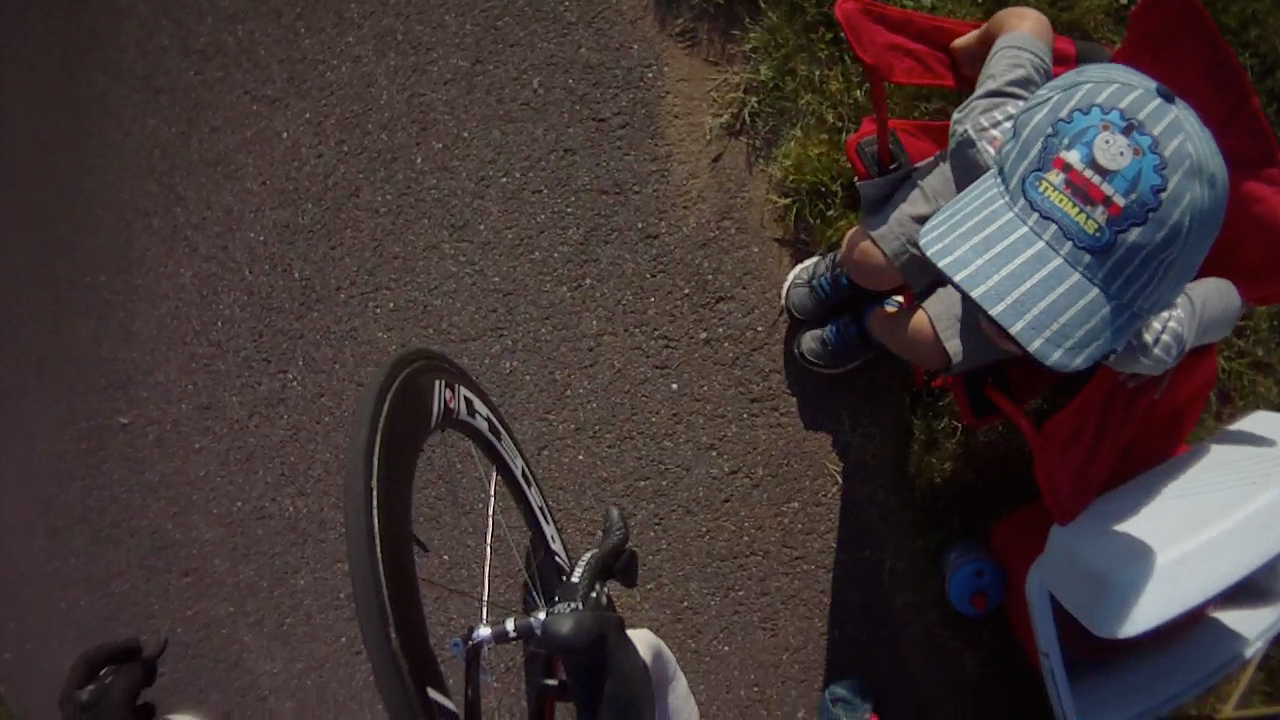
On the second neutral lap I stopped to grab the bottle. My dad, the Missus, and Junior are all sitting in a row.

I didn't see this in my focus on getting my bottle - Junior reaching out to touch my bike.

I feel bad because with all the stuff happening the one thing I don't want to do is ignore Junior. However, here, while I'm busy sticking the bottle into my cage, Junior is about to reach out to touch my bike. I didn't realize this at all.

I rolled out, the group was going a nice 12 or 15 mph, and I linked up at about Turn 3 on the course, the last turn.

Sitting in the field.

During the race I realized that in my winter experimenting with stems I'd ended up with a tight headset. On the trainer it doesn't show at all and I didn't really notice it in my wobbly pedaling to the registration desk. No warm up either so no chance for me to notice it then. However, once under way, it was painfully apparent to me that my headset was too tight. It made the bike hard to steer subtly, resulting in me swerving back and forth. It wasn't a lot, I wasn't swerving feet at a time, but it was definitely not ideal. So my apologies for any swerving I did out there.

In the last group, which was about to disintegrate.

As the race went on I realized something else - I didn't have the ability to rev the engine like normal. I could plod along at a steady pace but when riders made efforts I really couldn't move.

As one rider said to me after the race, I'm starting like it's March, but everyone else is 2-3 months into their season. I guess that this means that I'm better when everyone is worse, meaning I do better in the spring races when everyone collectively is doing worse. The better everyone gets the worse I do. I felt super rusty out there.

Rider after rider went off the front, forming groups, coming back, all sorts of stuff. It was actually pretty interesting from a tactical point of view. I could only watch from the back of the field.

When I was in the third group, and, really, the fourth since teammate Jeff had started a bridging move to the second group, I decided I should see how it'd go if I tried to bridge. Rev the engine, so to speak.

It didn't go well.

I mean, okay, I did a reasonable effort, but my jump was weak, my sustained power wasn't all that great. The longer reach didn't seem to hurt me but the shorter cranks... I'm seriously considering going back to the 175s.

At any rate I blew up pretty hard after my effort and sat up. My race was done, at least in the group.

Blowing up after doing a little bridge move.

I pedaled slowly, for the next 15 or 20 minutes, after racing for all of 30 minutes. Realistically our neutral laps were faster than what I was doing at this point.

On one lap Xander, ever the nice person, kindly pointed out the gap to the next group behind. I could barely get out of the saddle, forget about pedaling faster, but I like that that's how he was thinking.

Xander giving me a time gap.

I decided that I'd do another effort at 2 to go, to get baseline sprint numbers. I wanted to see what my peak, 5s, 10s, and, possibly, 20s numbers were on the bike as it was right there - 170s, longer reach, etc. I decided to jump into the crosswind on the backstretch and not necessarily go to the line. The cross-headwind after Turn 3 didn't seem so bad so I ended up going a bit further than I expected.

End of race (time) sprint.
I sprinted on the 2-laps-to-go lap, but I was lapped several times by then.

Sprint numbers?
Peak: 1064w
5s: 1014w
10s: 979w
20s: 801w
30s: 608w

I guess I took it relatively easy on the jump because it's a solid 200w lower than I'd expect in the same situation. My 10s is also lower by about 100-150w and my 20s about 100w lower. My 30s is about on par so I think I went easier but longer. I have a feeling that with 175s my peak would be higher but I'm not sure.

In comparison my best ever numbers were 500w higher for peak, about 300w higher for 10s, and a whopping 350w higher for 20s. I haven't seen those numbers in a while though, not since 2010-ish.

When I rolled up to our base camp after the race Junior spotted me and yelled out and ran over. That was nice.

Junior sees me.

So going forward the plan is to get the red bike rolling again, meaning replacing the BB30 bearings and retaping the bars. It has the newer Campy lever shape, the FSA Compact bars, and my normal reach. I'll stay with the 170s on that for a bit but if things really seem sour I'll move back to the 175s.

Thursday, June 02, 2016

Equipment - Black Tsunami, 2.1

(2.1 because it was 2.0 and then I fiddled with it)

Over the winter I experimented a bit with my bike. I raced it Tuesday May 31, my first race of the year and my first ride outside. I'll go into the race in a different post but I was on the black bike for the first time in a couple years. The main reason? I wanted to experiment with reach, and the red bike's custom stem makes it impossible for me to fiddle with reach. On the black bike, with a normal 12 cm stem as "default" I have room to go further out.

Longer stem with 26.0->31.8 adapter for bar/stem

My 26.0 bars, dating back from about 1997 or so, didn't fit the only 14 cm stem I had that would fit the black bike. Luckily I got some Wheels Manufacturing adapters. Made with aluminum, they allow the 3T stem to hold the 3ttt bars. And yes, the company changed names between the 1990s and now. Old was 3ttt, now it's 3T.

The rear triangle. 39 cm stays make it super compact.

I love the short stays for out of saddle sprinting. The black bike is marginally shorter than the red bike. It might be my imagination but the black bike feels a bit better out of the saddle.

The cranks are 170s. I tried them but I think I'd need a lot of outdoor time to get used to sprinting on them again. I used to do 10-15 sprints once a week for 2-3 months (plus race virtually every week) before I felt good sprinting on 167.5s and 170s. Nowadays I don't have that kind of time/energy. The 175s feel good out of the box even if on paper they're slower. I'm about 20% slower in my sprint than back in the day. I'm sure part of it is that I no longer do so many sprints, but I'm sure my age has a lot to do with it. I've given up on trying to regain that lost speed.

Using these saddles now, they are great for me.

Another thing I'll post on but the Adamo ISM saddles are great for me. They're very heavy, such that it's pretty noticeable when rocking the bike, but otherwise they're great. I didn't have problems before but after I tried the saddle I couldn't go back to the SLR that I had on the bike.

Detail on some cable management stuff.

With the longer stem I had to re-anchor all the cable housing. It worked out well, very compact, full range of motion for turning the bars. The random computer wire is for the SRM.

Front/wind view of cables.

The "aero" appearance of the cables. My bike is so short that the cables realistically don't play a big part of aero. Someone said somewhere that a foot of exposed cable is about 1 watt at some higher speed, 25 or 30 mph. My total exposed housing is probably a foot, if that. So not a big concern objectively speaking. Subjectively though I like clean housing and, my preference, internal routed housing.

Exustar pedals keep my foot in much better than the Keo Max 2 that I bought.

Another future post topic. I've been riding some old Keo Carbon pedals for forever, I think since 2007 or so. I bought more Keo pedals, the Keo 2 Max specifically, to replace the pretty worn Keo Carbons, but I unclipped out of them regularly, seated and standing. It was pretty disconcerting. The Exustars retain my foot better.

Detail on the dual speed pick ups and clearance to crank.

Because I ride Zwift on the trainer, and because I ride the trainer most of the time, I want an Ant+ speed sensor. The SRM uses its own proprietary speed sensor. I didn't want two magnets on the wheel so I set up the two pick ups on either side of the chainstay. The SRM is under or inward, the Ant+ is the big squarish one up top.

The SRM hangs down for the clinchers, points inward for the race wheels. Those have much more inboard spokes due to rim height, and all my wheels have basically the same hub, all HEDs.

The Ant+ points up and is set for my regular clincher wheel. I don't use Ant+ for racing so I don't have to adjust it.

The same pair of zip-ties holds both mounts tightly. I can rotate one or both mounts around the chainstay.

Although I like this bike I prefer the FSA Compact bars. I'll need to get a second custom stem for this frame so I can use those bars. Ultimately I'd like the newer Campy shifter shape as I much prefer them, but these work.

Monday, April 04, 2016

Equipment - Off Season Experimenting

(Not a great post but I need to put down some thoughts before I post other things.)

I recently realized I may be going for my record between outside rides, with both rides being races. In 2015 my first outdoor ride was the first race in the Aetna Nutmeg Spring Series. My last three rides outside were the second Limerock (July 19th) and two Tuesday Nights (July 28th and August 4th). I haven't ridden outside since. I'm pretty sure my first outdoor ride this year will be whatever race I do in 2016, possibly in May or June. I really don't want to go a year without racing so I want to race by August 4th.

To race, though, I need to make sure my bike is okay.

Winter for me is a time to refresh the equipment, try things out that I've been thinking of trying out. I have a list sorts of things I want to get done. Although I started this post a while back I figure that with today's weather it's appropriate to get this thing up. Now or never, right?

April 4, 2016
The view from our front door.

I have four major bike refreshing/reconditioning thoughts, as follows:

1. Goal: Get black bike up and running. Need: Another stem for that bike, install stem and FSA Compact bars. Install Adamo saddle. Solder in battery in SRM spider, measure slope, make sure wire harness is okay (I think it's not). Install Ant+ speed/cadence sensor for Zwift.

2. Goal: Get red bike up to snuff. Need: rewrap bars (it's been early 2014 since I've wrapped the bars). Replace SRM wire. Get Exustar pedals back on bike. BB30 bearings. Check race wheels.

3. Goal: Experiment with 170mm cranks. Need: fiddle with red bike. I already put the cranks on it.

4. Goal: Experiment with saddle position (related to 170mm cranks). With 5 mm shorter cranks I need 5 mm more set back because my foot doesn't go forward as much. I also need more height, because my foot doesn't drop down as far.

First Goal - Black Bike

I haven't had the black bike rideable since I put the custom stem on the red bike. Those that go to the same races as me might have noticed that I haven't been bringing a spare bike to the races for a couple years now - it's because the black bike isn't rideable.

The main reason is that I haven't ordered another custom stem. I guess it's money I don't want to spend right now. I have the old bar/stem and they fit the same for the drops so that should work for now. If I want to spend a few hundred dollars on a stem I already have the bars for the bike.

I do have a second Adamo saddle that I need to install. The saddle came free courtesy of a pay-it-forward from a member of bikeforums.

The one tricky bit is the 170 mm cranks. I don't have a second set of 170 mm arms for the Cannondale SI cranks, so I may leave 175s on the black bike.

I'm pretty sure the SRM wire is shot on the black bike. Someone asked how such a wire goes bad. Unlike a cyclocomputer (historically the super thin wired cyclocomputers aren't that reliable) the wire plugs directly into the SRM. A cyclocomputer normally sits on a mount, and the wires run into the mount. To repeat, the SRM doesn't plug into a bar mount. Therefore there's some regular movement with the wire  each time you plug and unplug said wire, and I think it makes it go bad. The wired SRMs rely on the wire for cadence, speed, and power. The only wireless aspect of the wired SRM is heart rate.

Since wiring harnesses are about $80-85 each, and I have two bikes, it starts adding up really quick when you consider that for me I need a harness every year or so.

Second Goal - Red Bike

For sure I need to rewrap the bars. It's been about 2 years since I last wrapped them. Enough said.

The SRM wire on the red bike just died a couple rides ago. As mentioned above the wire eventually breaks somewhere so cadence/speed/power data doesn't show up. I have to replace that before I have any kind of power readings and therefore any true experiments with Goal Three.

I put the 170 mm arms on the red bike - the Cannondale SI is a modular crank system so the cranks are separate from the (SRM in this case) spider. I have two sets of 175 mm arms, one set of 170 mm arms. I had some Look Carbon Keo Max pedals on the 170 arms. I slip out of the Keos like nobody's business so I need to switch them out for the Exustars. They're much more reluctant to let my feet out and that's better for me.

One possible solution is to get a wireless SRM. It's possible to upgrade an SRM from wired to wireless (just ask SRM if you have one). Apparently my SRM units are not consistently upgradeable, although I'll find out more what that means. I could sell my SRMs and buy a wireless, and use no power on one bike (leave it on the trainer for Zwift?). This is sort of jumbly totally not solid anything kind of stuff right now though.

My BB30 bearings are worn. I need to replace them.

I need to double check my race wheels to make sure they're okay. I'm sure they are but I don't want to find out at a precious race day that they're not okay.

Third and Fourth Goal - 170 mm cranks and resulting position and pedaling changes

I've been riding 170s for about a month now. It's not a super long time to acclimate to a different crank length but it's enough time to notice a few things. For historical reference I rode 170s from about 1983-1988, 1995 to 2003, in 2009, and in 2011. The last two times (2009, 2011) I was looking to regain lost speed and instead lost a good 30-50 feet in the sprints. I'm furiously chugging the Kool Aid though and I'm hoping that the 170s will help me this time. Otherwise I'll go back to the 175s. With the 170s there are a few things I know about.

First, for some reason, with 170s I need to be toe in a bit. With 175s I need to be toe out. I adjusted my cleats a couple times in about 20 minutes and it's been good since. I had historical precedence so I knew I needed about yay much toe in. Took me two tries, and about 10 minutes of pedaling gingerly to confirm, and I was good to go.

Next, since 170s have 5 mm less reach and drop than the 175s, I had to push the saddle back 5 mm and raise it 5 mm. I raised it a bit more, I think 4 mm extra, because it felt like my back was a bit flatter, but my knees screamed in protest. I quickly lowered it to the baseline and my knees recovered - it took about 3 weeks but they're okay now.

I do know that too much more set back and I'm pretty far back in terms of knee-pedal relationship. I'm slightly forward right now, but not much. The Adamo saddle lets me move back without much problem, so I've been pedaling lower rpm from further back, higher rpm sitting up front. My older saddles really didn't let me do that so this is a nice change.

So that's it for now. It's been pretty busy in a time consuming way here at home so it's tough for me to write posts. I do have a few thoughts jotted down in draft form (a couple hundred to be honest, but maybe 10 or 12 in the last few months). I hope to find time to get those out there shortly. For now this is it.

Wednesday, February 03, 2016

Racing - How I Learned About Racing


I saw a post on Facebook about how things like Zwift might make racing (and riding in general) more dangerous because on Zwift you don't have to worry about turning or overlapping wheels or any of those other "in real life" (IRL) cycling things. On Zwift (and other virtual riding platforms) you just pedal. The thought was that after a winter of Zwifting riders would come out and collide into each other, ride into ditches, stuff like that.

Although the poster had a point, the reality is that we've been experiencing a fundamental change in how new racers learn their craft. New racers nowadays tend to be better prepared physically, in terms of fitness, but there is no longer an inadvertent "indoctrination" process for most racers.

20-30 years ago there wasn't the internet (at this kind of "lemme Google it" level), you had to mail your license and pre-reg payments in using an envelope and a stamp (or two), and it was a big undreground thing to go find a bike race. Velonews was sort of the source for race listings (because USCF had a next to useless newsletter), and you had to go find Velonews because not every shop carried it. And, at some point back there, there were no Barnes & Nobles, and even when they first started popping up, they'd get maybe 3 or 4 Velonews per store. So it was really hard to find out about races and such.

(Back then promoters would buy pre-printed stickers from USCF, by region or state, and then mail flyers out to those addresses. I remember a few of us sitting at the shop stuffing envelopes. Back then the flyer was the key, the prize list, the entry, directions, everything was on the flyer, and everyone's refrigerators were plastered with race flyers. If you were cool you had your speeding ticket taped to the fridge also, the one you got while you were on the bike, ideally for speeds over 50 mph.)

My rule book from 1983.
Yes, you got a rulebook with your license because it was all done via mail (note it's envelope size).
You should still read the rulebook each year.
Or at least Google for the changes.

What this did was it forced those that wanted to race to really seek out races and everything that comes with it. You really had to join a club (because back then you might have paid $10 "Unattached Fee" on a $15 entry fee). Clubs, in turn, had to promote a race to be able to wear their kit (in 1988 I wore a generic kit becuase our race got canceled). This all made it highly unlikely that someone showed up at a race without any race knowledge at all. They had already searched out a shop that has Velonews, they joined a club (or at least were riding with one), they wanted to do some weird sport that involved doing some very un-American (for that time) things like shaving your legs and wearing lycra shorts with nothing underneath.

Generic kit in 1988 (the blue one, in case you're wondering).
I was really skinny back then, in the 110 lbs range.
I believe this is in Middletown in the July 4th Firecracker Criterium (field finish).
I was scared of the faster corners in this race.

Leading through Turn 4 at the Danbury Criterium, I think in 1992.
This time we had team kits.
(4th place in the field sprint/race).
I was much more confident in corners at this point.

This whole set up led to a great sharing of knowledge situation. I learned sooooo much from my first team (1983-1997, various entities), primarily from my first leadout man, Mike H. I learned about group riding, leadouts, tricks for climbing (which generally don't work for me because watts/kilogram), time trialing (ditto, because FTP), etc. When we talked about races I learned about courses and riders. I went to "race school" for 5 hours every weekend, the two 2.5 hour group rides I did with the club. I haven't gone to, or, I suppose now it would be "held", race school in forever. Even on the group rides I did in the last few years, all five or so of them, I've been too wasted trying to stay with the other much stronger riders to do much more than breathe.

When I finally went to my first race back in 1983 I'd already learned about gearing, about tubulars, about drafting, about all sorts of stuff, from my first mentor Ken B. I even learned about speed, but I hadn't grasped the concept yet. I'd already watched the US National Championships in person (because I tagged along when one of my teammates went to do the Junior race). Heck, just that day I learned a few things. First, don't fall over at the start (half the Intermediate field, i.e. 12-14 years old, fell over when one rider couldn't get their foot into their toe clips). Second, I learned that rolling a tubular is a bad thing (Roy Knickman rolled his tire in the sprint but he managed to finish 2nd with his tire flopping around in his frame!). Third, I learned that as a Junior I had to watch my gear limits that, fortunately, my club and shop had set up perfectly for me. I learned that last rule because the guy that beat Roy Knickman to the line had an illegal gear! He won the sprint in a 53x12 I think and the limit at the time was 53x15. So Knickman won after rolling a tire in the sprint because the guy that beat him was disqualified.

As the USCF, and later, USAC, sort of lost their way (I honestly don't remember what year clubs no longer had to promote a race, and it's been eons since I've seen any race with an "unattached fee"), clubs became less a "vehicle to hold a race" and more "just a club". There are clubs/teams around here with 4 or 5 riders because all they want to do is race together. In the old days they'd have to hold a race, and that discouraged such small groups. Now if someone started a business and wanted to wear a kit with the name on it (why not?), another small team would pop up. However there was no extra race, you never saw these people working a race, and you generally never heard of these guys riding together, or, significantly, recruiting and training a new rider.

This led to many clubs, not that many races, and less racers feeding into the system. It led to smaller clubs, to less organized ones, and to all sorts of clubs all over the place. A new racer now had a wealth of (typically less quality in terms of mentoring, race promotion, and group ride) choices as far as clubs went, and honestly, there are many groups that don't want to ride with new or non-racers (unless the rider in particular might be so strong as to make the team better).

With Lance Armstrong, road cycling became significantly more popular, more so than when Greg Lemond was racing. Significantly Lance also helped market, through Carmichael Training Systems, the concept of "power training", and riders started thinking "Oh, if I can do 250w I can race". A huge thing that happened is that riders working on their specific programs started skipping group rides, or they'd do their "own ride" within the group ride. "Sorry, I have to stay in Z2 today". This led to less group riding skills, less shared knowledge. Now riders started to ride on their own, doing intervals, etc, getting stronger.

However they lacked access to that pool of knowledge that clubs used to bring to the racer. Yes, they could find races now, thanks to the internet, and they could even register for them. They could buy a license immediately, at the race, instead of committing to racing a month prior by mailing in forms to get a license via mail. But this didn't help them find clubs, or, more significantly, mentors who could teach them some basic things.

It's one of the reasons why I post such long things here, in Facebook, and in forums and stuff, to try and brain dump my knowledge for others. These very fit, very strong, very optimized riders would show up at a race and not really have any idea how to race.

One significant thing that is missing out there is a book on HOW to race. Not "how to do a paceline", which is a technical thing (sit in another rider's draft, pull at an even speed when you get to the front, wiggle your elbow and pull off to the opposite side, drift to the back, start accelerating up to speed as you pass the last rider's cranks). What no one says is WHEN to do a paceline, which is a tactical thing. Do you do a paceline at the start? How about a break? What about at 1 lap to go?

The application of the technical skill, the paceline, is just as significant as the skill itself. In fact I'd argue, because it's easy to learn about pacelines but hard to learn when to apply them, the tactics are more significant. Obviously you have to learn one (the technical bit) before you can do the other (the tactical bit), but if you don't learn the tactical bit, you are at a major, major disadvantage.

There are books that claim to be tactical books but they don't actually talk about when to apply the technical stuff. Yes, there are isolated examples and such ("in such and such race, I did such and such because such and such and I won"). Generally speaking, though, you can't apply that to your world, because you're not some pro in some race with a given set of competitors with specific strengths and weaknesses and history and all that jazz.

Someone needs to write such a book. I've been on idle for about 10 years now, but I have just under three hundred pages of such stuff written over the course of about 15 years. I started writing stuff in about 1990, when I'd write notes for the team before races, with course maps, how to do the corners, what to watch for, historical race outcomes, etc.

The manuscript just sits there, waiting for me to finish it. Part of the problem is motivation. The other part, significantly, is that I keep learning more and more about tactics and how to apply different techniques, and I think, "Oh, this needs to go there, I need to add that there, " etc.

The other part is that I'm still trying to figure out what I take for granted, and how to describe to someone how to do those things or handle those situations. I had an epiphany in 2010 (which was long after I'd written most of the manuscript) when my then rival (and still a good friend) Bryan H opened a gap while I was on his wheel.

My "move" described below happens just after 4:35.
I'm cracking because of the action that started at about 3:00.

I'd been responding to attack after attack, I was absolutely on the edge of cracking, and if I'd made an effort at that moment, I'd have blown up.

(If I'd just pulled through, like a paceline, it would have been the end of my race. Therefore it's a tactical thing I had to apply, because doing the simple technical thing would have ended my race.)

I immediately, without any thought, moved over and waved everyone by. I knew I couldn't close the gap so I made it clear to the others that they needed to do it. A number of riders streamed by before both he and I picked up the pace a bit and got back on wheels.

I realized after the fact that this was a standard response for me. It was a situation where I reacted in the same way the same way given the same situation (me cracking, gap opens up one rider in front of me, single file field).

Someone asked me if I thought bike racing was so "algorithmic". He didn't use that word but he asked if we should race like a computer program. "If this, then that." I told him, yes, racing is like that. Problem is that I've been racing long enough that many of my reactions are automatic now, and I'm trying to figure out what they are and the situation that triggers them.

Yeah, so I have some work to do.

Friday, December 04, 2015

Life - Music, emotion, and, well, "life"

A while ago my brother pointed out that music can get "worn out". A song's searing emotional effect can fade if you listen to the same song too often. In fact there is one of his songs that I've never used in a cycling clip because it's just too much for me. I want to keep that song precious for me and I actually rarely listen to it at all because its powerful effect on me.

The clip below is a song that I'm trying to save a bit for later (meaning for myself, not for a cycling clip), if that makes sense. Still fresh for me right now, even though it's a commercial top hit. Although I haven't made any clips using commercial music, I have thought of particular projects using particular songs. I was into one moderately commercial song in 2006 when I read and heard about a special pro race in Europe (so it ended noon or so our time, while I was at work). I was so pumped after the race ended, and it tied in so well with the music, that I could see the whole clip in my head before I drove home. Unfortunately I never finished the clip and it's not timely at all so it'll linger for a long time.

Having said that now I have another inspiration - I'd love to make a cycling clip using this music, inspired by the lyric video linked below.


For me music has a lot of power. It tugs at my emotion strings, as much as a hint of a scent, a sample of someone's voice, all those human emotion things. Music evokes in me what I'm sure is a measurable physiological response.


Back in the day, on emotionally charged rides, I found myself feeling unstoppable. In the times before heart rate monitors and power meters I didn't have an objective metric, but the climbs I did in the big ring all over the place, trembling with adrenaline, all while humming particular songs… there had to be something there.


Based on those kinds of rides I tried to conditionally train myself to have adrenaline rushes. I would grip my bars a certain way before doing any major effort, trying to get the adrenaline flowing just by returning to that "sprint only" grip.


This worked for many years. I'd intentionally stay away from the "sprint grip" (basically on the drops but just a touch higher than normal so my forearms were a bit flatter) during races so that at 1 or 2 to go, when I finally went to it, I was well into the adrenaline boost mode.


In my younger racing years I had plenty of opportunities for spiky emotions, like any young person experiences. As I got older I realized that the spikes were flatter but more robust. As a teen, or in my early twenties, I'd be super high and super low within the space of a day or two (usually related to stuff like girls and such). As I got older the spikes seemed a bit blunted but the breadth of the emotion felt more expansive. Instead of feeling a week or three of intense "crush" emotions, they went on for months, even years.


The emotions could be triggered by anything. When I was racing the track in 2009 I'd drive up feeling the normal pre-race excitement.


But on the way back?


I felt like a kid again.


I had no idea why. I felt totally inspired, I felt that crazy rush for whatever reason, it was all I could do not to drive like a nut. I'd crank the music (which only increased the adrenaline thing), drive in the summer heat with the AC on (chilled air seems to amplify said adrenaline thing), and, well, just revel in the rush I felt.


It wasn't even like I was racing well at the track. It was something else, I don't know what it was.


Back in 2000-2003 my mom was battling cancer. It was a super emotional time for me, and I think I emotionally "used up" much of the music I listened to then. I spent a lot of time driving with the music cranked loudly, burning through the music's power over me. I'm just now starting to listen to that music now, and it's still a bit burnt emotionally. Most of those songs I listen for 10 or 20 seconds and I click to skip it; a few I listen for a minute or two, but there are none that I listen and listen and suddenly it's the end of the song.


Now it seems it's my dad's turn. He's physically healthy but other than that… He stopped recognizing me early this year, maybe around the Spring Series time. He has difficulty getting up. He hasn't spoken a word in years because he hasn't been able to say anything.


My SPS ("significant personal stuff"), a term I mentioned before, is to take care of my dad.


The plan is to move him into our house, for me to look after him. It'll be hard, for sure, but I feel compelled to do this.


My Pops, me, and Junior, when Junior was a day old.
I had just returned from the second 2012 Bethel Spring Series race.

I remember his vibrancy when I was a kid. We'd rake leaves, shovel the driveway, cut wood for the fireplace. When I was a little kid he couldn't afford gravel for the driveway so he'd break rocks with a hammer. There's a picture of me sitting in my diaper on our driveway, hammer in hand, rocks in front of me.


He drove carefully. I could tell when he was serious because all of his shifts were so methodical, his motions to use the turn signal perfect, no wasted energy, everything "just so". When he was distracted he'd let things slip a bit but then he'd catch himself and become more deliberate again.

He was always methodical about what he did. He tried to have back ups, when he understood what he needed to have a back up. As a chemical engineer he was appalled by one manager's response to a non-functioning eye wash station in a huge plant. The fix? They hung a sign that said, "Out of order".

He'd rake or chop wood or whatever like a machine. Even as recently as 10 or so years ago the tree guys would joke that my dad would put them out of business, he was clearing so much stuff (the tree guys would get the high stuff; he got the low stuff).

He worked really hard for the kids, and, really, for the grand kids. He felt a duty to provide for them, and I never understood even a little bit of it until now, and I honestly am still coming to terms with just how powerful this urge is for me. At times it was tough, but I think that's the case with anyone. He went from growing up in war torn Japan to being able to provide for his family in the US. After traveling all over the world, living on three continents, in the end he adopted the US as his home, choosing to live here instead of anywhere else in the world.


My dad can't care for himself any longer. My brother has been caring for my dad for many years but is reaching the end of his tether. My other brother and I both volunteered to take over, and, for mainly logistical reasons, my dad will be moving in with the Missus, Junior, and myself, toward the end of the year.


This means I'll be his 24/7 caretaker for the foreseeable future.


My brother told me that it's hard to explain just what it'll be like. It's like having a kid - you can explain and demonstrate and all that but until you experience it you just don't know. Likewise, this will be an unfathomable thing until I do it. I just hope to be up for it.


In preparation for this I've mentally written off 2016. I really can't leave the house much so no racing, no training outdoors. No real dinners out, no trips, etc. I'm trying to figure out a way to make the Aetna Spring Series a reality - it's still in the forefront of my mind, definitely more important than my own riding. I have strong hopes of pulling it off, although I'll be physically absent from the actual races.


The Missus, also, has accepted this, supporting my urge to care for my dad. It'll really disrupt her life but she's behind this 100%. She's always supported what I've done - the racing, the promoting, job stuff - and she's once again throwing herself into the effort. So to her, a thank you in advance, and many more to come I'm sure.


My last day working at the car place is next Wednesday - I have three work days left. After that it'll be a frantic two weeks to get the house ready, and then we'll bring my dad here for what we think will be the rest of his life.


I have no idea what that means, to tell the truth. I've written off a year already. A second year seems distant but possible, in terms of both caring for him as well as him continuing on. After that I may need help, and it may be that my dad will need more than I can provide. Whatever happens, we'll see when we get there. For now it'll be me taking care of him.


In the meantime?


I'll listen to music and I'll revel in this special thing called life.

Tuesday, December 01, 2015

Life - It's Been A While

So it's been a while since I posted, so much so that I actually forgot what I've posted about other than races.

I haven't posted in a while because life has gotten busy. I'm consciously putting away the computer for much of the time Junior is up (both to pay attention to him as well as to encourage me and him to do more "regular" play). Between the two (life, Junior) the blog sort of fell into a comatose state.

I'm going to present some sweeping things; later, I hope, I'll drill down into some of those broad statements and dissect them a bit. I think there will be stuff that I hope will help a variety of people. Some stuff is bike stuff, and perhaps people can learn from that. The other is life stuff and I think that's stuff that people will experience, are experiencing, or will experience. Hopefully someone gets something out of that as well.

Junior

First off, we have Junior, our now 3 3/4 year old son. He's been great, we love him to pieces, and we want the best for him. Part of that means making some changes for his benefit. One of those things has been to cut down dramatically on computer use, at least for me, on the days I'm with him. Before I used to still fiddle around on the computer while he was running around. Now I'd rather interact with him, or do "real life" stuff (chores or whatever). Also, once the computer comes out, he wants to watch whatever - YouTube (toys and such), Netflix (kid stuff), and, sometimes, my own bike race clips (his favorite is "When the racer turns green", my Zwift clip. The computer often sits off to the side now, to avoid distracting both him and me.

Junior, doing a fitting for his cousin's hat (that the Missus knit).

Work

The big thing for me was starting work, back in the summer. I tried not to make a big deal out of it because it was a sales job, and anything I wrote about the job could be construed as trying to sell stuff through my blog.

One thing that I'd never experienced is the massive "parental block" in place at work. Pretty much any streaming video, any motion gif, and anything with "blog" or "forum" or "news" or "mail" in it is blocked. Work specific sites are allowed, local competitors (but a couple manufacturer's sites were blocked for some reason, forcing me to view local competitors' sites to gather data), but overall it slashed any internet browsing down to virtually zilch. This meant no chipping away at blog posts or whatever.

I generally don't post about work and such but the picture below tells you about the job at least.

This car sat next to my desk for months.
Sort of karmically (is that a word?) I sold it yesterday.

Spring Series

Part of the reason for working was to pay for the Aetna Nutmeg Spring Series for this year. The races lost a lot of money, and I was still paying stuff off a few months later. I had to start working, partially to pay those bills.

This brings me to another major thing in my life - the Spring Series. I've been debating internally whether or not I can hold them in 2016. The big question is affordability - if I can't afford to hold the races then it doesn't make much sense holding them. I did a quick and dirty survey to see if racers would pay more (they would). I've promised to do my best to hold them in 2016. Based on the idea of a higher entry fee and the promise to hold the Series, I've informally secured two venues, the third is available (but nowhere near secured), allowing for five weeks of racing. 

Joel stepping into the trailer, 2014 Bethel Spring Series.

SPS

Then another life factor came into play. I'm sure I'll go into this a bit more later but for now I'm just labeling it "significant personal stuff" or SPS. It's significant because my expectation is that the SPS will do the following:

1. Make it realistically close to impossible to race for the foreseeable future, because I won't be able to get to the venue.

2. Make it realistically close to impossible to be at a venue to promote a race, because I won't be able to get to the venue.

3. Make it impossible to hold a job, because I won't be able to get to the office, or, if I'm working from home, I may not be able to get to the computer here.

4. Force me (and the Missus) to make some wholesale changes to our house, something we're starting to do already.

Therefore…

If you look at those things it appears that, first, I have to quit my job, because the race things have to do with next year, not right now, and we're already making changes to our house.

I tendered my resignation a couple weeks ago, effective a week from tomorrow.

I gave them as much notice as possible. Depending on how things go, it's possible that I return there, I don't know. I'd at least like to keep the option open. Plus it's the right thing to do.

(This also means that if you want a Cadillac, Fiat, Alfa, Maserati, Jaguar, or VW, let me know now. I can't promise anything deal wise but at least you'll have a friendly data point on pricing, you can learn about the cars, etc)

Next, it makes it seem virtually impossible to hold a Spring Series. I'm trying to make it possible to do the Series, I just need to figure out how. I'm working on it.

Finally, it's apparent that I won't be racing much this year. This I accept and I've already planned on doing, at most, one race next year. I hope to do that one race (whatever race, even a Tuesday Night training race would be fine) so that I can say I raced in 2016, but it'll be very, very tough to do.

In the meantime I'll have interim racing-related goals - return to my April 2015 weight (or lower), try to ride the trainer semi-regularly, and do some core/other stuff to keep my back okay. I also want to spend some time returning my second bike (the black one) back into working order. I spent the last two years without a real back up bike, and to me that's not good.

Zwift

In a future post I'll do some stuff on Zwift. Basically, for 2015, I managed to avoid training outdoors the entire year. Zwift was a big part of this, motivating me to do some big efforts on the trainer and keeping me fit enough to do some solid racing in the 2015 season. Before Zwift I never did sprints on the trainer and I rarely did "big efforts" longer than than a sprint.

So that's what's been going on here. I'd like to start posting a bit more regularly, perhaps with shorter but more frequent posts. I don't know.

Saturday, July 18, 2015

Training - Zwift Sprint, 21.67 seconds

Things have been super busy with me lately and it's hard to find time to post stuff in the blog. One thing that I've been doing is riding the trainer while logged into Zwift. I usually go for the green jersey sprint (a timed few hundred virtual meters sprint). I occasionally go hard on the KOM (my best time is over 3 minutes, typically it takes me 5-7 minutes).

Zwift awards you a boost when you cross a line (start/finish, KOM, sprint). Boosts can be weight reduction (15 seconds long, worth a few kg), aero (30 seconds, worth a second or two over a 30 second super hard effort), drafting (30 seconds, like drafting a truck if you're behind someone, otherwise it's nothing), etc.

If you don't use the boost (press the Space bar to use it) then at the next banner you don't get another one.

If I get an aero boost I feel obligated to save it until the Green Jersey sprint segment. Of course when I soft pedal through stuff I don't get the aero boost, and when I do a "okay this is the last sprint of the night" sprint I inevitably earn another aero boost. I've often ridden another 30-35 minute lap to use up that aero boost and I've extended a ride an hour at least once when on that "really the last sprint of the night sprint" I get yet another aero boost.

To give you an idea of what it's like during one of those sprints here's a short clip I made of a Green Jersey sprint on Watopia, the Zwift island. I got an aero boost at the prior banner (the KOM) so I was psyched to have it for the one sprint I planned on recording.

Enjoy!


Screen shot from the ride.